






Major Sea Ports of India: Locations and Importance
Indian Sea Ports play a crucial role in the country’s trade, economy, and connectivity with the rest of the world. With a long coastline of more than 7,500 km, India has developed a strong network of ports along the Arabian Sea and the Bay of Bengal. These ports handle the import and export of goods such as petroleum, coal, iron ore, fertilizers, machinery, and containers. For students and competitive exam aspirants, understanding Indian Sea Ports is important in Geography, Economy, and General Studies sections.
What are Sea Ports?
A sea port is a harbor where ships load and unload cargo and passengers. It acts as a gateway for international trade and transportation. Ports are equipped with docks, warehouses, cranes, and customs facilities to handle goods efficiently.
- Facilitate import and export activities
- Generate employment and revenue
- Promote industrial and economic growth
- Strengthen international trade relations
Classification of Indian Sea Ports
Indian ports are broadly classified into Major Ports and Minor Ports based on administration and cargo handling capacity.
1. Major Ports
Major ports are managed by the Central Government and handle a large volume of cargo. These ports are equipped with advanced infrastructure and modern facilities.
2. Minor Ports
Minor ports are managed by the respective State Governments. They handle smaller cargo volumes compared to major ports but are important for regional trade.
Major Sea Ports of India
| Port Name | State | Coast |
|---|---|---|
| Mumbai Port | Maharashtra | Arabian Sea |
| Kandla Port | Gujarat | Arabian Sea |
| Jawaharlal Nehru Port | Maharashtra | Arabian Sea |
| Chennai Port | Tamil Nadu | Bay of Bengal |
| Visakhapatnam Port | Andhra Pradesh | Bay of Bengal |
| Kolkata Port | West Bengal | Bay of Bengal |
India currently has 13 major ports including Deendayal Port, Paradip Port, Cochin Port, New Mangalore Port, V.O. Chidambaranar Port, and Port Blair. These ports are strategically located to facilitate trade across Asia, Europe, Africa, and the Middle East.
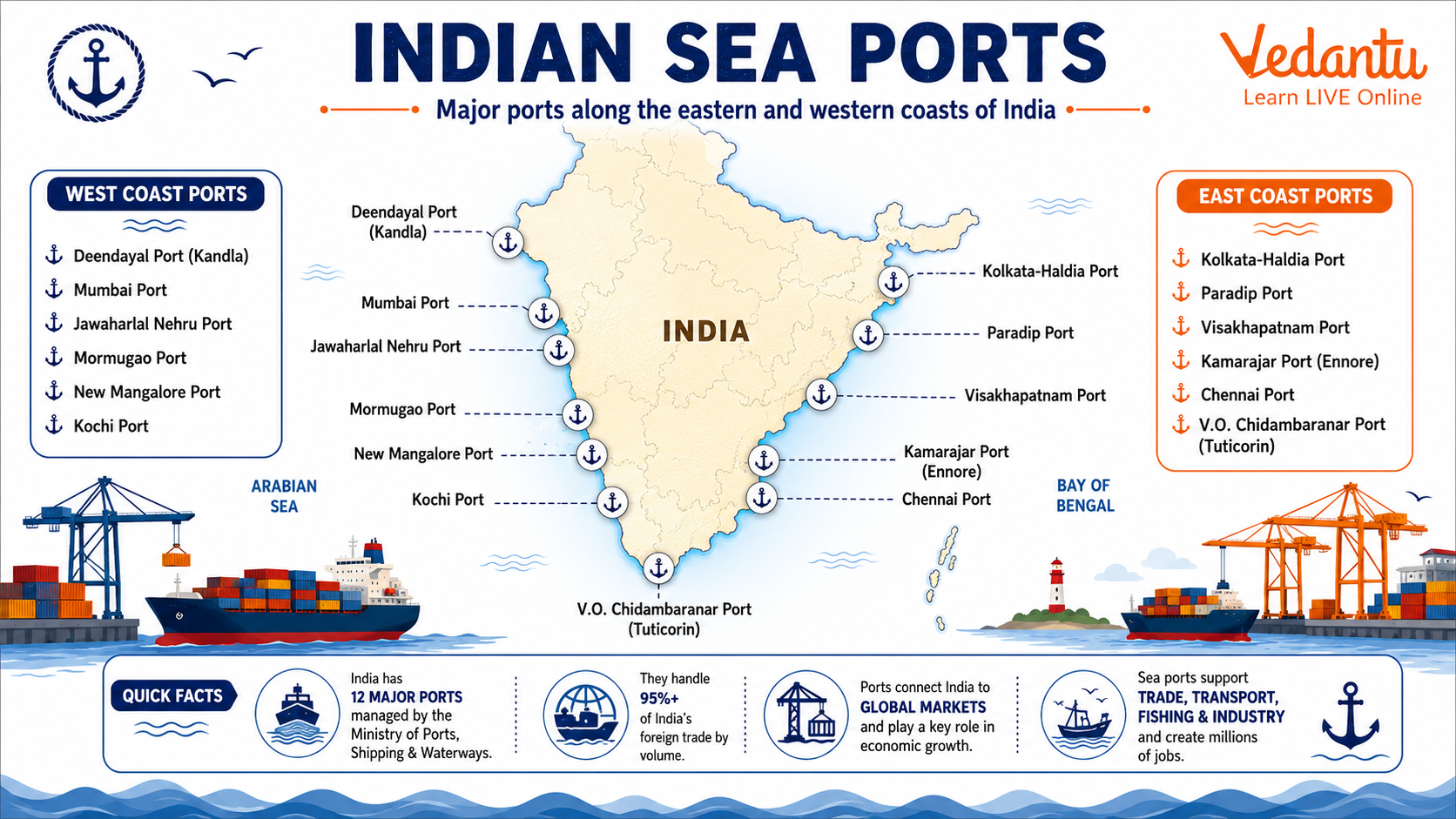
Important Ports on the West Coast
The western coast of India lies along the Arabian Sea. It is known for natural harbors and handles a significant share of petroleum and container traffic.
- Deendayal Port - Gujarat
- Mumbai Port - Maharashtra
- Jawaharlal Nehru Port - Maharashtra
- Mormugao Port - Goa
- New Mangalore Port - Karnataka
- Cochin Port - Kerala
Important Ports on the East Coast
The eastern coast lies along the Bay of Bengal. These ports mainly handle coal, iron ore, fertilizers, and petroleum products.
- Kolkata Port - West Bengal
- Paradip Port - Odisha
- Visakhapatnam Port - Andhra Pradesh
- Chennai Port - Tamil Nadu
- V.O. Chidambaranar Port - Tamil Nadu
- Port Blair - Andaman and Nicobar Islands
Economic Importance of Indian Sea Ports
Sea ports are the backbone of India’s international trade. Nearly 90 percent of India’s trade by volume and about 70 percent by value is carried through maritime transport.
- Support export of agricultural and industrial goods
- Import crude oil, machinery, and raw materials
- Boost coastal shipping and inland waterways
- Contribute significantly to GDP growth
Government Initiatives Related to Ports
The Government of India has launched several initiatives to modernize and expand port infrastructure.
- Sagarmala Project - Focuses on port modernization and coastal development
- Maritime India Vision 2030 - Aims to enhance port capacity and efficiency
- Development of Smart Ports - Adoption of digital and green technologies
Key Facts for Competitive Exams
- India has 13 Major Ports and more than 200 Minor Ports
- Jawaharlal Nehru Port is the largest container port in India
- Kolkata Port is the only riverine major port in India
- Mumbai Port is a natural harbor
- Paradip Port is known for iron ore exports
Conclusion
Indian Sea Ports are vital for the country’s economic growth and global trade connectivity. With a strategic coastal location and continuous modernization efforts, India is strengthening its maritime infrastructure. A clear understanding of major ports, their locations, and their significance is essential for students preparing for competitive examinations and for anyone interested in India’s economic geography.
FAQs on Indian Sea Ports and Their Role in India's Trade
1. What are Indian Sea Ports?
Indian Sea Ports are coastal facilities where ships load and unload cargo and passengers, playing a vital role in India’s foreign trade and economy.
• Located along the Arabian Sea and Bay of Bengal
• Handle imports, exports, and passenger movement
• Classified into Major Ports and Minor (Non-Major) Ports
• Controlled by the Ministry of Ports, Shipping and Waterways
They are also known as maritime ports, shipping ports, or seaports in India.
2. How many major ports are there in India?
India has 13 Major Ports recognized by the Government of India.
• Examples: Mumbai Port, Kolkata Port, Chennai Port, Visakhapatnam Port, Cochin Port
• Governed under the Major Port Authorities Act, 2021
• Handle a large percentage of India’s international maritime trade
These ports are crucial for cargo handling, container traffic, and bulk trade.
3. What is the difference between major and minor ports in India?
The main difference lies in administration and cargo handling capacity.
• Major Ports: Controlled by the Central Government, handle high cargo volume
• Minor Ports: Managed by State Governments
• Major ports have advanced infrastructure and container terminals
• Minor ports support regional trade and coastal shipping
This classification is important for competitive exams and general knowledge.
4. Which is the largest port in India?
Jawaharlal Nehru Port (Nhava Sheva) is the largest container port in India.
• Located in Maharashtra
• Handles maximum container traffic (TEUs)
• Plays a key role in India’s import-export trade
It is often searched as biggest port in India or largest container port in India.
5. Which is the oldest port in India?
Kolkata Port is considered the oldest operating port in India.
• Established in 1870
• Located on the Hooghly River
• Known as a riverine port
It is officially called Syama Prasad Mookerjee Port today.
6. Which Indian port is known as a natural port?
Mumbai Port is known as a natural port due to its naturally protected harbor.
• Located on the west coast of India
• Safe anchorage for ships
• Important for petroleum and cargo trade
Natural ports require less artificial construction compared to artificial or tidal ports.
7. What is the importance of Indian Sea Ports?
Indian Sea Ports are essential for economic growth and international trade.
• Handle around 90% of India’s foreign trade by volume
• Support export-import business
• Generate employment in shipping and logistics
• Strengthen maritime security and coastal development
They are key to India’s blue economy and global trade network.
8. Which port is called the Gateway of India?
Mumbai Port is often called the Gateway of India because of its historical and commercial importance.
• Major entry point during British rule
• Important center for international shipping routes
• Located in Maharashtra
This term is commonly asked in GK and competitive exams.
9. What are some important ports on the east coast of India?
The east coast of India has several major ports along the Bay of Bengal.
• Kolkata Port (West Bengal)
• Paradip Port (Odisha)
• Visakhapatnam Port (Andhra Pradesh)
• Chennai Port (Tamil Nadu)
These ports are vital for coal, iron ore, and container trade.
10. What is the Sagarmala Project related to Indian ports?
The Sagarmala Project is a government initiative to modernize and develop Indian ports.
• Launched in 2015
• Focuses on port-led development
• Aims to improve coastal infrastructure and logistics
• Promotes economic corridors and industrial clusters
It enhances India’s maritime sector, coastal shipping, and global competitiveness.
