






What Ibn Battuta Reveals About Muhammad bin Tughlaq’s Rule
Ibn Battuta’s memoir is one of the most important primary sources for understanding the Tughlaq Dynasty of the Delhi Sultanate. Ibn Battuta, a Moroccan traveler and scholar, visited India during the reign of Sultan Muhammad bin Tughlaq in the 14th century. His detailed account, known as the Rihla, provides valuable insights into the political administration, social life, economy, justice system, and court culture of the Tughlaq period. For students and competitive exam aspirants, Ibn Battuta’s memoir is an essential source to study medieval Indian history, especially the functioning of Muhammad bin Tughlaq’s rule.
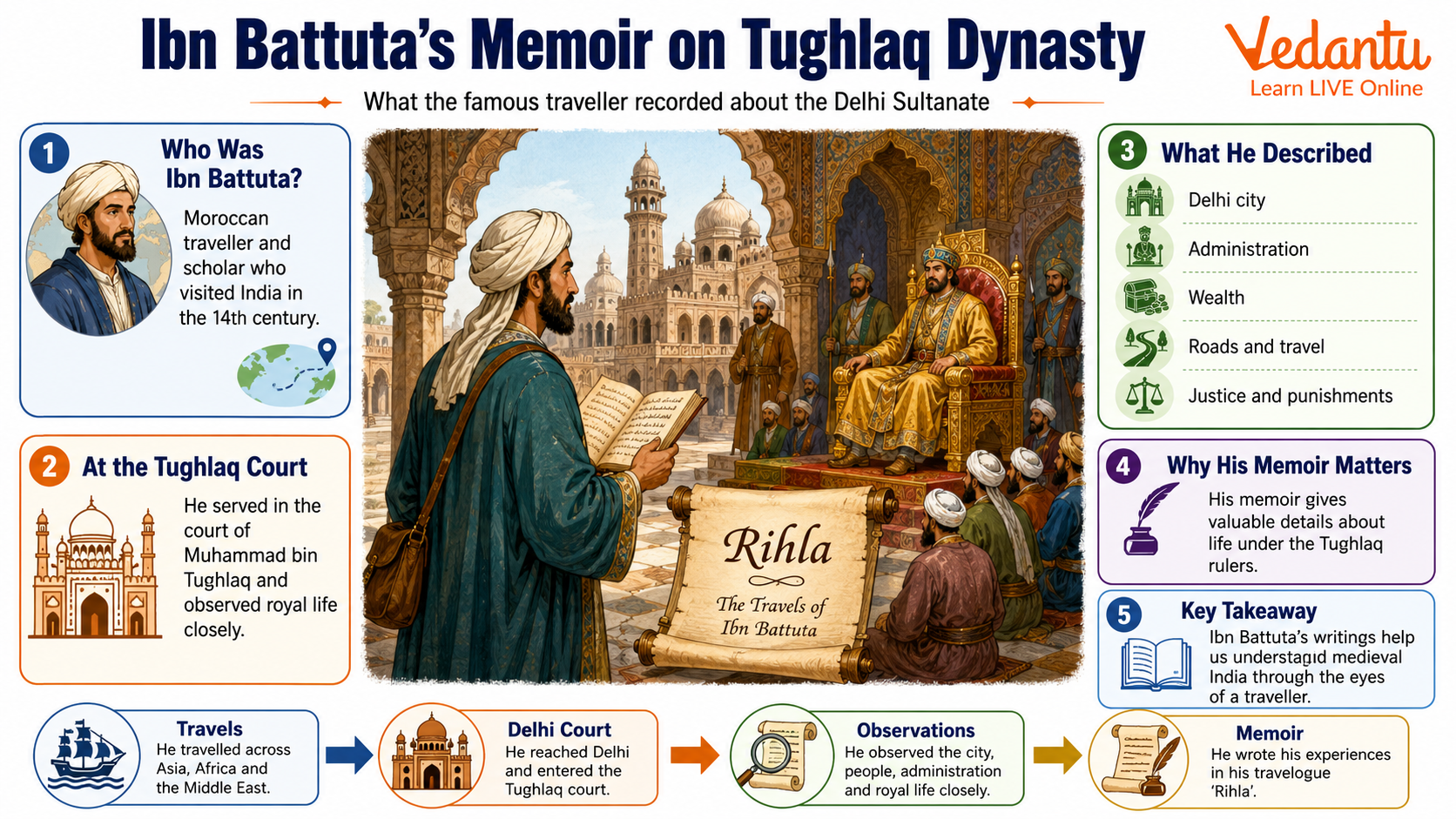
Who Was Ibn Battuta?
Ibn Battuta was a Moroccan traveler born in 1304 CE in Tangier. He traveled extensively across Africa, the Middle East, Central Asia, and India. In 1333 CE, he arrived in India during the reign of Muhammad bin Tughlaq and was appointed as the Qazi of Delhi. He stayed in India for several years and later recorded his experiences in his travel memoir called the Rihla.
- Full Name - Abu Abdullah Muhammad Ibn Battuta
- Born - 1304 CE, Tangier (Morocco)
- Visited India - 1333 CE
- Position in India - Qazi under Muhammad bin Tughlaq
- Famous Work - Rihla (Travel Account)
Historical Context - Tughlaq Dynasty
The Tughlaq Dynasty ruled the Delhi Sultanate from 1320 to 1414 CE. It was founded by Ghiyasuddin Tughlaq. The most prominent ruler during Ibn Battuta’s visit was Muhammad bin Tughlaq, known for his ambitious administrative experiments and strict rule. Ibn Battuta’s memoir provides a firsthand account of the governance and personality of this ruler.
Key Observations in Ibn Battuta’s Memoir
1. Administration and Governance
Ibn Battuta described Muhammad bin Tughlaq as a powerful and intelligent ruler. He noted the Sultan’s strict administration and centralized control over the empire. The Sultan rewarded scholars and officials generously but also punished disobedience severely.
- Strong central administration
- Strict law enforcement
- Generous grants to scholars and nobles
- Harsh punishments for rebellion
2. Court Life and Culture
The memoir gives a vivid description of the royal court of Delhi. Ibn Battuta highlighted the grandeur of the palace, elaborate ceremonies, and the presence of foreign scholars and travelers. The court reflected wealth, diversity, and strict protocol.
- Lavish court ceremonies
- Multicultural environment
- High respect for Islamic scholars
- Strict royal etiquette
3. Economic Conditions
Ibn Battuta mentioned the prosperity of Indian cities, especially Delhi. He described busy markets, trade activities, and the availability of goods. However, he also referred to famines and hardships during certain periods.
- Flourishing trade and markets
- Agricultural productivity
- Presence of famine in some regions
- Use of token currency experiment under Muhammad bin Tughlaq
4. Social Life and Customs
The memoir provides insights into the daily lives, customs, and religious practices of people in India. Ibn Battuta described Hindu and Muslim communities, festivals, marriages, and the status of women. His observations help historians understand the multicultural fabric of medieval India.
Key Features of Ibn Battuta’s Account on Tughlaq Dynasty
| Aspect | Description | Historical Importance |
|---|---|---|
| Administration | Centralized and strict rule of Muhammad bin Tughlaq | Helps understand governance system |
| Court Culture | Lavish ceremonies and foreign scholars | Shows cultural diversity of Delhi Sultanate |
| Economy | Prosperous markets and token currency | Explains economic experiments |
The table above summarizes the major contributions of Ibn Battuta’s memoir in understanding the Tughlaq period. His account is considered reliable because it is based on direct observation, though historians also cross check it with other sources.
Importance of Ibn Battuta’s Memoir in History
Ibn Battuta’s account is significant because it is a foreign traveler’s perspective on medieval India. It provides detailed descriptions that are not always available in official records. His writings help historians reconstruct the political, economic, and social life of the 14th century.
- Primary source for Muhammad bin Tughlaq’s reign
- Insight into Delhi Sultanate administration
- Description of Indian society and customs
- Helps compare Indian and Islamic world practices
Limitations of the Memoir
Although Ibn Battuta’s memoir is valuable, it has certain limitations. Being a foreign traveler, his observations were sometimes influenced by personal experiences and cultural background. Some descriptions may be exaggerated or based on hearsay.
- Possible exaggeration of events
- Bias due to personal association with the Sultan
- Limited understanding of rural India
Conclusion
Ibn Battuta’s memoir on the Tughlaq Dynasty remains one of the most valuable historical sources for medieval India. His firsthand account of Muhammad bin Tughlaq’s administration, court life, economic policies, and social customs provides deep insight into the functioning of the Delhi Sultanate. Despite certain limitations, the Rihla continues to serve as a crucial reference for students and historians studying the Tughlaq period. Understanding his memoir helps learners gain a clearer picture of 14th century India and the complexities of Tughlaq rule.
FAQs on Ibn Battuta’s Memoir on the Tughlaq Dynasty Explained for Students
1. Who was Ibn Battuta and why is he important in the Tughlaq Dynasty?
Ibn Battuta was a Moroccan traveler and scholar whose memoir provides valuable information about the Tughlaq Dynasty in medieval India.
• He visited India during the reign of Muhammad bin Tughlaq in 1333 CE.
• He was appointed as the Qazi (judge) in Delhi.
• His travel account, Rihla, describes the political, social, economic, and cultural life of the Delhi Sultanate.
• His observations are important sources for understanding medieval Indian history, especially the rule of Muhammad bin Tughlaq.
2. What is the name of Ibn Battuta’s memoir?
The memoir of Ibn Battuta is called Rihla, which means "The Journey."
• Written in Arabic after returning to Morocco.
• Officially titled Kitab-ul-Rihla.
• It records his travels across Africa, the Middle East, and India.
• It is a key historical source for the Delhi Sultanate and the Tughlaq period.
3. When did Ibn Battuta visit India and how long did he stay?
Ibn Battuta arrived in India in 1333 CE during the reign of Muhammad bin Tughlaq.
• He stayed in India for about eight years.
• Served as Qazi in the Delhi court.
• Traveled to places like Delhi, Daulatabad, Malabar, and Bengal.
• Later, he was sent as an ambassador to China.
4. What did Ibn Battuta write about Muhammad bin Tughlaq?
Ibn Battuta described Muhammad bin Tughlaq as intelligent but unpredictable and sometimes harsh.
• Praised his generosity and knowledge.
• Mentioned his sudden decisions and strict punishments.
• Wrote about administrative experiments like the transfer of capital and token currency.
• Highlighted both positive and negative aspects of his rule.
5. How does Ibn Battuta describe the social life of people during the Tughlaq period?
Ibn Battuta’s memoir gives detailed insights into the social life of medieval India under the Tughlaqs.
• Described the caste system and social divisions.
• Mentioned the position of women and practices like sati.
• Noted the presence of slaves in households.
• Wrote about festivals, marriages, and urban lifestyle in Delhi Sultanate.
6. What economic details did Ibn Battuta provide about the Tughlaq Dynasty?
Ibn Battuta recorded important information about the economy of the Tughlaq Dynasty.
• Mentioned flourishing trade in cities like Delhi and Daulatabad.
• Described the use of coins including token currency.
• Highlighted India’s rich agricultural production.
• Noted trade links with China and the Middle East.
7. Why is Ibn Battuta’s Rihla considered an important historical source?
Rihla is considered a crucial primary source for studying the Tughlaq Dynasty and Delhi Sultanate.
• Provides first-hand observations of court life.
• Describes administration, economy, and society.
• Offers comparative views between India and other regions.
• Widely used by historians for understanding medieval Indian history.
8. What challenges did Ibn Battuta face during his stay in India?
Ibn Battuta faced several difficulties while serving under Muhammad bin Tughlaq.
• Lived in fear due to the Sultan’s unpredictable nature.
• Faced financial troubles despite royal gifts.
• Survived political conspiracies in the court.
• Experienced hardships during his journey to China.
9. How did Ibn Battuta describe Delhi during the Tughlaq rule?
Ibn Battuta described Delhi as a large and prosperous city under the Tughlaq Dynasty.
• Mentioned its grand mosques and markets.
• Noted the diversity of its population.
• Highlighted the presence of scholars and officials.
• Called it one of the greatest cities in the Islamic world at that time.
10. What role did Ibn Battuta play in the court of Muhammad bin Tughlaq?
Ibn Battuta served as a Qazi (Islamic judge) in the court of Muhammad bin Tughlaq.
• Appointed due to his knowledge of Islamic law.
• Received royal gifts and high status.
• Later appointed as an ambassador to China.
• His court experience enriched his famous memoir Rihla.
