






Why Did Sikkim Join India? Key Events and Referendum Explained
Sikkim is one of the most strategically important states of India, located in the northeastern Himalayas. However, Sikkim was not always a part of India after independence in 1947. It became the 22nd state of India in 1975 after a series of political developments, agreements, and a historic referendum. Understanding how Sikkim became part of India is important for students preparing for competitive exams and for gaining deeper knowledge of Indian political history and constitutional development.
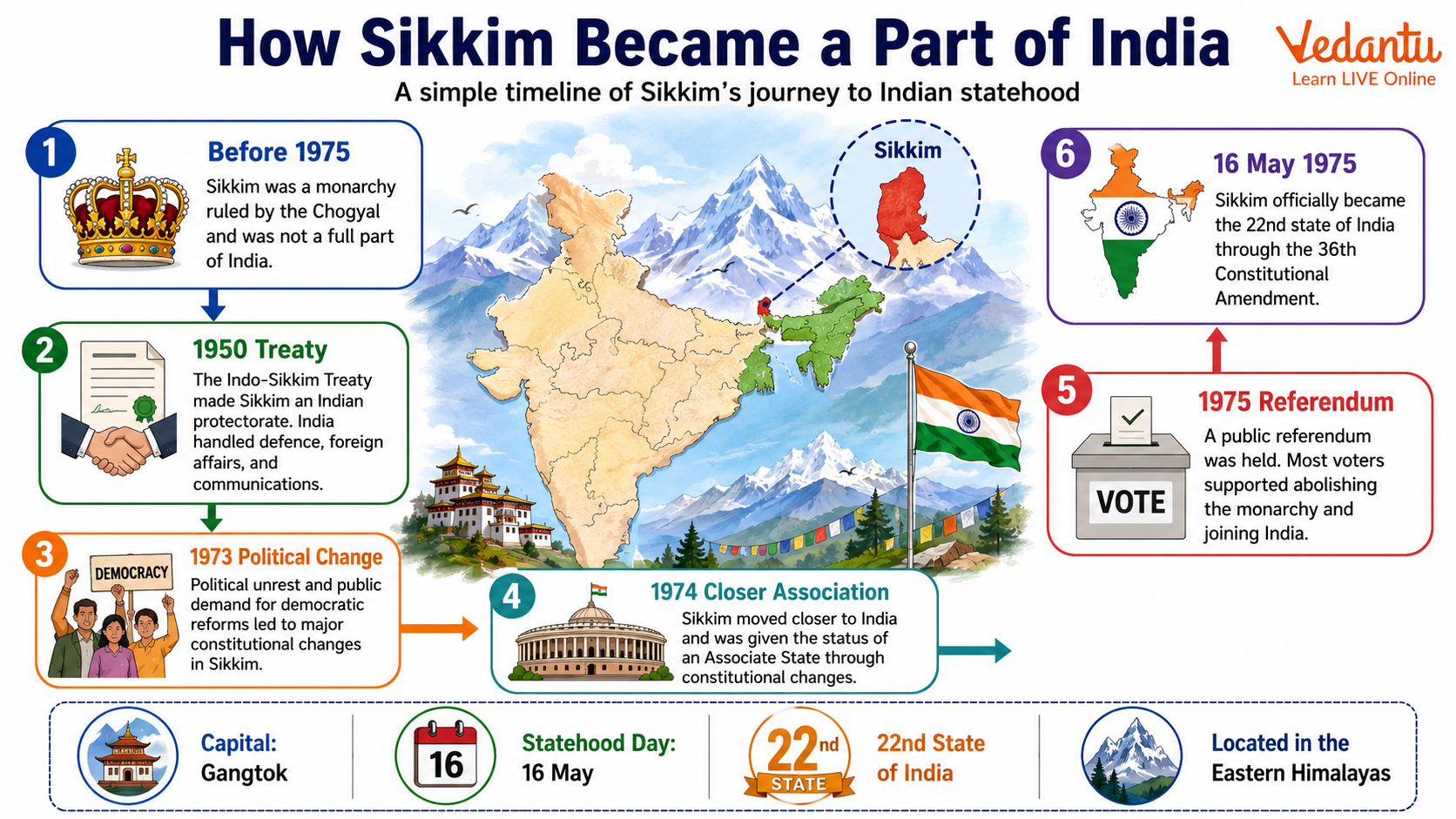
Background of Sikkim Before 1947
Before India’s independence, Sikkim was a princely state ruled by a monarch known as the Chogyal. The Namgyal dynasty governed Sikkim since the 17th century. Although Sikkim maintained internal autonomy, it was under British suzerainty after the Anglo-Sikkim Treaty of 1861.
- Sikkim was ruled by the Chogyal monarchy.
- It became a British protectorate in the 19th century.
- Britain controlled its external affairs, while internal matters were managed by the monarch.
After India gained independence in 1947, the British left the region, and Sikkim’s status needed to be redefined in relation to the newly formed Indian Union.
Sikkim’s Status After Indian Independence
In 1950, India and Sikkim signed the Indo-Sikkim Treaty. According to this treaty, Sikkim became a protectorate of India. India took responsibility for Sikkim’s defense, foreign affairs, and communications, while the Chogyal continued to rule internally.
Key Features of the 1950 Treaty
- India controlled defense and external relations.
- Sikkim retained internal autonomy.
- India appointed a Political Officer to oversee affairs.
Despite this arrangement, political unrest began to grow within Sikkim due to demands for democratic reforms and better representation.
Political Unrest and Demand for Democracy
During the 1960s and early 1970s, the people of Sikkim started demanding democratic governance. The Chogyal’s rule was seen as undemocratic, and there were concerns about ethnic imbalance in political representation.
- Majority Nepali population demanded equal political rights.
- Political parties were formed to challenge monarchical authority.
- Mass protests took place in 1973 against the Chogyal.
In 1973, a tripartite agreement was signed between the Chogyal, leaders of political parties in Sikkim, and the Government of India. This agreement aimed to introduce democratic reforms.
The 1974 Developments and Referendum
In 1974, Sikkim held elections under a new constitution that reduced the powers of the Chogyal. The newly elected Assembly passed a resolution seeking closer association with India. The situation intensified when political instability continued.
In April 1975, a historic referendum was conducted to decide whether Sikkim should abolish the monarchy and become a full-fledged state of India.
- More than 97 percent of voters supported joining India.
- The monarchy was officially abolished.
- The Chogyal’s rule came to an end.
36th Constitutional Amendment Act, 1975
After the referendum, the Indian Parliament passed the 36th Constitutional Amendment Act in 1975. This amendment made Sikkim the 22nd state of India.
Important Constitutional Changes
- Article 371F was added to provide special provisions for Sikkim.
- Sikkim was formally admitted into the Indian Union on 16 May 1975.
- Representation was given in the Indian Parliament.
Timeline of Sikkim’s Merger with India
| Year | Event | Significance |
|---|---|---|
| 1861 | Anglo-Sikkim Treaty | Sikkim became British protectorate |
| 1950 | Indo-Sikkim Treaty | Sikkim became protectorate of India |
| 1975 | Referendum and 36th Amendment | Sikkim became 22nd state of India |
This timeline clearly shows the gradual transition of Sikkim from a monarchy under British influence to a democratic state within the Indian Union.
Why Sikkim’s Merger Was Important
The merger of Sikkim was significant both politically and strategically. It strengthened India’s position in the Himalayan region, especially considering its borders with China, Nepal, and Bhutan.
- Enhanced national security in the northeast.
- Promoted democratic governance in Sikkim.
- Integrated Sikkim into India’s constitutional framework.
Key Points for Competitive Exams
- Sikkim became the 22nd state of India on 16 May 1975.
- The 36th Constitutional Amendment Act facilitated its statehood.
- Article 371F provides special provisions for Sikkim.
- A referendum in 1975 abolished the monarchy.
Conclusion
Sikkim’s journey from a Himalayan monarchy to becoming the 22nd state of India reflects the democratic aspirations of its people and the constitutional flexibility of the Indian Union. The 1975 referendum and the 36th Constitutional Amendment marked a historic turning point in India’s political map. Understanding this process helps students appreciate the evolution of Indian federalism and the importance of democratic integration in nation-building.
FAQs on How Sikkim Became Part of India in 1975 – Complete History
1. How did Sikkim become a part of India?
Sikkim became a part of India in 1975 after a referendum abolished the monarchy and approved its merger with the Indian Union.
- Sikkim was earlier ruled by the Chogyal (monarch) under a protectorate status of India.
- Political unrest and demand for democracy increased in the early 1970s.
- In April 1975, a referendum was held where the majority voted to join India.
- The 36th Constitutional Amendment Act, 1975 made Sikkim the 22nd state of India.
- This event is also referred to as the merger of Sikkim or Sikkim’s integration into India.
2. When did Sikkim officially become the 22nd state of India?
Sikkim officially became the 22nd state of India on 16 May 1975.
- The merger followed the approval of the Indian Parliament.
- The 36th Amendment Act amended Article 371F of the Constitution.
- This ended the rule of the Chogyal monarchy.
- The day marks Sikkim’s full integration into the Indian Union.
3. What was Sikkim’s political status before joining India?
Before joining India, Sikkim was a protectorate state under Indian supervision but ruled by its own monarch.
- Ruled by the Chogyal dynasty since the 17th century.
- Became a protectorate of British India in 1890.
- After India’s independence in 1947, Sikkim signed a Treaty with India in 1950.
- India controlled its defence, external affairs, and communications.
- It was not initially a full-fledged Indian state.
4. Why was a referendum held in Sikkim in 1975?
A referendum was held in 1975 to decide whether Sikkim should abolish the monarchy and join India.
- Growing dissatisfaction with the Chogyal’s rule.
- Demand for democratic reforms by political parties.
- Political instability and protests in Gangtok.
- Over 97% of voters supported joining India.
- This public vote legitimized Sikkim’s integration with India.
5. Who was the last ruler of Sikkim?
The last ruler of Sikkim was Chogyal Palden Thondup Namgyal.
- He ruled from 1963 to 1975.
- Faced political opposition and public protests.
- His powers were reduced before the 1975 referendum.
- After Sikkim became a state, the monarchy was officially abolished.
6. What role did the 36th Constitutional Amendment play in Sikkim’s merger?
The 36th Constitutional Amendment Act, 1975 formally included Sikkim as a state in the Indian Constitution.
- Inserted Article 371F for special provisions.
- Recognized Sikkim as the 22nd state of India.
- Provided safeguards for Sikkim’s laws and traditions.
- Completed the legal process of Sikkim’s accession to India.
7. What were the main reasons behind Sikkim’s merger with India?
Sikkim merged with India due to political instability, demand for democracy, and security concerns.
- Public dissatisfaction with the monarchical system.
- Demand for representative government.
- Strategic importance near China and Tibet.
- Economic and administrative support from India.
- These factors led to the historic Sikkim merger 1975.
8. What is Article 371F and why is it important for Sikkim?
Article 371F provides special constitutional provisions for the state of Sikkim.
- Protects Sikkim’s cultural and social identity.
- Safeguards old laws until amended.
- Ensures representation of different communities.
- Maintains Sikkim’s unique administrative structure within the Indian Constitution.
9. How did the people of Sikkim react to joining India?
The majority of Sikkim’s population supported joining India as shown in the 1975 referendum.
- Over 97% voted in favor of integration.
- Many wanted democracy and political stability.
- Some sections supported the monarchy, but they were a minority.
- The result reflected the people’s desire for becoming part of the Republic of India.
10. Why is Sikkim strategically important for India?
Sikkim is strategically important due to its location near international borders and sensitive regions.
- Shares borders with China (Tibet), Bhutan, and Nepal.
- Close to the strategic Nathu La Pass.
- Important for India’s national security and defense.
- Acts as a buffer zone in the Himalayan region.
- Its integration strengthened India’s geopolitical position in Northeast India.
