






How GI Tags Protect Traditional Products in India
Geographical Indications in India refer to special tags given to products that originate from a specific geographical region and possess unique qualities, reputation, or characteristics due to that location. These products can be agricultural goods, natural products, handicrafts, or manufactured items. Geographical Indications, commonly known as GI tags, play an important role in protecting traditional knowledge, promoting rural development, and preventing unauthorized use of famous regional names. For students and competitive exam aspirants, GI tags are an important part of General Knowledge, especially in subjects like Geography, Economy, and Current Affairs.
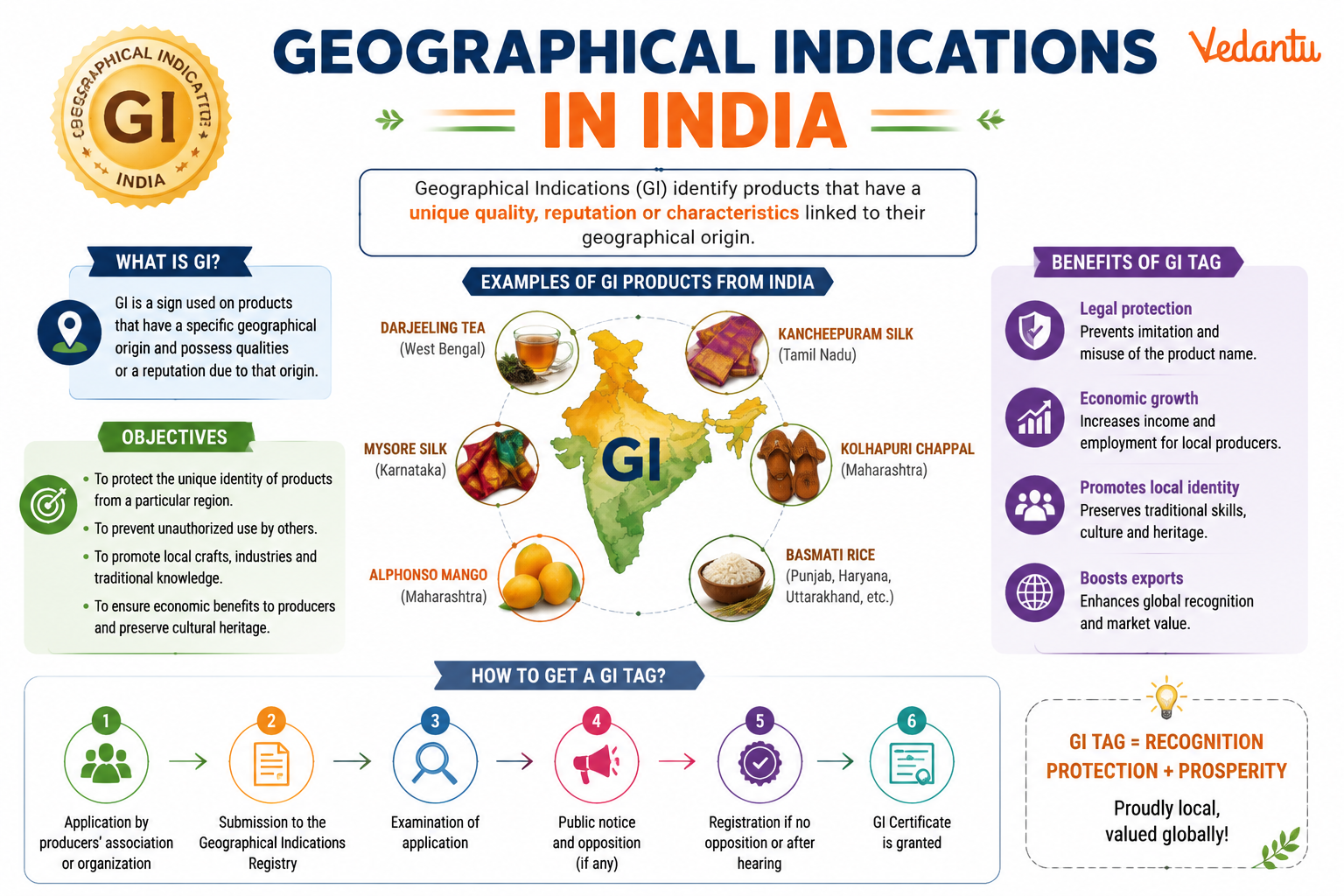
What is a Geographical Indication (GI)?
A Geographical Indication is a sign used on products that have a specific geographical origin and possess qualities or a reputation that are due to that origin. The GI tag ensures that only authorized users or producers from that region can use the product name.
- It identifies the product as originating from a specific region.
- The quality or reputation of the product is linked to its geographical location.
- It provides legal protection against misuse or imitation.
- It promotes economic growth of local communities.
Legal Framework of GI in India
In India, Geographical Indications are governed by the Geographical Indications of Goods (Registration and Protection) Act, 1999. The Act came into force in 2003. The registration of GI tags is administered by the Geographical Indications Registry under the Controller General of Patents, Designs and Trademarks, headquartered in Chennai.
- The GI tag is valid for 10 years.
- It can be renewed after every 10 years.
- It provides protection under the World Trade Organization agreement on Trade Related Aspects of Intellectual Property Rights (TRIPS).
Types of Products Eligible for GI Tag
Various categories of products can receive GI status in India. These categories ensure protection of diverse traditional goods.
- Agricultural Products - Darjeeling Tea, Basmati Rice, Alphonso Mango.
- Handicrafts - Madhubani Paintings, Pochampally Ikat, Channapatna Toys.
- Manufactured Goods - Kolhapuri Chappal, Kanchipuram Silk Saree.
- Natural Products - Makrana Marble.
Important GI Tagged Products in India
| Product | State/Region | Category |
|---|---|---|
| Darjeeling Tea | West Bengal | Agricultural |
| Kanchipuram Silk | Tamil Nadu | Handicraft |
| Alphonso Mango | Maharashtra | Agricultural |
Darjeeling Tea was the first Indian product to receive a GI tag in 2004. Since then, hundreds of products across different states have been registered. These tags help preserve the cultural identity and authenticity of traditional products.
Objectives of GI Tags
The primary aim of GI registration is to protect the interests of producers and consumers. It ensures that genuine products are not replaced by cheap imitations in the market.
- To prevent unauthorized use of registered geographical names.
- To promote exports of traditional Indian products.
- To provide legal protection to producers.
- To enhance rural employment and economic development.
Difference Between GI Tag and Trademark
Although both GI tags and trademarks are forms of intellectual property rights, they are different in nature and purpose.
GI Tag vs Trademark
| Basis | GI Tag | Trademark |
|---|---|---|
| Ownership | Collective right of producers | Individual or company right |
| Link with Location | Must be linked to specific region | No geographical link required |
| Validity | 10 years renewable | 10 years renewable |
A GI tag protects the name of a region-based product, while a trademark protects a brand name or logo used by a company or individual.
Importance of GI Tags for India
Geographical Indications contribute significantly to India's cultural heritage and economic growth. They encourage preservation of traditional skills and boost exports.
- Preserves traditional knowledge and craftsmanship.
- Enhances global recognition of Indian products.
- Increases income of local artisans and farmers.
- Prevents counterfeiting and misuse.
Key Facts for Competitive Exams
- First GI tag in India - Darjeeling Tea.
- GI Act passed in 1999 and enforced in 2003.
- GI Registry located in Chennai.
- Protection valid for 10 years and renewable.
- GI protection is covered under TRIPS agreement.
Conclusion
Geographical Indications in India are a vital tool for protecting region-specific products and promoting economic development. They help maintain the authenticity, quality, and cultural identity of traditional goods. For students preparing for competitive exams, understanding the concept of GI tags, their legal framework, examples, and importance is essential. Knowledge of recently awarded GI tags and their respective states can also be useful for current affairs and general awareness sections.
FAQs on Geographical Indications in India: Meaning, Law and Examples
1. What are Geographical Indications (GI) in India?
Geographical Indications (GI) are special labels used on products that originate from a specific region and possess unique qualities due to that location.
• Protected under the Geographical Indications of Goods (Registration and Protection) Act, 1999
• Indicate origin, quality, reputation, and traditional methods
• Common in agricultural products, handicrafts, textiles, and food items
• Examples: Darjeeling Tea, Kanchipuram Silk, Banarasi Saree
GI tags help preserve traditional knowledge, prevent misuse, and promote regional identity in India.
2. Why are Geographical Indications important in India?
Geographical Indications are important because they protect regional products and promote economic growth.
• Provide legal protection against imitation and misuse
• Enhance brand value and export potential
• Support local artisans, farmers, and rural economy
• Preserve traditional knowledge and cultural heritage
GI registration boosts authenticity, consumer trust, and global recognition of Indian products.
3. Which was the first GI-tagged product in India?
Darjeeling Tea was the first product in India to receive a GI tag in 2004-05.
• Registered under the GI Act, 1999
• Known for its unique aroma and flavor due to Himalayan climate
• Managed by the Tea Board of India
It is often referred to as the “Champagne of Teas” and remains a classic example in competitive exams and GK topics.
4. What is the Geographical Indications Act, 1999?
The Geographical Indications of Goods (Registration and Protection) Act, 1999 is the law governing GI registration in India.
• Came into force in 2003
• Administered by the Controller General of Patents, Designs and Trademarks
• GI Registry located in Chennai, Tamil Nadu
• Provides protection for 10 years (renewable)
This Act ensures legal safeguards and prevents unauthorized use of registered GI products.
5. How is a Geographical Indication different from a trademark?
A Geographical Indication differs from a trademark because it represents a region, not an individual brand.
• GI: Identifies goods from a specific geographical area
• Trademark: Identifies goods/services of a particular company
• GI is collectively owned by producers of that region
• Trademark is privately owned by an individual or firm
Both provide intellectual property protection, but GI focuses on location-based authenticity.
6. Which types of products can receive a GI tag in India?
Various categories of goods can receive a GI tag if they originate from a specific region and have unique characteristics.
• Agricultural products: Basmati Rice, Alphonso Mango
• Natural goods: Makrana Marble
• Handicrafts: Madhubani Paintings, Pashmina Shawls
• Manufactured goods: Kanchipuram Silk Sarees
The product must demonstrate a clear link between its quality and geographical origin.
7. How long is a GI tag valid in India?
A GI tag in India is valid for 10 years and can be renewed indefinitely.
• Initial validity: 10 years
• Renewable every 10 years
• Requires payment of renewal fee
• Failure to renew may lead to removal from the register
This ensures continued legal protection for registered geographical products.
8. Who grants GI tags in India?
GI tags in India are granted by the Geographical Indications Registry.
• Operates under the Department for Promotion of Industry and Internal Trade (DPIIT)
• Head office located in Chennai
• Functions under the Ministry of Commerce and Industry
The registry examines applications, verifies claims, and provides official registration certificates.
9. What are some famous GI-tagged products in India?
India has hundreds of GI-tagged products representing diverse cultures and regions.
• Darjeeling Tea (West Bengal)
• Banarasi Saree (Uttar Pradesh)
• Pochampally Ikat (Telangana)
• Alphonso Mango (Maharashtra)
• Mysore Sandalwood Oil (Karnataka)
These products highlight India’s rich heritage and regional craftsmanship.
10. How do Geographical Indications benefit farmers and artisans?
Geographical Indications benefit farmers and artisans by increasing income and protecting traditional livelihoods.
• Prevents duplication and unfair competition
• Enhances market value and export demand
• Encourages rural development and employment
• Promotes sustainable production practices
GI recognition strengthens local economies and ensures long-term socio-economic growth.
