






Key Contributions of Ancient and Modern Indian Mathematicians
India has a rich and continuous mathematical tradition that stretches from ancient Vedic times to the modern scientific era. Famous Indian mathematicians from ancient to modern India have made groundbreaking contributions in areas such as arithmetic, algebra, geometry, trigonometry, calculus, number theory, and statistics. Concepts like zero, the decimal place value system, algebraic methods, and early ideas of calculus originated or were significantly developed in India. This General Knowledge page provides a structured overview of major Indian mathematicians, their time periods, and their key contributions, making it useful for students, competitive exam aspirants, and general readers.
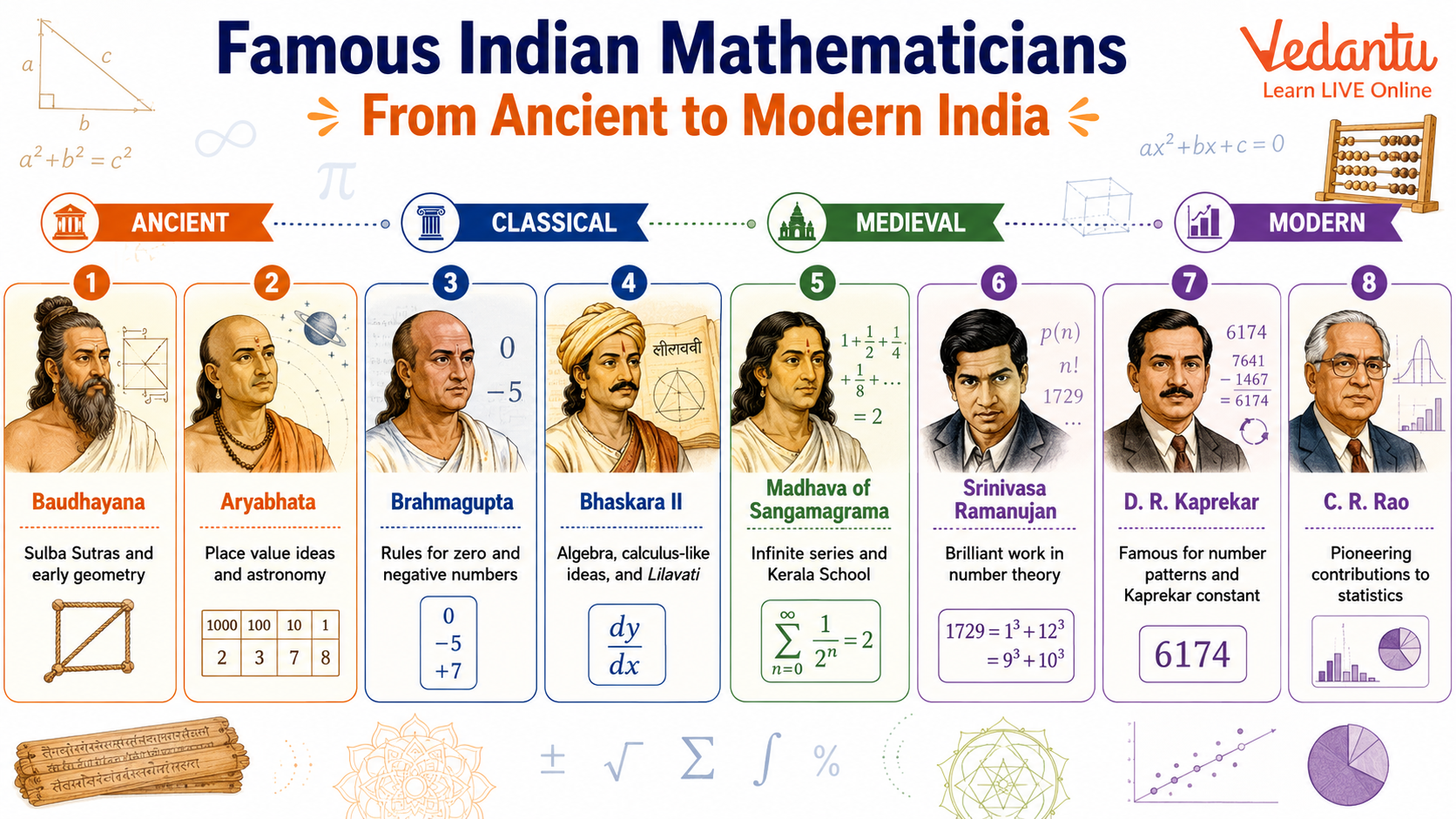
Importance of Indian Mathematicians in World History
Indian mathematicians played a foundational role in shaping global mathematics. The invention of zero as a number and the development of the decimal system revolutionized arithmetic worldwide. Indian mathematical texts were translated into Arabic and later into Latin, influencing European mathematics during the medieval and Renaissance periods.
- Introduction of zero as a number and symbol
- Development of the decimal place value system
- Advancement in algebra and quadratic equations
- Early concepts of trigonometry and calculus
- Major contributions to statistics and modern mathematics
Famous Indian Mathematicians From Ancient To Modern India
Ancient Indian Mathematicians
Major Ancient Indian Mathematicians
| Name | Period | Key Contributions |
|---|---|---|
| Aryabhata | 476 - 550 CE | Value of pi, trigonometry, place value system |
| Brahmagupta | 598 - 668 CE | Rules for zero and negative numbers, algebra |
| Bhaskara I | 7th century CE | Work on sine approximation |
| Bhaskara II | 1114 - 1185 CE | Lilavati, early calculus concepts |
Aryabhata wrote Aryabhatiya, where he gave an accurate approximation of pi and introduced sine tables. Brahmagupta established rules for operations involving zero and negative numbers in his work Brahmasphutasiddhanta. Bhaskara II discussed differential calculus concepts such as instantaneous motion centuries before Newton and Leibniz.
Medieval Contributions - Kerala School of Mathematics
The Kerala School of Mathematics and Astronomy, founded by Madhava of Sangamagrama in the 14th century, made pioneering discoveries in infinite series and calculus.
- Madhava developed infinite series expansions for pi, sine, and cosine
- Nilakantha Somayaji improved planetary models
- Early foundations of calculus were established
These discoveries predated similar developments in Europe and demonstrate India's advanced mathematical thinking during the medieval period.
Modern Indian Mathematicians
Major Modern Indian Mathematicians
| Name | Period | Field and Contributions |
|---|---|---|
| Srinivasa Ramanujan | 1887 - 1920 | Number theory, infinite series, partitions |
| C R Rao | 1920 - 2023 | Statistics, Cramer Rao bound |
| Harish Chandra | 1923 - 1983 | Representation theory |
| Manjul Bhargava | 1974 - Present | Number theory, Fields Medal 2014 |
Srinivasa Ramanujan made extraordinary contributions to number theory despite limited formal training. His work on partitions, modular forms, and infinite series continues to influence modern mathematics. C R Rao made fundamental contributions to statistics, including the Cramer Rao inequality. Manjul Bhargava received the Fields Medal for his work in number theory, bringing global recognition to modern Indian mathematics.
Key Contributions of Indian Mathematics
- Formal use of zero as both symbol and number
- Decimal place value number system
- Solutions to quadratic and indeterminate equations
- Development of trigonometric functions
- Infinite series and early calculus methods
- Foundations of modern statistics
Why This Topic Is Important for Competitive Exams
Questions about famous Indian mathematicians frequently appear in GK sections of competitive exams such as UPSC, SSC, State PSC, Banking, Railways, and other entrance tests. Candidates are often asked about the inventor of zero, the author of Lilavati, or the contributions of Ramanujan. Understanding timelines and key achievements helps in quick revision and accurate answering.
Preparation Tips
- Memorize major mathematicians along with their key works
- Focus on contributions like zero, decimal system, and calculus
- Revise chronological order from ancient to modern period
- Practice previous year GK questions related to Indian mathematicians
Conclusion
Famous Indian mathematicians from ancient to modern India have profoundly influenced the development of mathematics worldwide. From Aryabhata and Brahmagupta to Ramanujan and Manjul Bhargava, each contributed uniquely to expanding mathematical knowledge. Their discoveries in zero, algebra, trigonometry, calculus, and statistics continue to shape science and technology today. Understanding their achievements not only strengthens General Knowledge but also highlights India's enduring intellectual legacy.
FAQs on Famous Indian Mathematicians from Ancient to Modern Times
1. Who are the most famous Indian mathematicians from ancient to modern India?
The most famous Indian mathematicians include legendary scholars from both ancient and modern India who made groundbreaking contributions to mathematics.
• Aryabhata – Introduced the concept of zero and place value system.
• Brahmagupta – Developed rules for zero and negative numbers.
• Bhaskara I & Bhaskara II – Advanced algebra and calculus concepts.
• Srinivasa Ramanujan – Made major contributions to number theory.
• C. R. Rao – Renowned statistician in modern mathematics.
These mathematicians shaped number theory, algebra, trigonometry, and statistics, influencing global mathematical development.
2. What were the major contributions of Aryabhata?
The major contributions of Aryabhata (476 CE) laid the foundation of classical Indian mathematics and astronomy.
• Wrote Aryabhatiya, a famous mathematical text.
• Explained the place value system and early concept of zero.
• Calculated the value of π (pi) accurately.
• Proposed that the Earth rotates on its axis.
His work greatly influenced trigonometry, algebra, and astronomy in India and abroad.
3. Why is Brahmagupta important in mathematics?
Brahmagupta is important because he formalized rules for zero and negative numbers in mathematics.
• Wrote Brahmasphutasiddhanta in 628 CE.
• Provided arithmetic rules for zero.
• Developed formulas for quadratic equations.
• Contributed to geometry and algebra.
His discoveries significantly advanced number systems and algebra, influencing Arab and European mathematics.
4. Who was Bhaskara II and what were his achievements?
Bhaskara II, also known as Bhaskaracharya (1114–1185), was a leading medieval Indian mathematician and astronomer.
• Authored Lilavati (arithmetic) and Bijaganita (algebra).
• Worked on early concepts of calculus.
• Explained cyclic methods for solving equations.
• Made advances in trigonometry.
He is regarded as one of the greatest scholars of medieval Indian mathematics.
5. Why is Srinivasa Ramanujan famous worldwide?
Srinivasa Ramanujan is famous for his extraordinary contributions to number theory and infinite series.
• Developed complex mathematical formulas independently.
• Worked with G. H. Hardy at Cambridge University.
• Contributed to partition theory, modular forms, and continued fractions.
• Introduced the famous Ramanujan Prime and Ramanujan Theta Function.
He remains one of the greatest mathematical geniuses in modern India.
6. What is the contribution of Indian mathematicians to the invention of zero?
Indian mathematicians were the first to formally define and use zero (0) as a number.
• Aryabhata introduced the place value system.
• Brahmagupta gave arithmetic rules for zero.
• Zero enabled development of the decimal number system.
The invention of zero revolutionized mathematics, arithmetic, algebra, and global commerce.
7. How did ancient Indian mathematicians influence the world?
Ancient Indian mathematicians greatly influenced global mathematics through the spread of their ideas to Arabia and Europe.
• Introduced the Hindu-Arabic numeral system.
• Developed early algebra and trigonometry.
• Contributed to astronomy and geometry.
• Mathematical texts were translated into Arabic and Latin.
Their work shaped modern mathematical science and scientific calculations worldwide.
8. Who are some modern Indian mathematicians after Ramanujan?
After Ramanujan, several modern Indian mathematicians gained global recognition.
• C. R. Rao – Pioneer in statistics and probability theory.
• Harish-Chandra – Known for representation theory.
• Manjul Bhargava – Fields Medal winner in number theory.
• Narendra Karmarkar – Developed Karmarkar’s algorithm.
These scholars strengthened India’s position in modern mathematics and mathematical research.
9. What books were written by famous Indian mathematicians?
Several famous mathematical texts were written by Indian mathematicians across centuries.
• Aryabhatiya – Aryabhata.
• Brahmasphutasiddhanta – Brahmagupta.
• Lilavati and Bijaganita – Bhaskara II.
• Collected Papers of Srinivasa Ramanujan – Ramanujan’s works.
These texts form the foundation of Indian mathematical literature and academic study.
10. Why are Indian mathematicians important for competitive exams and GK?
Indian mathematicians are important for General Knowledge (GK) and competitive exams because their contributions are frequently asked in exams.
• Questions on zero and decimal system.
• Facts about Ramanujan, Aryabhata, and Brahmagupta.
• Books and mathematical discoveries.
• Contributions to algebra, calculus, and statistics.
Understanding these scholars helps students prepare for UPSC, SSC, banking, railways, and school examinations.
