






Major Differences Between FERA and FEMA in Objectives, Penalties, and Regulations
The Differences Between FERA and FEMA is an important topic in Indian Economy and General Knowledge. FERA (Foreign Exchange Regulation Act) and FEMA (Foreign Exchange Management Act) are two major laws related to foreign exchange in India. FERA was enacted in 1973 to regulate foreign exchange strictly, while FEMA replaced it in 1999 with a more liberal and management-oriented approach. Understanding the difference between FERA and FEMA helps students, competitive exam aspirants, and general readers grasp how India shifted from a controlled economy to a liberalized economic system.
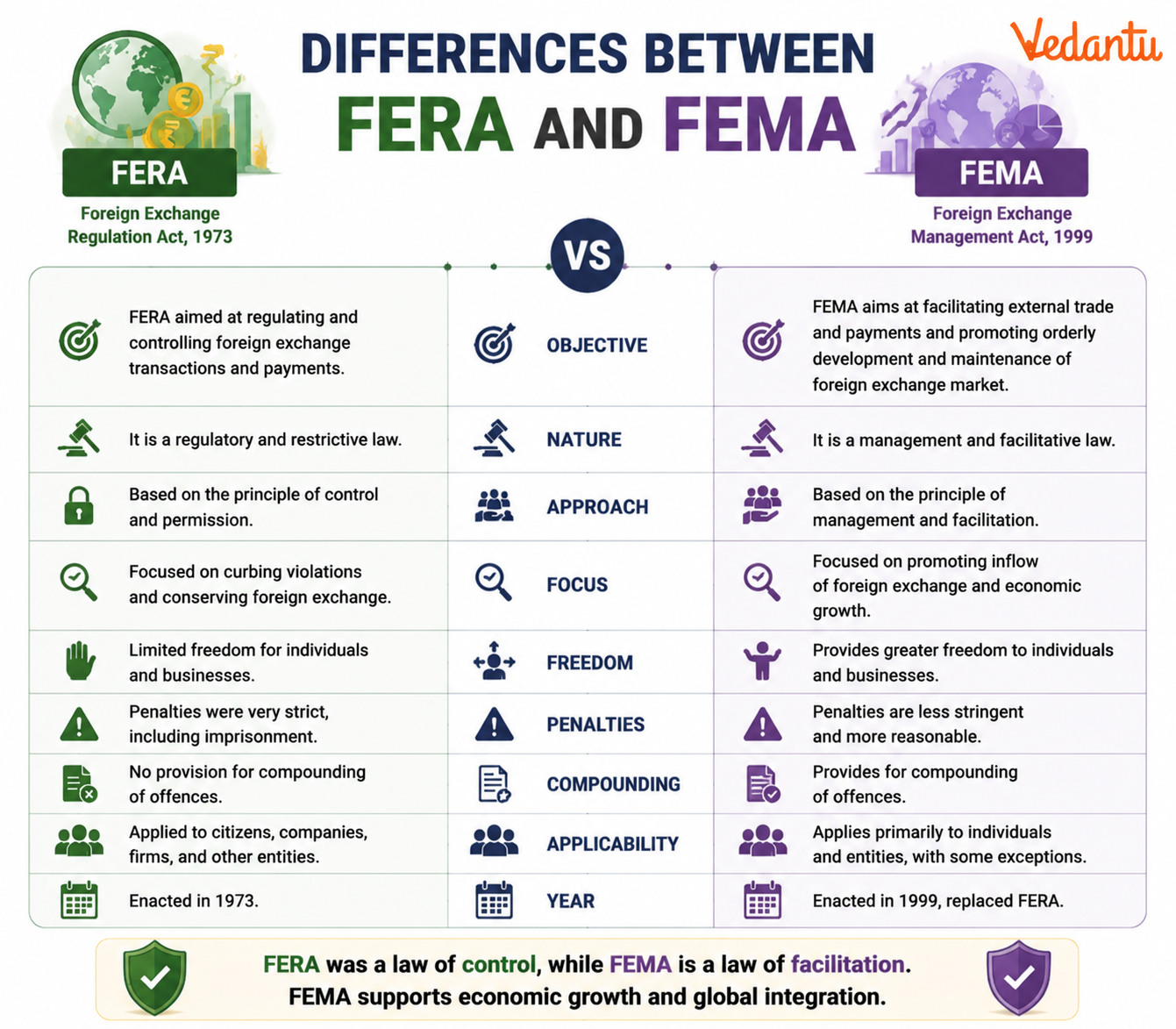
What is FERA?
FERA stands for Foreign Exchange Regulation Act. It was enacted in 1973 during a period when India had limited foreign exchange reserves. The main objective of FERA was to conserve foreign exchange and regulate payments and transactions involving foreign exchange strictly.
Key Features of FERA
- Enacted in 1973 and came into force in 1974.
- Focused on strict control and regulation of foreign exchange.
- All foreign exchange transactions required permission from the Reserve Bank of India (RBI).
- Violations were treated as criminal offences.
- Burden of proof was on the accused person.
What is FEMA?
FEMA stands for Foreign Exchange Management Act. It was enacted in 1999 and came into effect on 1 June 2000. FEMA replaced FERA as part of India's economic liberalization reforms initiated in 1991. The main objective of FEMA is to facilitate external trade and payments and promote the orderly development of the foreign exchange market in India.
Key Features of FEMA
- Enacted in 1999 and implemented in 2000.
- Focused on management rather than strict regulation of foreign exchange.
- Encourages foreign trade and investment.
- Violations are treated as civil offences.
- Burden of proof is generally on the enforcement authorities.
Differences Between FERA and FEMA
| Basis of Difference | FERA | FEMA |
|---|---|---|
| Full Form | Foreign Exchange Regulation Act | Foreign Exchange Management Act |
| Year of Enactment | 1973 | 1999 |
| Objective | Strict regulation and conservation of foreign exchange | Management and facilitation of foreign exchange |
| Nature of Offence | Criminal offence | Civil offence |
| Economic Approach | Control oriented economy | Liberalized economy |
| Burden of Proof | On the accused | On enforcement authorities |
The table clearly shows that FERA was strict and control oriented, while FEMA is flexible and management oriented. FEMA reflects India's shift toward globalization and economic reforms after 1991.
Why Was FERA Replaced by FEMA?
FERA was considered too strict and unsuitable for a liberalizing economy. After the economic crisis of 1991, India adopted reforms to open its economy to foreign investment and trade. The government introduced FEMA to create a more investor friendly and growth oriented legal framework.
- India moved from a shortage economy to a more stable foreign exchange position.
- Need to promote foreign investment and international trade.
- To reduce criminalization of minor foreign exchange violations.
- To align with global economic practices.
Importance of FERA and FEMA in Competitive Exams
Questions on Differences Between FERA and FEMA are frequently asked in competitive exams such as UPSC, SSC, Banking exams, and State PSC exams. Students should focus on the year of enactment, objective, type of offence, and economic background associated with both Acts.
Preparation Tips
- Memorize the full forms and years of enactment.
- Understand the economic conditions during 1973 and 1999.
- Focus on the difference between criminal and civil offences.
- Revise comparison tables regularly for quick recall.
Conclusion
In summary, the Differences Between FERA and FEMA reflect India's transformation from a tightly controlled economy to a liberalized and globally integrated one. FERA emphasized strict control and criminal penalties, while FEMA focuses on management, facilitation, and civil penalties. Understanding these differences is essential for building strong conceptual clarity in Indian Economy and performing well in competitive examinations.
FAQs on Differences Between FERA and FEMA: Key Concepts and Legal Changes
1. What is the main difference between FERA and FEMA?
The main difference between FERA and FEMA lies in their approach to foreign exchange regulation.
• FERA (Foreign Exchange Regulation Act, 1973) was restrictive and aimed at conserving foreign exchange.
• FEMA (Foreign Exchange Management Act, 1999) is liberal and focuses on managing foreign exchange efficiently.
• FERA treated violations as criminal offences, while FEMA treats them as civil offences.
This shift reflects India’s move from a controlled economy to a liberalized economic system, a common People Also Ask (PAA) query in competitive exams.
2. When were FERA and FEMA enacted in India?
FERA was enacted in 1973, while FEMA replaced it in 1999.
• FERA came into force in 1973 during a period of foreign exchange shortage.
• FEMA was introduced in 1999 and became effective from June 1, 2000.
• FEMA was introduced after the 1991 economic reforms to promote globalization and foreign investment.
These dates are important for GK, UPSC, SSC, and banking exams.
3. Why was FERA replaced by FEMA?
FERA was replaced by FEMA to liberalize foreign exchange laws and support economic reforms.
• FERA was too strict and discouraged foreign investment.
• India adopted a liberalized economic policy after 1991.
• FEMA simplified procedures and encouraged external trade and payments.
This transition is frequently searched under “Why was FERA abolished?” and “Reasons for FEMA introduction.”
4. How did FERA and FEMA differ in terms of offences and penalties?
FERA treated violations as criminal offences, whereas FEMA treats them as civil offences.
• Under FERA, offenders could face imprisonment.
• Under FEMA, penalties are mainly monetary fines.
• The burden of proof under FERA was on the accused; FEMA follows a more balanced legal approach.
This distinction is crucial in understanding the difference between criminal liability and civil liability in foreign exchange laws.
5. What was the objective of FERA?
The main objective of FERA was to conserve India’s foreign exchange reserves.
• Regulate payments in foreign currency.
• Control foreign companies operating in India.
• Prevent misuse of scarce foreign exchange.
FERA reflected India’s protectionist economic policy during the 1970s.
6. What is the objective of FEMA?
The objective of FEMA is to facilitate external trade and promote orderly foreign exchange management.
• Encourage foreign direct investment (FDI).
• Simplify foreign exchange procedures.
• Maintain stability in the forex market.
FEMA supports India’s integration with the global economy, a key topic in commerce and economics GK.
7. What is the full form of FERA and FEMA?
FERA stands for Foreign Exchange Regulation Act, and FEMA stands for Foreign Exchange Management Act.
• FERA – Foreign Exchange Regulation Act, 1973
• FEMA – Foreign Exchange Management Act, 1999
These full forms are commonly asked in quizzes, interviews, and competitive exams under Indian Polity and Economy GK.
8. Which act is more liberal: FERA or FEMA?
FEMA is more liberal compared to FERA.
• FEMA promotes ease of doing business.
• It reduces strict controls on foreign exchange transactions.
• Encourages globalization and foreign trade.
In contrast, FERA imposed strict restrictions and controls, making FEMA more business-friendly and reform-oriented.
9. Who regulates foreign exchange under FEMA?
The Reserve Bank of India (RBI) regulates foreign exchange under FEMA.
• RBI issues guidelines for foreign transactions.
• The Central Government frames rules under FEMA.
• Authorized dealers like banks handle forex transactions.
This regulatory framework ensures proper foreign exchange management in India.
10. How did FERA impact foreign companies in India?
FERA imposed strict restrictions on foreign companies operating in India.
• Limited foreign equity participation.
• Required special permissions for operations.
• Imposed tight regulatory compliance.
Due to these restrictions, many multinational companies faced operational challenges until FEMA introduced a more flexible regime.
