






Key Differences Between States and Union Territories in India for Exams
India is a federal country with a unique system of governance that includes both States and Union Territories. Understanding the Difference Between State and Union Territory in India is important for students, competitive exam aspirants, and general readers. While both are administrative divisions of the country, they differ in terms of powers, governance, constitutional status, and relationship with the Central Government. This topic is frequently asked in UPSC, SSC, State PSC, and other competitive examinations.
Meaning of State in India
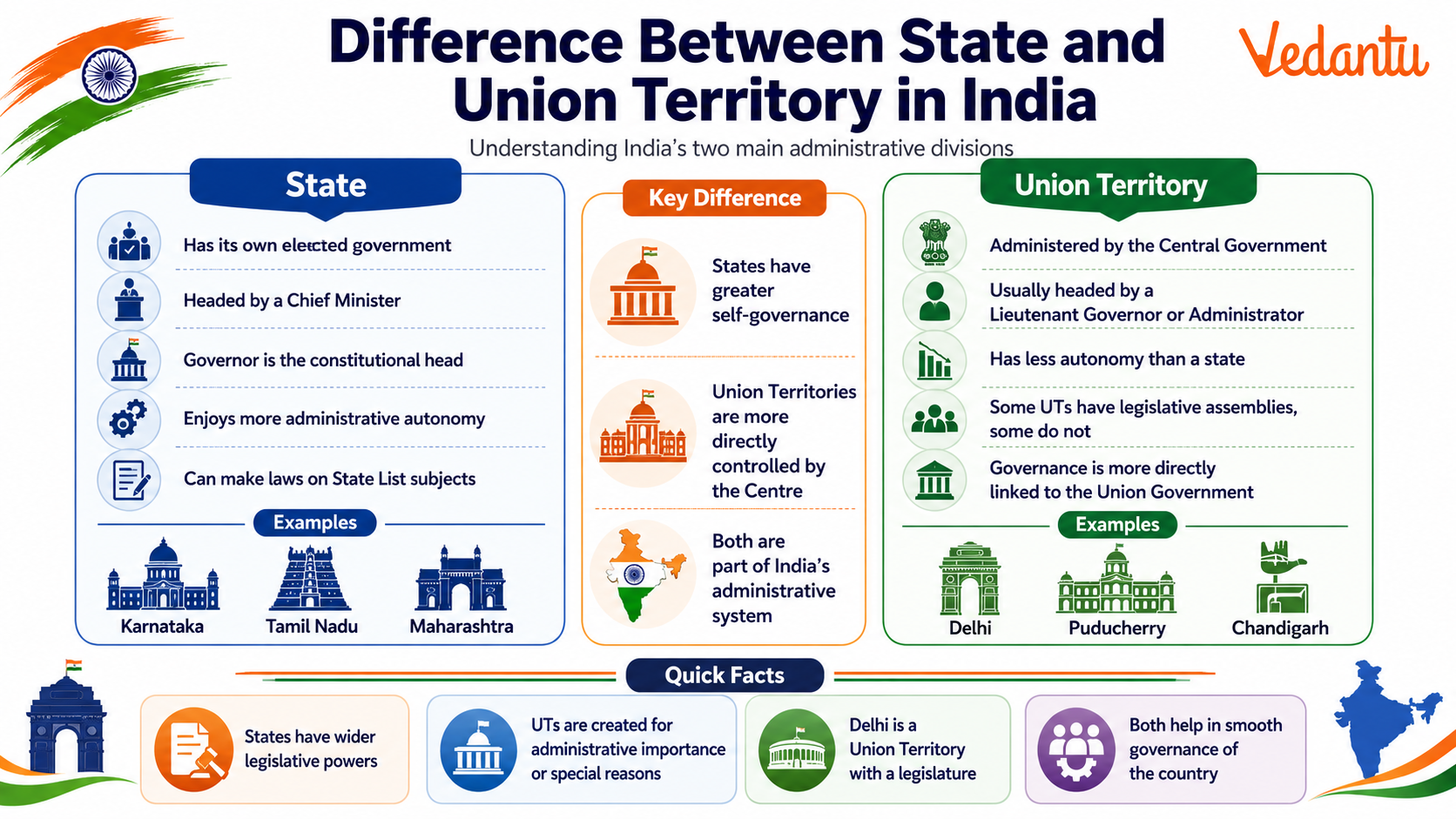
A State in India is a constituent unit of the Indian Union with its own elected government. States have autonomy in certain matters as defined by the Constitution of India. They function under a federal structure where powers are divided between the Centre and the States.
Key Features of a State
- Has its own elected Legislative Assembly.
- Headed by a Chief Minister.
- Governor acts as the constitutional head.
- Has powers under the State List and Concurrent List.
- Greater administrative and legislative autonomy.
Meaning of Union Territory in India
A Union Territory is an administrative division that is directly governed by the Central Government. Union Territories are created for better administration of small regions, strategic locations, or culturally distinct areas. Some Union Territories have partial state-like features, while others are fully controlled by the Centre.
Key Features of a Union Territory
- Administered by an Administrator or Lieutenant Governor.
- Directly controlled by the Central Government.
- Some Union Territories have Legislative Assemblies such as Delhi and Puducherry.
- Parliament can make laws on any subject for Union Territories.
- Less autonomy compared to States.
Difference Between State and Union Territory in India
| Basis of Difference | State | Union Territory |
|---|---|---|
| Governance | Has its own elected government | Directly governed by Central Government |
| Executive Head | Governor | Administrator or Lieutenant Governor |
| Legislative Powers | Can legislate on State List and Concurrent List | Parliament legislates on most matters |
| Autonomy | High degree of autonomy | Limited autonomy |
| Representation | Has representation in Rajya Sabha | Limited representation in Rajya Sabha |
The main difference lies in the level of autonomy and governance. States enjoy constitutional powers and independent functioning within their domain, whereas Union Territories are more closely controlled by the Central Government.
Number of States and Union Territories in India
As of 2026, India has 28 States and 8 Union Territories. The reorganization of Jammu and Kashmir in 2019 led to the formation of two Union Territories - Jammu and Kashmir, and Ladakh.
List of Union Territories
- Andaman and Nicobar Islands
- Chandigarh
- Dadra and Nagar Haveli and Daman and Diu
- Delhi
- Jammu and Kashmir
- Ladakh
- Lakshadweep
- Puducherry
Why Does India Have Union Territories?
Union Territories are created for specific administrative and strategic reasons. Some regions are small in size and population, making full statehood impractical. Others have strategic importance or unique cultural identities that require special governance arrangements.
- To ensure better administrative efficiency.
- To manage strategically important regions.
- To provide special status to culturally distinct areas.
- To maintain direct control over the national capital.
Special Cases Among Union Territories
Not all Union Territories are governed in the same manner. Delhi and Puducherry have their own Legislative Assemblies and Council of Ministers. However, their powers are limited compared to full-fledged States. For example, Delhi does not have control over subjects like police, public order, and land.
Conclusion
The difference between State and Union Territory in India is mainly based on governance, autonomy, and constitutional powers. States have greater independence with elected governments and legislative authority, while Union Territories are administered directly by the Central Government with limited autonomy. Understanding this distinction is essential for competitive exams and for developing a clear understanding of India's federal structure.
By learning the administrative structure, powers, and constitutional provisions related to States and Union Territories, students can strengthen their General Knowledge and improve their performance in various government examinations.
FAQs on Difference Between State and Union Territory in India: Key Constitutional Differences
1. What is the main difference between a State and a Union Territory in India?
The main difference between a State and a Union Territory (UT) lies in their administrative powers and relationship with the Central Government.
- States have their own elected government with full legislative powers.
- Union Territories are directly governed by the President of India through an Administrator or Lieutenant Governor.
- States enjoy more autonomy under the Indian Constitution.
- UTs have limited powers, though some like Delhi and Puducherry have partial statehood features.
This topic is important for Indian Polity, competitive exams, and GK preparation.
2. How many States and Union Territories are there in India in 2026?
As of 2026, India has 28 States and 8 Union Territories.
- States: Fully functioning elected governments.
- Union Territories: Include Delhi, Puducherry, Jammu and Kashmir, Ladakh, Chandigarh, Andaman and Nicobar Islands, Lakshadweep, and Dadra and Nagar Haveli and Daman and Diu.
The number changed after the Jammu and Kashmir Reorganisation Act, 2019.
This is a frequently asked question in SSC, UPSC, Railways, and State PSC exams.
3. Why are some regions made Union Territories instead of States?
Some regions are made Union Territories for better administrative control, strategic importance, or small size.
- Small population or geographical area (e.g., Lakshadweep).
- Strategic or border importance (e.g., Ladakh).
- Cultural or political sensitivity (e.g., Delhi as the national capital).
- Need for direct Central Government administration.
The decision is made under Articles 1 and 3 of the Indian Constitution.
4. Do Union Territories have their own Legislative Assembly?
Only some Union Territories have a Legislative Assembly with limited law-making powers.
- UTs with Assembly: Delhi, Puducherry, and Jammu & Kashmir.
- UTs without Assembly: Ladakh, Chandigarh, Lakshadweep, Andaman and Nicobar Islands, Dadra and Nagar Haveli and Daman and Diu.
- In UTs without Assembly, laws are made by the Parliament of India.
This distinction is crucial in understanding Indian federalism.
5. Who appoints the Governor of a State and the Administrator of a Union Territory?
Both the Governor of a State and the Administrator/Lieutenant Governor of a Union Territory are appointed by the President of India.
- Governor: Constitutional head of a State.
- Administrator or Lieutenant Governor: Head of a Union Territory.
- They act as representatives of the Central Government.
This is an important concept under Indian Polity and Constitution.
6. What constitutional articles deal with States and Union Territories?
The formation and governance of States and Union Territories are covered under specific Articles of the Indian Constitution.
- Article 1: India as a Union of States.
- Article 2 & 3: Creation and reorganization of States and UTs.
- Articles 239–241: Administration of Union Territories.
These Articles are frequently asked in UPSC, SSC, and other government exams.
7. Can a Union Territory become a State?
Yes, a Union Territory can be converted into a State by an Act of Parliament.
- Example: Himachal Pradesh, Goa, and Manipur were once UTs.
- Parliament passes a law under Article 3 of the Constitution.
- The President refers the bill to the concerned legislature for opinion.
This process reflects the flexibility of the Indian federal system.
8. What is the financial difference between a State and a Union Territory?
States have greater financial independence compared to Union Territories.
- States have their own budget and can levy certain taxes.
- Union Territories largely depend on financial assistance from the Central Government.
- UTs without legislature have budgets passed by Parliament.
This difference affects governance, taxation, and development policies.
9. Is Delhi a State or a Union Territory?
Delhi is a Union Territory with a Legislative Assembly, officially called the National Capital Territory (NCT) of Delhi.
- Has an elected Chief Minister and Assembly.
- Certain subjects like police, land, and public order are controlled by the Central Government.
- Administered by a Lieutenant Governor.
Delhi’s special status often appears in current affairs and polity questions.
10. What is the role of the Central Government in Union Territories?
The Central Government plays a direct administrative role in governing Union Territories.
- Laws are made by the Parliament of India (especially for UTs without legislature).
- The President governs through an Administrator or Lieutenant Governor.
- Greater central control ensures national security and administrative efficiency.
This highlights the key difference between State autonomy and Union Territory administration in India.
