






What Is the Difference Between Judicial and Police Custody in Law?
Judicial Custody and Police Custody are two important legal terms used in criminal law in India. These concepts relate to the detention of an accused person during investigation or trial. Understanding the difference between Judicial Custody and Police Custody is essential for students, competitive exam aspirants, and general readers as it forms a crucial part of General Knowledge and Indian Polity. Though both involve the detention of a person, the authority in control, purpose, and conditions of custody are different.
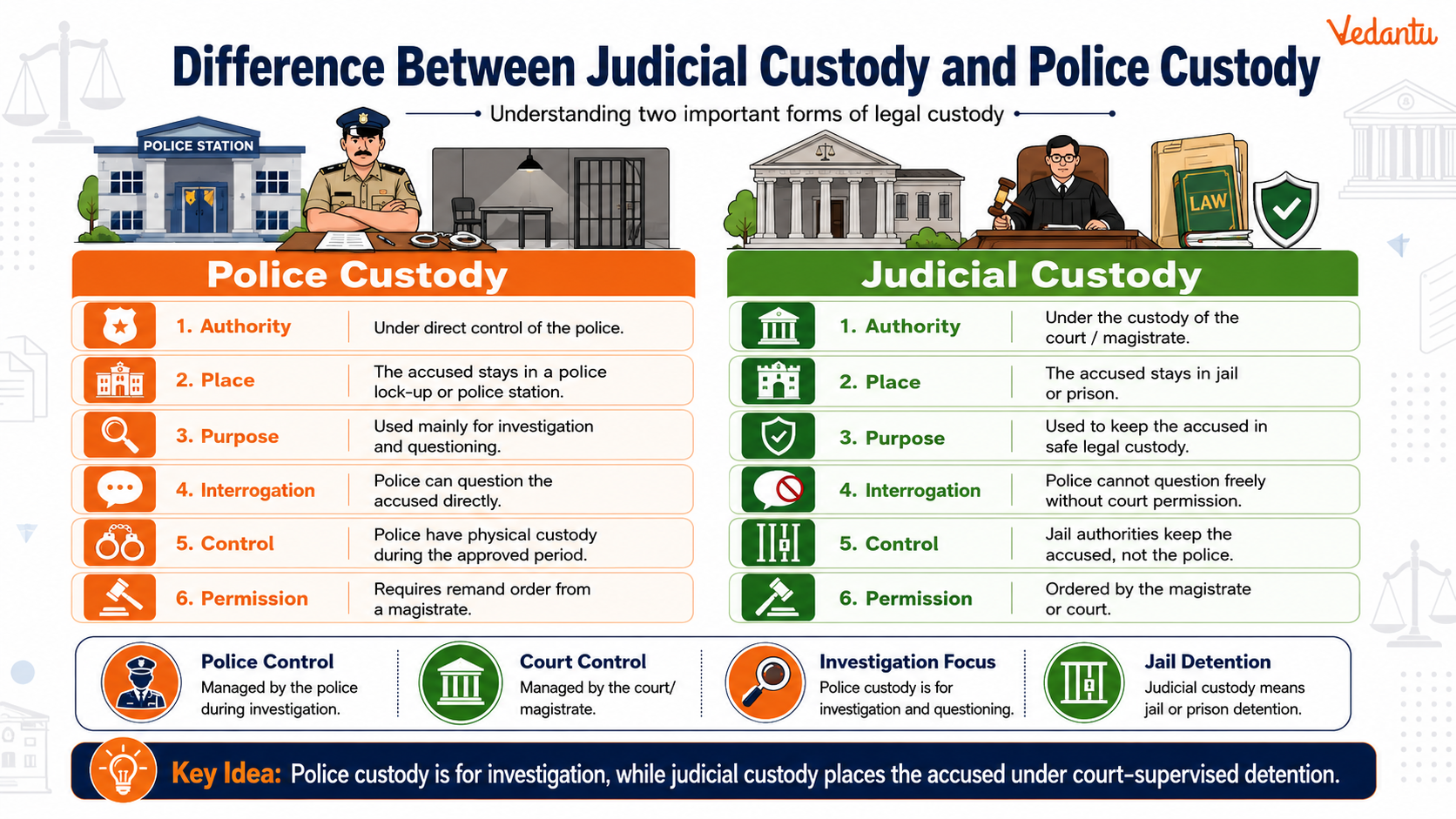
What is Police Custody?
Police Custody refers to the detention of an accused person in a police station for the purpose of investigation. In this type of custody, the accused remains under the direct control of the police authorities. Police custody is generally granted by a Magistrate for a limited period to allow the police to interrogate the accused and collect evidence.
Key Features of Police Custody
- The accused is kept in a police station lock-up.
- The police have direct physical control over the accused.
- Main purpose is interrogation and investigation.
- Maximum duration is 15 days from the date of first remand as per Section 167 of the Criminal Procedure Code.
- The accused must be produced before a Magistrate within 24 hours of arrest.
What is Judicial Custody?
Judicial Custody refers to the detention of an accused person in a jail under the supervision of a Magistrate. In this type of custody, the accused is not under direct police control but is kept in a prison. Judicial custody is usually ordered when the Magistrate believes that further detention is necessary but does not require police interrogation.
Key Features of Judicial Custody
- The accused is lodged in a jail or prison.
- The jail authorities are responsible for the custody of the accused.
- Police cannot interrogate the accused without court permission.
- Judicial custody can extend up to 90 days for serious offences and 60 days for less serious offences.
- It ensures greater protection of the rights of the accused.
Difference Between Judicial Custody And Police Custody
| Basis of Difference | Police Custody | Judicial Custody |
|---|---|---|
| Place of Detention | Police station lock-up | Jail or prison |
| Control Authority | Under police control | Under Magistrate and jail authorities |
| Purpose | Investigation and interrogation | Detention during trial or investigation |
| Duration | Maximum 15 days | Up to 60 or 90 days depending on offence |
| Police Access | Direct and continuous access | Only with court permission |
The table clearly shows that the primary difference lies in the authority controlling the accused and the purpose of detention. Police custody focuses on investigation, while judicial custody focuses on detention under court supervision to ensure legal compliance and protection of rights.
Legal Provisions Related to Custody
The provisions related to police and judicial custody are mainly governed by the Criminal Procedure Code, 1973. Section 167 of the Code deals with the procedure when investigation cannot be completed within 24 hours.
- Article 22 of the Indian Constitution provides protection against arbitrary arrest and detention.
- An arrested person must be informed of the grounds of arrest.
- The accused has the right to consult a legal practitioner.
- Production before a Magistrate within 24 hours is mandatory.
Importance of Understanding the Difference
Knowing the difference between Judicial Custody and Police Custody is important for various competitive examinations such as UPSC, SSC, State PSC, and other law-related exams. It also helps citizens understand their legal rights and the safeguards provided under Indian law. This topic is frequently asked in General Knowledge and Polity sections due to its relevance in current affairs and legal awareness.
Conclusion
In summary, Police Custody and Judicial Custody are two different forms of detention under Indian criminal law. Police custody is primarily for investigation and interrogation under police supervision, while judicial custody involves detention in jail under the authority of a Magistrate. The differences in control, duration, and purpose make both forms of custody legally distinct. A clear understanding of these concepts not only strengthens General Knowledge but also enhances awareness of constitutional rights and legal procedures in India.
FAQs on Judicial Custody vs Police Custody – Clear Comparison for Students
1. What is the difference between judicial custody and police custody?
Judicial custody means the accused is kept in jail under a magistrate’s supervision, while police custody means the accused is kept in police lock-up for investigation.
- Judicial Custody: Accused is lodged in jail and monitored by the court.
- Police Custody: Accused remains in police station lock-up for interrogation.
- Police custody is mainly for investigation and questioning.
- Judicial custody ensures legal protection and court supervision.
These terms are commonly searched in topics like Criminal Procedure Code (CrPC), arrest procedure, and rights of the accused.
2. What is judicial custody?
Judicial custody refers to the detention of an accused person in jail under the authority of a magistrate.
- Ordered by a Judicial Magistrate.
- Accused is kept in central or district jail.
- Police cannot interrogate without court permission.
- Ensures protection under Article 22 of the Indian Constitution.
It is often discussed in relation to remand, bail, and trial procedures.
3. What is police custody?
Police custody means the accused is kept in a police station lock-up for investigation purposes.
- Granted by a Magistrate under Section 167 of CrPC.
- Maximum period is usually 15 days.
- Used for interrogation, evidence collection, and confession.
- Higher risk of custodial interrogation.
This concept is frequently searched under arrest laws, custodial rights, and criminal investigation process.
4. How long can a person be kept in police custody?
A person can be kept in police custody for a maximum of 15 days as per Section 167 of the Criminal Procedure Code (CrPC).
- Initial detention: 24 hours without magistrate approval.
- Extension requires court permission.
- Cannot exceed 15 days in total.
After this period, the accused is usually sent to judicial custody.
5. Who has more control in judicial custody and police custody?
In police custody, the police have direct control, while in judicial custody, the court has control.
- Police Custody: Managed by investigating officers.
- Judicial Custody: Managed by jail authorities under court orders.
- Court supervises rights and treatment in judicial detention.
This distinction is important in topics like custodial violence, legal safeguards, and human rights.
6. Can police interrogate a person in judicial custody?
Yes, but police need prior permission from the court to interrogate a person in judicial custody.
- Requires magistrate approval.
- Interrogation happens under legal supervision.
- Ensures protection of accused rights and due process.
This is often searched under rights of arrested person and legal procedure after arrest.
7. What happens after police custody ends?
After police custody ends, the accused is usually sent to judicial custody.
- Magistrate reviews the case progress.
- Accused may be shifted to jail.
- Bail application can be filed.
This transition is part of the criminal justice system and is important for competitive exams like UPSC, SSC, and State PSC.
8. Which custody is safer for the accused?
Judicial custody is generally considered safer for the accused.
- Supervised by court and jail authorities.
- Reduced risk of custodial interrogation.
- Legal safeguards under Indian Constitution and CrPC.
This concern is commonly related to custodial deaths, human rights, and legal protection laws.
9. What is Section 167 of CrPC in relation to custody?
Section 167 of the Criminal Procedure Code (CrPC) deals with the procedure when investigation cannot be completed within 24 hours.
- Magistrate can authorize police or judicial custody.
- Police custody limited to 15 days.
- Judicial custody can extend up to 60 or 90 days depending on the offence.
This section is frequently asked in exams under Indian Polity and Legal GK.
10. Can an accused get bail during judicial or police custody?
Yes, an accused can apply for bail during both police custody and judicial custody.
- Bail depends on whether the offence is bailable or non-bailable.
- Granted by a Magistrate or Sessions Court.
- Factors include seriousness of crime and investigation status.
This topic is widely searched under bail procedure, remand, and criminal law basics.
