






Types of Indian Rocks: Igneous, Sedimentary and Metamorphic Explained
The Classification of the Indian Rocks is an important topic in Geography and General Knowledge, especially for students preparing for competitive examinations like NEET, UPSC, SSC, and state-level exams. India has a diverse geological structure that reflects a long and complex history of the Earth’s evolution. Rocks in India are classified based on their origin, composition, and mode of formation. Understanding this classification helps in studying landforms, soil types, mineral resources, and the geological history of the Indian subcontinent.
What are Rocks?
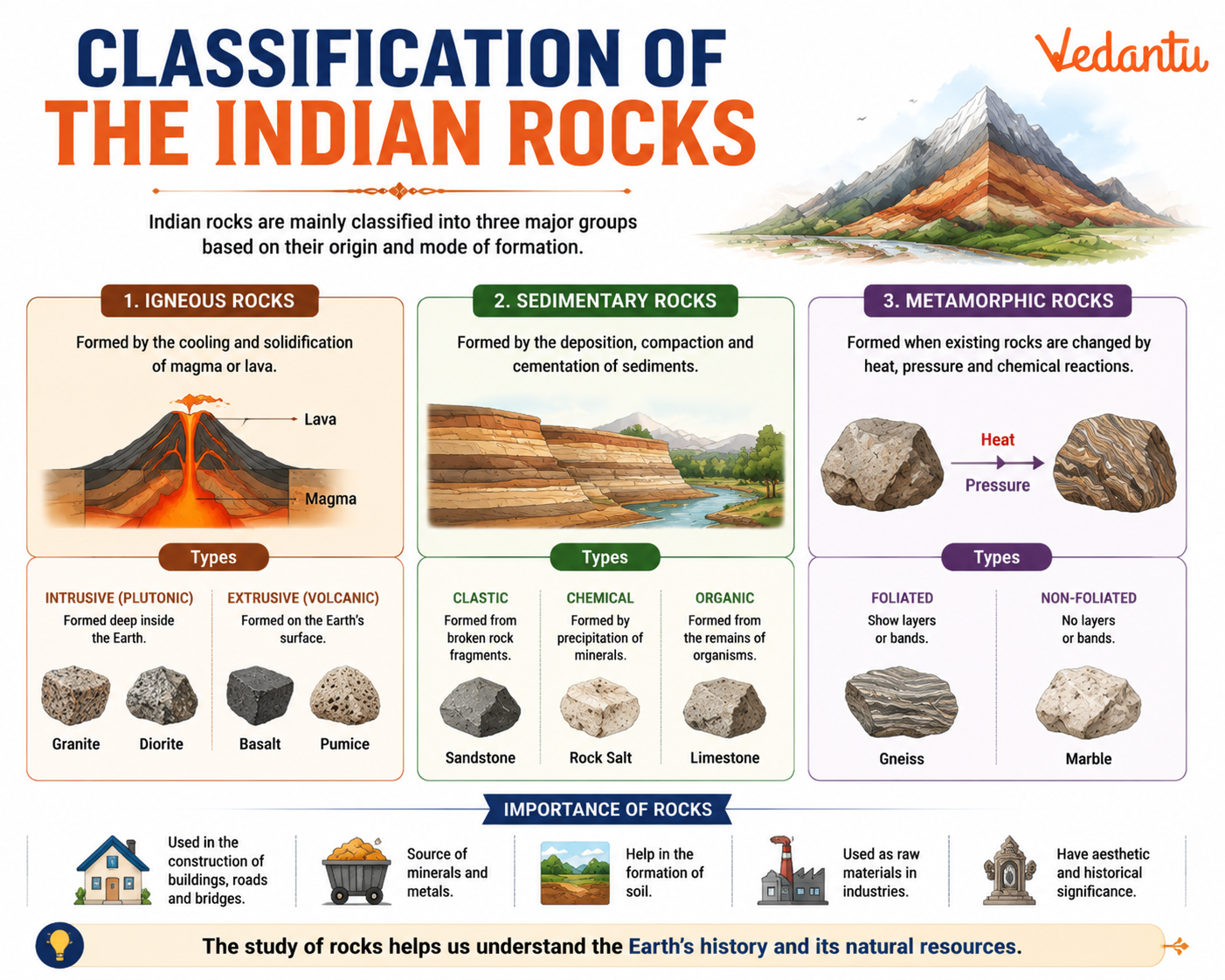
Rocks are naturally occurring solid aggregates of minerals that form the Earth’s crust. They differ in texture, composition, structure, and origin. In India, rocks are broadly classified into three major types based on their mode of formation - Igneous rocks, Sedimentary rocks, and Metamorphic rocks.
Major Classification of the Indian Rocks
Types of Rocks in India
| Type of Rock | Mode of Formation | Examples in India |
|---|---|---|
| Igneous Rocks | Formed by cooling and solidification of magma or lava | Basalt, Granite, Deccan Trap |
| Sedimentary Rocks | Formed by deposition and compaction of sediments | Sandstone, Limestone, Shale |
| Metamorphic Rocks | Formed by transformation of existing rocks under heat and pressure | Marble, Slate, Quartzite |
Each of these rock types plays a significant role in shaping India’s physical features and providing valuable mineral resources.
Igneous Rocks in India
Igneous rocks are also known as primary rocks because they are the first rocks formed from molten material. They are hard and resistant to weathering.
Types of Igneous Rocks
- Intrusive Igneous Rocks - Formed when magma cools slowly beneath the Earth’s surface. Example: Granite.
- Extrusive Igneous Rocks - Formed when lava cools quickly on the surface. Example: Basalt.
Distribution in India
- The Deccan Plateau is mainly composed of basalt rocks known as the Deccan Trap.
- Granite rocks are widely found in Rajasthan, Jharkhand, and parts of South India.
Sedimentary Rocks in India
Sedimentary rocks are formed by the accumulation and compaction of sediments over long periods. These rocks often contain fossils and are layered in structure.
Characteristics
- Generally soft and porous in nature.
- Often contain fossil remains of plants and animals.
- Form major plains and river basins.
Distribution in India
- The Indo-Gangetic Plain consists largely of sedimentary deposits.
- Limestone deposits are found in Madhya Pradesh, Chhattisgarh, and Andhra Pradesh.
- Sandstone is common in Rajasthan.
Metamorphic Rocks in India
Metamorphic rocks are formed when existing igneous or sedimentary rocks are subjected to intense heat and pressure. This process changes their physical and chemical properties.
Types of Metamorphism
- Contact Metamorphism - Caused by heat from nearby magma.
- Regional Metamorphism - Caused by large scale pressure and temperature changes.
Distribution in India
- Marble is found in Rajasthan, especially Makrana.
- Slate is common in Himachal Pradesh and Uttarakhand.
- Quartzite is widely distributed in the Aravalli Range.
Geological Divisions of India Based on Rock Systems
Apart from classification by origin, Indian rocks are also classified based on geological time periods. These are known as rock systems.
- Archaean Rock System - The oldest rocks found in the Peninsular Plateau.
- Gondwana Rock System - Known for coal deposits in Jharkhand and West Bengal.
- Deccan Trap - Formed by volcanic activity during the Cretaceous period.
- Recent Alluvium - Found in the Northern Plains formed by river deposits.
Importance of Classification of Indian Rocks
The classification of Indian rocks is significant for understanding natural resources and landforms. It helps in mineral exploration, construction planning, soil analysis, and environmental studies.
- Helps identify mineral rich regions.
- Explains formation of mountains, plateaus, and plains.
- Important for disaster management and land use planning.
- Useful for competitive exams and academic studies.
Preparation Tips for Competitive Exams
For exams like NEET and other competitive tests, students should focus on understanding the differences between igneous, sedimentary, and metamorphic rocks along with their examples and distribution in India.
- Learn the definitions and characteristics of each rock type.
- Remember important examples and their locations in India.
- Understand geological rock systems like Archaean and Gondwana.
- Practice multiple choice questions related to rock classification.
Conclusion
The Classification of the Indian Rocks provides a clear understanding of the geological structure of India. By studying igneous, sedimentary, and metamorphic rocks along with major rock systems, students can better understand the formation of landforms and distribution of minerals in India. This topic holds great importance in General Knowledge and competitive examinations, making it essential for thorough preparation.
FAQs on Classification of Rocks in India and Their Major Types
1. What are the main classifications of Indian rocks?
The classification of Indian rocks is mainly based on their origin into three major types.
• Igneous Rocks – Formed from solidified magma or lava (e.g., Basalt, Granite).
• Sedimentary Rocks – Formed by deposition of sediments (e.g., Sandstone, Limestone).
• Metamorphic Rocks – Formed when existing rocks change due to heat and pressure (e.g., Marble, Gneiss).
These rock types are important for Indian geography, UPSC, SSC, and state PSC exams.
2. What are igneous rocks and where are they found in India?
Igneous rocks are formed from the cooling and solidification of magma or lava.
• Also called Primary Rocks.
• Two types: Intrusive (Granite) and Extrusive (Basalt).
• Major example: Deccan Traps in Maharashtra (Basalt plateau).
• Rich in minerals like iron, magnesium.
They form the base of the Peninsular Plateau of India.
3. What are sedimentary rocks and how are they formed?
Sedimentary rocks are formed by the deposition and compaction of sediments over time.
• Created by weathering, erosion, and deposition.
• Often contain fossils.
• Examples: Sandstone, Limestone, Shale.
• Found in the Indo-Gangetic Plains and river basins.
They are economically important for coal, petroleum, and natural gas resources.
4. What are metamorphic rocks and how are they formed?
Metamorphic rocks are formed when existing rocks undergo physical and chemical changes due to heat and pressure.
• Process called Metamorphism.
• Igneous or sedimentary rocks transform into new forms.
• Examples: Marble (from Limestone), Slate (from Shale).
• Found in the Himalayan region and parts of Rajasthan.
These rocks are widely used in construction and sculpture.
5. Why are the Deccan Traps important in Indian rock classification?
The Deccan Traps are one of the largest volcanic formations in the world.
• Formed from massive volcanic eruptions.
• Made primarily of Basalt (igneous rock).
• Cover parts of Maharashtra, Gujarat, and Madhya Pradesh.
• Important for black cotton soil formation.
They play a key role in understanding volcanic activity and Peninsular India geology.
6. What is the economic importance of Indian rocks?
Indian rocks are economically significant due to their rich mineral resources.
• Igneous rocks – Source of metallic minerals like iron and copper.
• Sedimentary rocks – Contain coal, petroleum, limestone.
• Metamorphic rocks – Used in building materials like marble.
They support industries such as mining, cement, and construction in India.
7. How does the rock cycle relate to the classification of Indian rocks?
The rock cycle explains how rocks continuously change from one type to another.
• Magma cools to form Igneous rocks.
• Weathering forms Sedimentary rocks.
• Heat and pressure create Metamorphic rocks.
This cycle helps students understand Indian rock formation, geological processes, and landforms.
8. Which regions of India have ancient rocks?
The oldest rocks in India are found in the Peninsular Plateau.
• Composed mainly of igneous and metamorphic rocks.
• Includes regions like Karnataka, Tamil Nadu, and Chotanagpur Plateau.
• Belong to the Archaean rock system.
These ancient formations are rich in metallic minerals.
9. What are the differences between igneous, sedimentary, and metamorphic rocks?
The three rock types differ based on their origin and characteristics.
• Igneous – Formed from magma; hard and crystalline.
• Sedimentary – Layered; formed from sediments; may contain fossils.
• Metamorphic – Formed by transformation due to heat and pressure.
Understanding these differences is crucial for geography exams and general knowledge.
10. Why is the study of Indian rocks important for competitive exams?
The study of Classification of Indian Rocks is important for scoring well in competitive exams.
• Frequently asked in UPSC, SSC, Railways, and State PSC exams.
• Helps in understanding Indian physiography and mineral distribution.
• Connected to topics like rock cycle, soil formation, and natural resources.
It builds strong fundamentals in Indian Geography and Earth Science.
