






List of Major Civilian Honour Awards in India and Their Criteria
Civil Honors Awards in India are among the highest recognitions given by the Government of India to individuals for their exceptional contributions in various fields such as arts, literature, science, public service, sports, and social work. These awards celebrate excellence and service to the nation without distinction of race, occupation, position, or gender. Established in 1954, civil honors play a significant role in acknowledging outstanding achievements that inspire society and promote national pride.
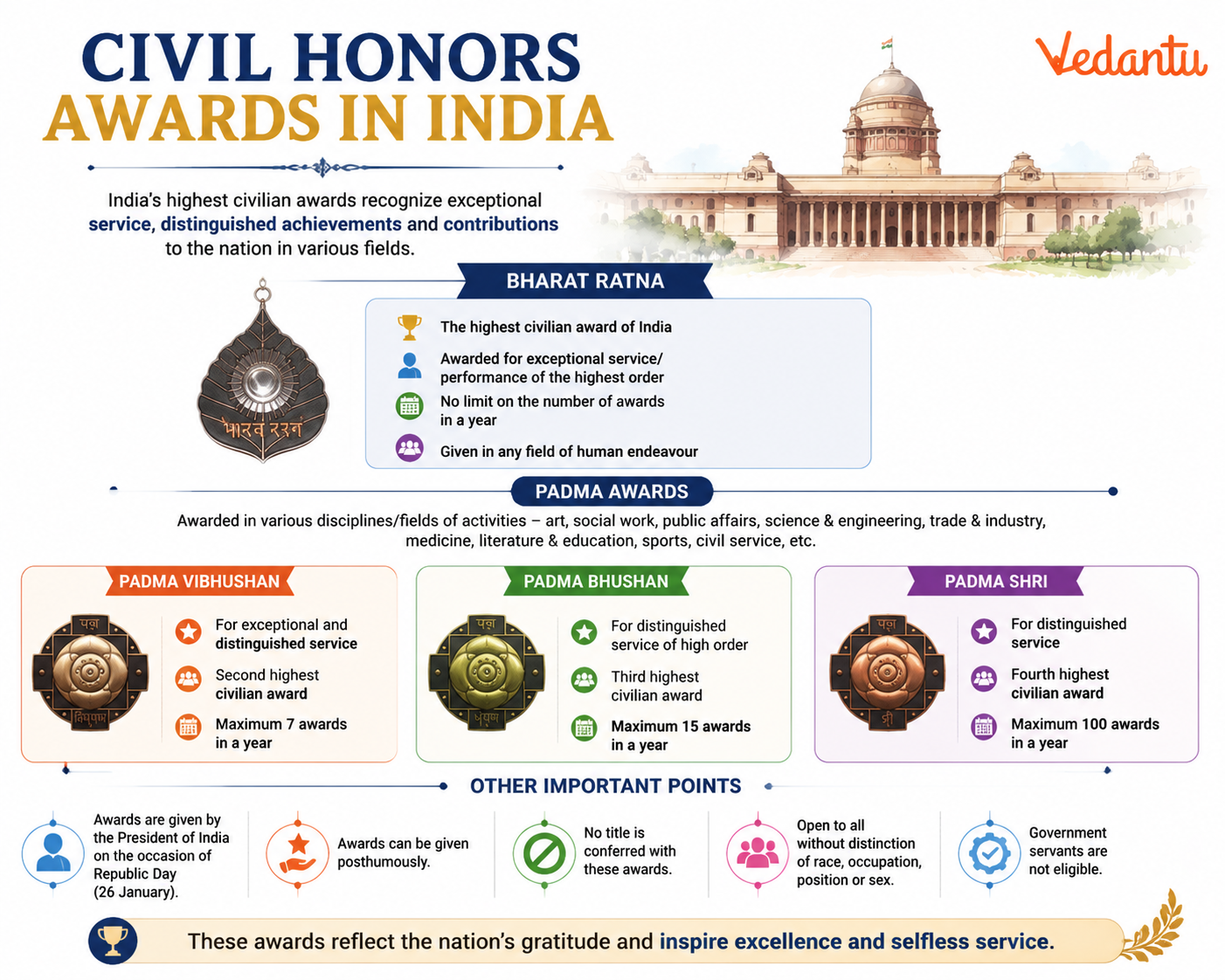
Overview of Civil Honors Awards in India
Civil honors are national awards presented annually by the President of India. The recommendations for these awards are made by the Prime Minister and the Union Government. The awards are announced every year on the eve of Republic Day, 26 January.
These awards are divided into two main categories:
- Bharat Ratna
- Padma Awards - Padma Vibhushan, Padma Bhushan, and Padma Shri
Major Civilian Awards of India
| Award Name | Year Started | Significance |
|---|---|---|
| Bharat Ratna | 1954 | Highest Civilian Award in India |
| Padma Vibhushan | 1954 | Second Highest Civilian Award |
| Padma Bhushan | 1954 | Third Highest Civilian Award |
| Padma Shri | 1954 | Fourth Highest Civilian Award |
The Bharat Ratna is the most prestigious civilian award, followed by the three categories of Padma Awards in descending order of importance.
Bharat Ratna
The Bharat Ratna is the highest civilian award of India. It was instituted in 1954 to recognize exceptional service towards the advancement of art, literature, science, and public service. Later, the scope was expanded to include achievements in any field of human endeavor.
Key Features
- Awarded by the President of India
- Maximum of three awards per year
- No monetary grant attached
- Can be awarded posthumously
Padma Awards
The Padma Awards were instituted in 1954 and are announced annually on Republic Day. They recognize achievements in various disciplines such as social work, arts, public affairs, science and engineering, medicine, literature, sports, civil service, and trade and industry.
Categories of Padma Awards
- Padma Vibhushan - For exceptional and distinguished service
- Padma Bhushan - For distinguished service of high order
- Padma Shri - For distinguished service in any field
Important Points About Padma Awards
- Open to all individuals regardless of nationality
- Government servants are not eligible except doctors and scientists
- Nominations can be made by citizens
- No titles are conferred by these awards as per Article 18 of the Indian Constitution
Eligibility and Selection Process
The selection process for civil honors is rigorous and transparent. Nominations are received from state governments, union territories, ministries, previous awardees, and the general public. A committee constituted by the Prime Minister reviews the nominations and submits recommendations to the President of India.
General Eligibility Criteria
- Exceptional service in respective fields
- High standards of excellence and integrity
- Contribution benefiting the nation or humanity
Importance of Civil Honors Awards
Civil honors serve multiple purposes in a democratic society. They recognize and reward excellence, encourage citizens to contribute positively to society, and strengthen national unity. These awards also highlight the diversity of achievements across various fields and inspire future generations.
- Promote national integration
- Encourage excellence and innovation
- Recognize unsung heroes from rural and remote areas
- Enhance India's global image
Frequently Asked Questions on Civil Honors Awards
When were Civil Honors Awards started in India?
Civil Honors Awards were instituted in 1954.
Who presents the Civilian Awards in India?
The President of India presents these awards at a ceremonial function held at Rashtrapati Bhavan.
Is there any monetary reward associated with these awards?
No, civil honors awards do not carry any monetary grant.
Can a person receive more than one Padma Award?
Yes, a person can receive a higher category Padma Award in subsequent years, but not the same category again.
Conclusion
Civil Honors Awards in India represent the highest form of national recognition for outstanding contributions across diverse fields. From the Bharat Ratna to the Padma Shri, these awards celebrate excellence, dedication, and service to the nation. Understanding these awards is essential for students preparing for competitive exams and for anyone interested in India's governance and recognition system. These honors reflect the values, diversity, and achievements of the nation.
FAQs on Civil Honors Awards in India: Meaning, Types and Importance
1. What are Civilian Honors Awards in India?
The Civilian Honors Awards in India are national awards given to recognize exceptional service and achievements in various fields.
• Instituted in 1954 by the Government of India
• Conferred by the President of India
• Include Bharat Ratna, Padma Vibhushan, Padma Bhushan, and Padma Shri
• Awarded for excellence in arts, literature, science, public service, sports, and social work
These awards are often searched under terms like national awards of India, highest civilian awards, and Indian honor system.
2. Which is the highest civilian award in India?
The Bharat Ratna is the highest civilian award in India.
• Established in 1954
• Awarded for exceptional service towards advancement of art, literature, science, and public service
• Can be given to Indian citizens and foreign nationals
• Not limited to any specific field
It is commonly searched as India’s top civilian honour and highest national award.
3. What are the different types of Padma Awards?
The Padma Awards are divided into three categories based on the level of contribution.
• Padma Vibhushan – For exceptional and distinguished service
• Padma Bhushan – For distinguished service of high order
• Padma Shri – For distinguished service in any field
These awards form an important part of India's civilian honours system and are announced every year on Republic Day.
4. Who gives Civilian Awards in India?
The President of India presents Civilian Awards during a formal ceremony at Rashtrapati Bhavan.
• Recommendations are made by the Prime Minister
• Nominations are reviewed by a special awards committee
• Awards are usually presented in March or April
This process ensures transparency and national recognition of outstanding citizens.
5. When were the Civilian Honors Awards started in India?
The Civilian Honors Awards were started in 1954 after India became a republic.
• Bharat Ratna and Padma Awards were introduced the same year
• Briefly suspended between 1977 and 1980
• Reintroduced due to public demand and national importance
They remain key national awards in India’s honour system.
6. Can a foreigner receive India's civilian awards?
Yes, foreigners are eligible to receive certain Indian civilian awards.
• Bharat Ratna has been awarded to foreign nationals
• Example: Khan Abdul Ghaffar Khan and Nelson Mandela
• Padma Awards may also be given to non-resident Indians and foreigners
This highlights India’s global recognition of excellence and international contributions.
7. Are Civilian Awards titles in India?
No, Civilian Awards are not titles and cannot be used as prefixes or suffixes.
• Article 18 of the Indian Constitution prohibits titles
• Awardees cannot use titles like Sir or Bharat Ratna before their names
• They are honors, not hereditary distinctions
This ensures equality and constitutional values in the Indian awards system.
8. What fields are considered for Civilian Honors in India?
Civilian Honors in India cover a wide range of fields.
• Arts and Culture
• Literature and Education
• Science and Engineering
• Sports and Medicine
• Social Work and Public Affairs
The awards recognize outstanding achievements and contributions to nation-building and public service.
9. How are people nominated for Padma Awards?
Anyone can nominate a deserving person for the Padma Awards through an online process.
• Nominations are submitted on the official government portal
• Self-nomination is allowed
• Reviewed by the Padma Awards Committee
• Final approval by the President of India
This transparent system encourages public participation in national recognition.
10. What is the difference between Bharat Ratna and Padma Awards?
The main difference lies in the level of recognition and prestige.
• Bharat Ratna is the highest civilian award in India
• Padma Awards are categorized into three levels
• Bharat Ratna is awarded for exceptional national service of the highest order
• Padma Awards recognize distinguished contributions in specific fields
Both are key components of India’s national honours and civilian awards system.
