






How the Chola Administrative Structure Managed Provinces and Villages
The Chola Administration was one of the most efficient and well-organized systems of governance in medieval Indian history. The Chola dynasty, which ruled parts of South India from the 9th to the 13th century, is especially known for its strong central authority, effective local self-government, systematic revenue collection, and military strength. Under rulers like Rajaraja I and Rajendra I, the Chola Empire expanded widely and maintained a stable administrative structure. The administrative system of the Cholas is considered advanced for its time because it combined central control with local autonomy.
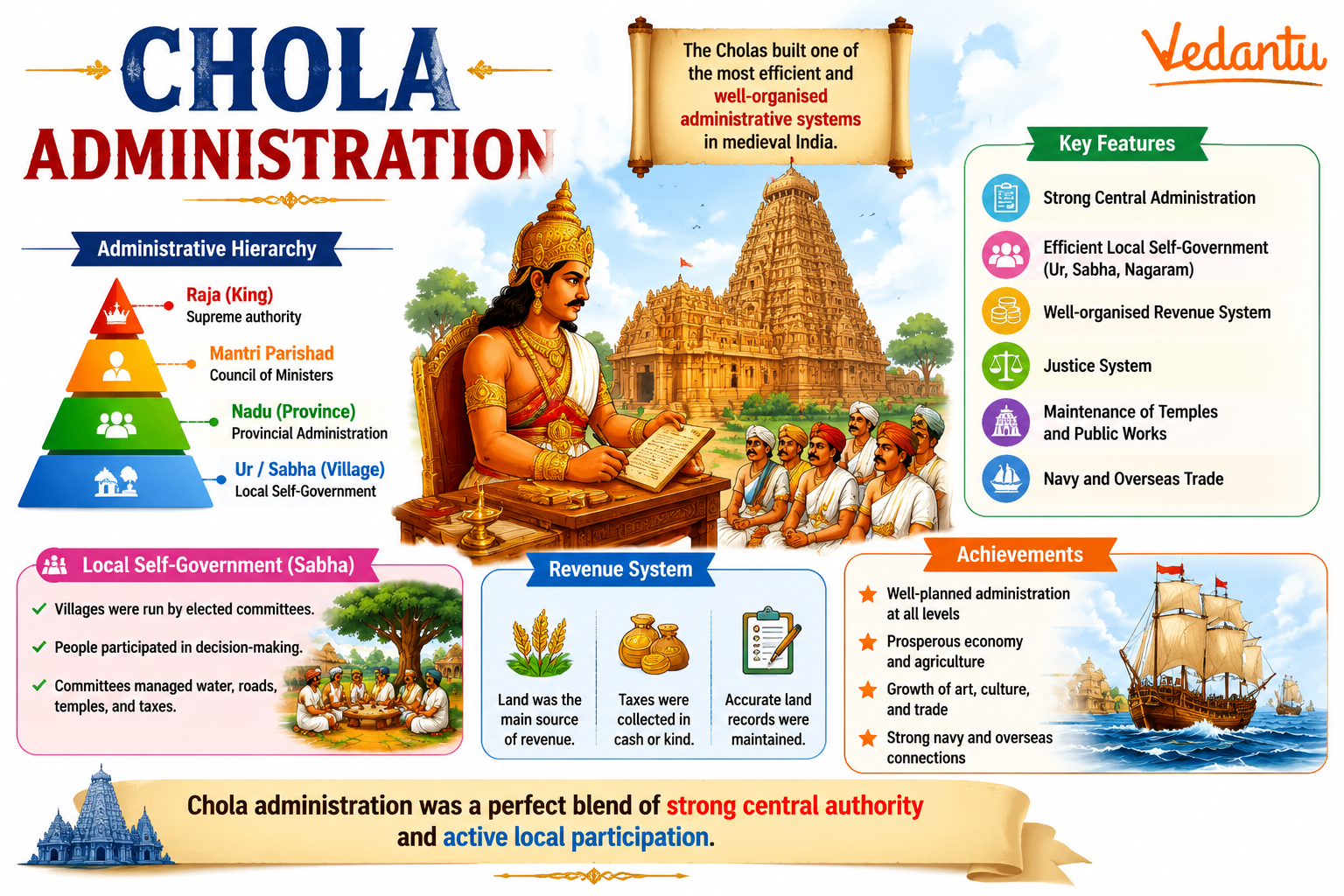
Features of Chola Administration
The Chola administrative system was highly organized and hierarchical. It ensured smooth governance across a vast empire through proper division of territories and clear delegation of powers.
- Strong central monarchy with the king as the supreme authority
- Well-defined territorial divisions for effective administration
- Efficient revenue system based mainly on land tax
- Active local self-government in villages
- Powerful army and navy for expansion and protection
Central Administration
The king was the head of the Chola administration. He held absolute power and was responsible for law, order, justice, and military affairs. The Chola rulers believed in divine kingship and were often associated with gods. However, they were assisted by a council of ministers in governance.
Role of the King
- Supreme commander of the army
- Head of the judicial system
- Controller of revenue and expenditure
- Appointer of high officials
Council of Ministers
The king was assisted by ministers and high officials who helped in administrative duties. These officials were usually appointed from royal families or trusted nobles. They advised the king but final decisions were taken by the ruler.
Provincial Administration
For administrative convenience, the Chola Empire was divided into different units. Each unit had its own officials to maintain order and collect revenue.
Administrative Divisions under the Cholas
| Administrative Unit | Head/Authority | Function |
|---|---|---|
| Mandalam (Province) | Governor or Royal Prince | Supervised large territorial area |
| Valanadu | Local Officials | Intermediate administrative division |
| Nadu | Nattar | Collection of villages and revenue management |
The empire was divided into Mandalams, which were further divided into Valanadus, Nadus, and villages. This systematic division helped in better supervision and efficient tax collection.
Village Administration
One of the most remarkable features of Chola administration was its efficient village self-government system. Villages enjoyed a significant degree of autonomy in managing local affairs.
Types of Village Assemblies
- Ur - Assembly of common people in non-Brahmin villages
- Sabha - Assembly of Brahmins in Brahmadeya villages
- Nagaram - Assembly of merchants in towns
Functions of Village Assemblies
- Maintenance of irrigation tanks and roads
- Collection of local taxes
- Settlement of disputes
- Management of temples and educational institutions
The Uttaramerur inscriptions provide detailed information about the election process of village committees. Members were selected through a system called Kudavolai, which ensured fair representation.
Revenue System
Land revenue was the primary source of income for the Chola state. The land was carefully surveyed and classified based on fertility and irrigation facilities. Taxes were generally collected in the form of produce.
- Land tax was the main source of revenue
- Professional taxes and customs duties were also collected
- Revenue supported the army, administration, and temple construction
Military Administration
The Cholas maintained a strong and disciplined army. Their military strength played a crucial role in territorial expansion and protection of trade routes.
- Well-organized infantry, cavalry, and elephant corps
- Powerful navy for overseas expeditions
- Military cantonments established in strategic locations
The Chola navy helped in controlling trade in the Bay of Bengal and led expeditions to Sri Lanka and Southeast Asia.
Judicial System
Justice was administered at different levels. Minor disputes were settled at the village level, while serious cases were handled by higher authorities. Punishments varied from fines to corporal punishment depending on the offense.
Significance of Chola Administration
The Chola administrative system stands out in Indian history due to its efficiency and decentralization. The balance between central authority and local autonomy ensured stability and prosperity. The advanced village self-government system is often considered a precursor to modern local governance in India.
- Promoted agricultural development through irrigation management
- Encouraged local participation in governance
- Supported cultural and temple architecture growth
- Strengthened trade and maritime activities
In conclusion, the Chola Administration was a well-structured and progressive system that contributed significantly to the success and longevity of the Chola Empire. Its organized central governance, efficient revenue collection, strong military, and remarkable village self-government make it an important topic in Indian history and General Knowledge studies.
FAQs on Chola Administration System in Medieval South India
1. What was the main feature of the Chola administration?
The main feature of the Chola administration was its highly organized and decentralized system of governance.
• The empire was divided into Mandalam (province), Valanadu (district), Nadu, and Gramam (village).
• Strong local self-government was practiced, especially at the village level.
• Efficient revenue administration and land surveys ensured proper taxation.
• The king was the supreme authority but worked with ministers and officials.
This structured political system made the Chola Empire one of the most efficient administrations in medieval India.
2. How was the Chola Empire divided for administrative purposes?
The Chola Empire was divided into several administrative units for effective governance.
• Mandalam – Province ruled by royal princes or governors.
• Valanadu – Subdivision of a province.
• Nadu – Group of villages functioning as a revenue unit.
• Gramam – The smallest unit, meaning village.
This multi-tier administrative division ensured smooth functioning of the Chola government system and better control over territories.
3. What was the role of the king in Chola administration?
The Chola king was the supreme head of the administration, army, and judiciary.
• Held titles like Rajaraja I and Rajendra I.
• Issued royal orders and supervised revenue collection.
• Appointed ministers and high officials.
• Acted as the final authority in judicial matters.
The king played a central role in maintaining political stability and expanding the Chola Empire.
4. What was the importance of village administration in the Chola period?
Village administration was the backbone of the Chola administrative system.
• Villages functioned as self-governing units called Ur and Sabha.
• Managed local affairs like irrigation, justice, and tax collection.
• Maintained detailed records of land and revenue.
• Demonstrated early forms of local self-government in India.
This decentralized governance made the Chola administration unique and efficient.
5. What was the Sabha system in Chola administration?
The Sabha was an assembly of Brahmin landowners that managed village administration.
• Found in Brahmadeya villages.
• Members were selected through the Kudavolai system (lottery method).
• Handled revenue, irrigation, justice, and temple management.
• Maintained written records and accounts.
The Sabha system reflects the advanced and democratic features of Chola local governance.
6. What was the Kudavolai system in the Chola Empire?
The Kudavolai system was a unique method of selecting village committee members through a lottery.
• Names were written on palm leaves and placed in a pot (Kudam).
• A child picked the names randomly.
• Ensured fair and transparent selection.
• Applied mainly in Sabha assemblies.
This method highlights the democratic aspects of the Chola administrative system.
7. How was revenue collected in the Chola administration?
Revenue in the Chola Empire was mainly collected from land taxes.
• Land revenue was the primary source of income.
• Regular land surveys were conducted for accurate assessment.
• Taxes were collected in cash or kind.
• Other sources included trade tax and customs duties.
Efficient revenue management strengthened the economic foundation of the Chola kingdom.
8. What role did irrigation play in Chola administration?
Irrigation was crucial for agriculture and revenue in the Chola period.
• Construction of tanks, canals, and reservoirs like the Grand Anicut (Kallanai).
• Village committees managed water distribution.
• Boosted agricultural productivity.
• Increased land revenue collection.
Strong irrigation policies contributed to the prosperity of the Chola agricultural economy.
9. How was the judicial system organized in the Chola Empire?
The judicial system in the Chola Empire functioned at both central and village levels.
• Village assemblies settled minor disputes.
• Serious cases were referred to higher authorities or the king.
• Punishments included fines and property confiscation.
• Legal decisions were recorded in inscriptions.
This organized judicial structure ensured law and order under the Chola rule.
10. Why is the Chola administration considered advanced in medieval India?
The Chola administration is considered advanced due to its decentralization, efficient revenue system, and local self-governance.
• Well-defined administrative divisions.
• Democratic features like the Kudavolai system.
• Strong village assemblies (Sabha, Ur).
• Effective irrigation and revenue management.
Because of these features, the Chola administrative system is often studied in Indian history and competitive exams as a model of efficient governance.
