






List of British India Viceroys with Major Reforms and Years (1858–1947)
The British Viceroys of India played a crucial role in shaping the political, administrative, economic, and social structure of India during British rule. The position of Viceroy was officially created in 1858 after the Revolt of 1857, when the British Crown took direct control from the East India Company. From 1858 to 1947, Viceroys acted as representatives of the British monarch in India and were responsible for implementing imperial policies. Understanding the British Viceroys during British India is essential for students and competitive exam aspirants, as many major reforms, acts, wars, and movements are directly associated with their tenure.
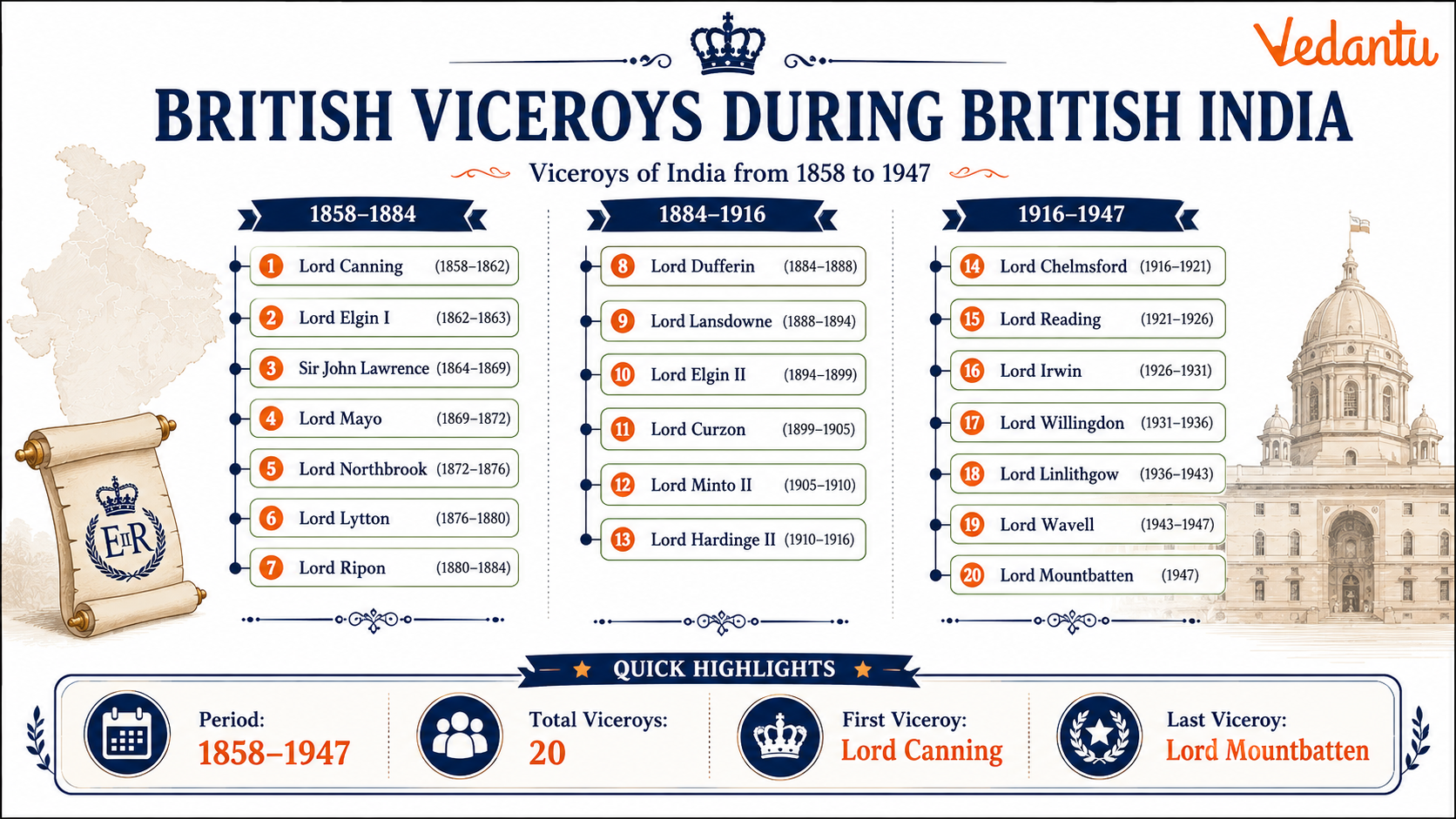
Who Was a Viceroy?
A Viceroy was the highest official appointed by the British Crown to govern India. The office replaced the position of Governor-General of India after 1858, although the same person continued to hold both titles. The Viceroy represented the British monarch and had executive, legislative, and military authority in India.
Key Responsibilities of a Viceroy
- Implementing British government policies in India
- Maintaining law and order across the provinces
- Supervising administration and revenue collection
- Handling relations with princely states
- Responding to nationalist movements and political reforms
Major British Viceroys During British India
| Viceroy | Tenure | Major Events and Reforms |
|---|---|---|
| Lord Canning | 1858 - 1862 | First Viceroy, Indian Councils Act 1861 |
| Lord Lytton | 1876 - 1880 | Vernacular Press Act 1878, Delhi Durbar |
| Lord Ripon | 1880 - 1884 | Local Self Government, Ilbert Bill |
| Lord Curzon | 1899 - 1905 | Partition of Bengal 1905 |
| Lord Hardinge II | 1910 - 1916 | Capital shifted to Delhi 1911 |
| Lord Chelmsford | 1916 - 1921 | Government of India Act 1919, Jallianwala Bagh |
| Lord Irwin | 1926 - 1931 | Simon Commission, Gandhi Irwin Pact |
| Lord Linlithgow | 1936 - 1943 | Government of India Act 1935 implemented, Quit India Movement |
| Lord Mountbatten | 1947 | Partition of India, Indian Independence Act 1947 |
The above Viceroys were directly associated with significant developments in Indian history. Their policies influenced administrative reforms, economic systems, and the rise of Indian nationalism.
Important Policies and Acts Under Viceroys
Indian Councils Act 1861
Introduced during Lord Canning's tenure, this Act expanded the legislative councils and included Indians in the law-making process in a limited capacity.
Vernacular Press Act 1878
Passed under Lord Lytton, this Act restricted the freedom of Indian language newspapers and aimed to suppress criticism of British policies.
Ilbert Bill Controversy 1883
During Lord Ripon's tenure, the Ilbert Bill proposed allowing Indian judges to try European offenders. It faced strong opposition from the British community in India.
Partition of Bengal 1905
Implemented by Lord Curzon, Bengal was divided for administrative reasons but was widely seen as a divide and rule policy. It triggered the Swadeshi Movement.
Government of India Act 1919
Also known as the Montagu Chelmsford Reforms, it introduced dyarchy in provinces during Lord Chelmsford's period.
Government of India Act 1935
Implemented during Lord Linlithgow's tenure, this Act provided provincial autonomy and laid the foundation for the federal structure later adopted in independent India.
Role of Viceroys in Indian National Movement
The actions of British Viceroys directly influenced the growth of the Indian freedom struggle. Repressive laws, economic exploitation, and racial discrimination led to mass movements across the country.
- Partition of Bengal led to the Swadeshi and Boycott Movements
- Rowlatt Act during Lord Chelmsford intensified protests
- Civil Disobedience Movement during Lord Irwin
- Quit India Movement during Lord Linlithgow
- Partition and Independence under Lord Mountbatten
Difference Between Governor-General and Viceroy
Although the same person often held both titles, there was a conceptual difference between Governor-General and Viceroy.
- Governor-General was the administrative head of British territories in India
- Viceroy represented the British monarch in relations with princely states
- The title Viceroy was used after 1858
Why British Viceroys Are Important for Competitive Exams
Questions related to British Viceroys frequently appear in competitive exams such as UPSC, SSC, State PSC, and other government examinations. Students are often asked to match Viceroys with important events, reforms, and acts passed during their tenure.
Preparation Tips
- Prepare a timeline of Viceroys from 1858 to 1947
- Associate each Viceroy with 2 to 3 major events
- Revise important Acts passed during their tenure
- Practice previous year questions for better retention
Conclusion
The British Viceroys during British India were central figures in shaping the political and administrative history of the country. From Lord Canning, the first Viceroy, to Lord Mountbatten, the last Viceroy who oversaw independence and partition, each played a significant role in India's colonial journey. Understanding their tenure, policies, and impact provides valuable insight into the evolution of modern India and is essential for academic and competitive exam preparation.
FAQs on British Viceroys of British India: Timeline and Key Policies
1. Who were the British Viceroys in India?
The British Viceroys in India were representatives of the British Crown who governed India from 1858 to 1947 after the Revolt of 1857.
• The first Viceroy was Lord Canning (1858–1862).
• The last Viceroy was Lord Mountbatten (1947).
• They replaced the earlier Governor-Generals of the East India Company.
• Their role included administration, law-making, and implementing British colonial policies in British India.
2. Who was the first Viceroy of India?
The first Viceroy of India was Lord Canning, appointed in 1858 after the Government of India Act 1858.
• He previously served as the last Governor-General of India.
• He handled the aftermath of the Revolt of 1857.
• Introduced important reforms like the Indian Councils Act 1861.
• Known for his moderate policies toward Indian rulers.
3. Who was the last Viceroy of India?
The last Viceroy of India was Lord Louis Mountbatten, who oversaw India’s independence in 1947.
• Implemented the Mountbatten Plan.
• Supervised the Partition of India and Pakistan.
• Became the first Governor-General of independent India.
• Played a key role in transferring power from British rule.
4. What was the role of the Viceroy in British India?
The Viceroy of India acted as the supreme representative of the British Crown and head of administration in colonial India.
• Implemented British laws and policies.
• Controlled the Indian Civil Services (ICS).
• Managed foreign relations and princely states.
• Presided over the Executive Council and legislative matters.
5. Which Viceroy partitioned Bengal in 1905?
The Partition of Bengal (1905) was carried out by Lord Curzon during his tenure as Viceroy.
• Aimed at administrative efficiency but seen as a divide-and-rule policy.
• Sparked the Swadeshi Movement.
• Intensified the Indian National Movement.
• Annulled in 1911 due to widespread protests.
6. Which Viceroy introduced the Indian Councils Act of 1909?
The Indian Councils Act 1909, also called the Morley-Minto Reforms, was introduced during Lord Minto II’s tenure.
• Provided separate electorates for Muslims.
• Expanded legislative councils.
• Marked the beginning of communal representation in India.
• Aimed to increase Indian participation in governance.
7. Which Viceroy was associated with the Jallianwala Bagh massacre?
The Jallianwala Bagh massacre (1919) occurred during the tenure of Lord Chelmsford.
• Incident took place in Amritsar.
• Ordered by General Reginald Dyer.
• Linked with the repressive Rowlatt Act.
• Intensified the Non-Cooperation Movement led by Mahatma Gandhi.
8. Which Viceroy announced the partition of India in 1947?
The Partition of India in 1947 was announced by Lord Mountbatten under the Mountbatten Plan.
• Led to the creation of India and Pakistan.
• Resulted in large-scale migration and communal violence.
• Marked the end of British colonial rule in India.
• Implemented under the Indian Independence Act 1947.
9. Which Viceroy shifted the capital from Calcutta to Delhi?
The capital of British India was shifted from Calcutta to Delhi in 1911 during the tenure of Lord Hardinge II.
• Decision announced at the Delhi Durbar (1911).
• Aimed at better administrative control.
• Delhi became the new political center of British India.
• Strengthened imperial symbolism and authority.
10. What is the difference between a Governor-General and a Viceroy?
The main difference between a Governor-General and a Viceroy lies in their authority and period of rule in India.
• Governor-General (1773–1858) represented the East India Company.
• Viceroy (1858–1947) represented the British Crown.
• The change occurred after the Government of India Act 1858.
• Both were heads of administration in colonial India.
