






How to Use Positive, Comparative and Superlative Forms in English for Classes 8, 9 and 10
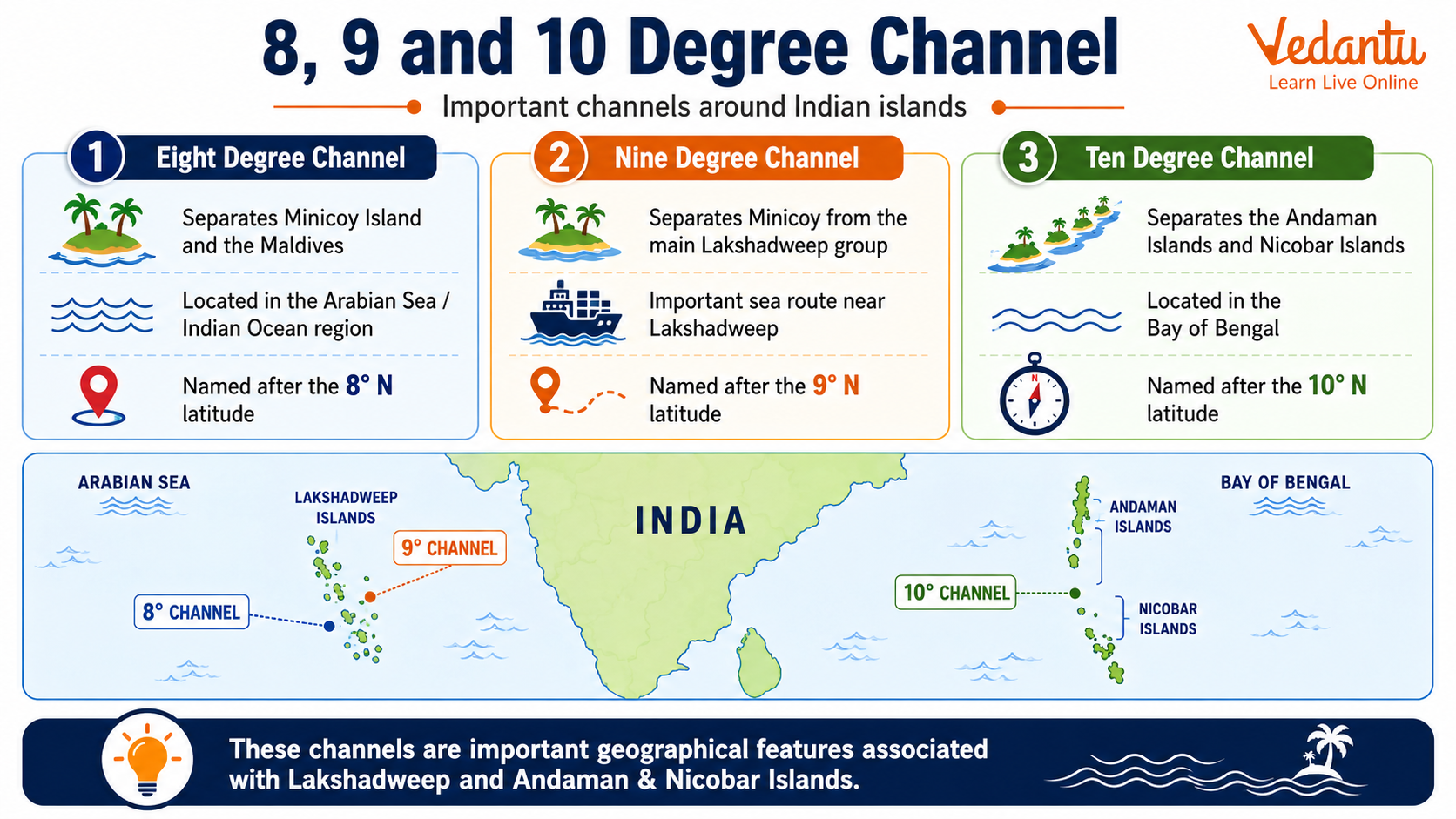
The 8 Degree Channel, 9 Degree Channel, and 10 Degree Channel are important geographical water bodies located in the Indian Ocean region. These channels are significant in physical geography, maritime navigation, ocean currents, and strategic defense studies. They separate major island groups and play a crucial role in international trade routes and geopolitical importance. Understanding these channels is essential for students preparing for competitive exams like UPSC, SSC, NDA, CDS, and other government examinations.
What is a Degree Channel?
A degree channel is a stretch of water that lies between two landmasses and is named according to the latitude line that passes through it. The number indicates the approximate degree of latitude at which the channel is located. These channels are important for navigation, climatic influence, and strategic military significance.
8 Degree Channel
The 8 Degree Channel lies approximately along the 8 degree north latitude. It separates the Minicoy Island of Lakshadweep (India) from the Maldives. This channel is an important maritime boundary between India and the Maldives.
Key Features of 8 Degree Channel
- Located between Minicoy Island and Maldives
- Situated at approximately 8 degree north latitude
- Acts as a maritime boundary between India and Maldives
- Important for international shipping routes
- Strategically significant for Indian Ocean security
9 Degree Channel
The 9 Degree Channel lies near the 9 degree north latitude. It separates the Lakshadweep Islands from Minicoy Island. This channel is entirely within Indian territory and plays an important role in domestic maritime movement.
Key Features of 9 Degree Channel
- Separates Minicoy Island from the rest of Lakshadweep Islands
- Located at approximately 9 degree north latitude
- Falls completely within Indian territorial waters
- Important for local shipping and fishing activities
- Strategically important for coastal surveillance
10 Degree Channel
The 10 Degree Channel lies along the 10 degree north latitude. It separates the Andaman Islands from the Nicobar Islands in the Bay of Bengal. This is one of the most important channels in India due to its strategic and naval importance.
Key Features of 10 Degree Channel
- Separates Andaman Islands and Nicobar Islands
- Located at approximately 10 degree north latitude
- Situated in the Bay of Bengal
- Very important for Indian naval operations
- Close to major international sea routes like Malacca Strait
Comparison of 8, 9 and 10 Degree Channels
| Channel | Separates | Water Body |
|---|---|---|
| 8 Degree Channel | Minicoy Island and Maldives | Indian Ocean |
| 9 Degree Channel | Minicoy and Lakshadweep Islands | Arabian Sea |
| 10 Degree Channel | Andaman and Nicobar Islands | Bay of Bengal |
The table above clearly shows the geographical location and separation role of each channel. Among these, the 10 Degree Channel is considered highly strategic due to its proximity to major international shipping lanes.
Strategic and Economic Importance
These degree channels are not only geographical features but also play a vital role in maritime trade, national security, and regional diplomacy. The Indian Ocean region handles a significant portion of global trade, making these channels highly valuable.
- Ensure safe passage for commercial ships
- Important for naval patrol and surveillance
- Help in monitoring illegal fishing and smuggling
- Strengthen India maritime security framework
Exam Importance and Preparation Tips
Questions related to 8, 9 and 10 Degree Channels are frequently asked in competitive exams under Indian Geography and Current Affairs sections. Students should remember their location, the islands they separate, and their strategic importance.
Preparation Tips
- Mark these channels clearly on a political map of India.
- Revise island groups of Lakshadweep and Andaman and Nicobar.
- Understand their strategic importance in the Indian Ocean region.
- Practice previous year questions from Geography section.
Conclusion
The 8 Degree Channel, 9 Degree Channel, and 10 Degree Channel are crucial geographical features of India maritime boundaries. They separate important island groups and hold strategic, economic, and navigational value. A clear understanding of their location and importance helps students perform better in competitive examinations and strengthens their knowledge of Indian geography.
FAQs on English Classes 8, 9 & 10 Degrees of Comparison Explained
1. What is the 8 Degree Channel in India?
The 8 Degree Channel is a narrow sea channel that separates the Lakshadweep Islands (India) from the Maldives in the Indian Ocean.
• Located at approximately 8° North latitude
• Lies between Minicoy Island (Lakshadweep) and Maldives
• Important for international maritime trade routes
• Frequently asked in GK, UPSC, SSC, and State PSC exams
It is a key geographical feature in the Arabian Sea region and often appears in questions about Indian island geography.
2. What is the 9 Degree Channel?
The 9 Degree Channel is the water body that separates the Minicoy Island from the rest of the Lakshadweep Islands.
• Located at about 9° North latitude
• Divides Minicoy from the main Lakshadweep group
• Situated in the Arabian Sea
• Important for navigation and maritime geography
This channel is commonly asked in competitive exams under Indian geography and island separation topics.
3. What is the 10 Degree Channel?
The 10 Degree Channel separates the Andaman Islands from the Nicobar Islands in the Bay of Bengal.
• Located at approximately 10° North latitude
• Divides Andaman group (north) and Nicobar group (south)
• Strategically important for India’s naval operations
• Frequently asked in Indian geography GK questions
It is one of the most important sea channels in the Andaman and Nicobar region.
4. Why are the 8°, 9°, and 10° Channels important in competitive exams?
The 8°, 9°, and 10° Channels are important because they are key geographical separators of Indian islands.
• Commonly asked in UPSC, SSC, NDA, CDS, and State PSC exams
• Important for understanding Indian island geography
• Linked to questions on Indian Ocean, Arabian Sea, and Bay of Bengal
• Relevant in topics like maritime boundaries and strategic locations
These channels help students understand India’s physical geography and strategic maritime position.
5. Which channel separates Lakshadweep from Maldives?
The 8 Degree Channel separates Lakshadweep (India) from the Maldives.
• Located in the Indian Ocean
• Lies south of Minicoy Island
• Important international sea route
• Frequently asked in GK under Indian islands and neighboring countries
This channel marks an important maritime boundary between India and Maldives.
6. Which channel separates Andaman and Nicobar Islands?
The 10 Degree Channel separates the Andaman Islands from the Nicobar Islands.
• Situated in the Bay of Bengal
• Located at 10° North latitude
• Has strategic military importance for India
• Important in maps and geography-based questions
This channel is a crucial geographical and strategic division within the Andaman and Nicobar Union Territory.
7. Which channel separates Minicoy Island from Lakshadweep?
The 9 Degree Channel separates Minicoy Island from the rest of the Lakshadweep Islands.
• Located in the Arabian Sea
• Positioned at 9° North latitude
• Important in understanding Lakshadweep’s island grouping
• Often asked in Indian Geography MCQs
It plays a key role in defining the internal geographical divisions of Lakshadweep.
8. In which water bodies are the 8°, 9°, and 10° Channels located?
The 8° and 9° Channels are located in the Arabian Sea, while the 10° Channel is located in the Bay of Bengal.
• 8° Channel – Between Lakshadweep and Maldives
• 9° Channel – Within Lakshadweep Islands
• 10° Channel – Between Andaman and Nicobar Islands
These channels are part of the larger Indian Ocean region and are vital for maritime geography.
9. Why is the 10 Degree Channel strategically important for India?
The 10 Degree Channel is strategically important because it lies in a sensitive maritime zone of the Bay of Bengal.
• Crucial for Indian Navy surveillance
• Close to important international shipping routes
• Protects India’s eastern maritime boundary
• Enhances India’s role in the Indo-Pacific region
Its location makes it significant for defense, trade, and regional security.
10. How can students easily remember the 8°, 9°, and 10° Channels?
Students can remember the 8°, 9°, and 10° Channels by linking them with their latitude and island separation.
• 8° – Lakshadweep and Maldives
• 9° – Minicoy and Lakshadweep
• 10° – Andaman and Nicobar
• Think: "8-9 in Arabian Sea, 10 in Bay of Bengal"
This simple memory trick helps in solving GK and competitive exam questions quickly.
