







Preposition Exercise with Answers and Usage Rules
Prepositions are essential components of English grammar that connect nouns, pronouns, and phrases to other words in a sentence. They often indicate relationships of direction, place, time, or manner, making sentences more informative and clear. Understanding prepositions and their correct usage can significantly improve your writing and speaking skills.
 Table of Content
Here’s Some Interesting Facts about Prepositions!!
What are Prepositions, Its Types, and Its Uses?
Words that show relationships between nouns or pronouns and other words in a sentence.
Types of Prepositions
Simple Prepositions: in, on, at, by, with, under, over
Compound Prepositions: out of, into, next to, in front of
Complex Prepositions: because of, due to, according to
Uses of Prepositions
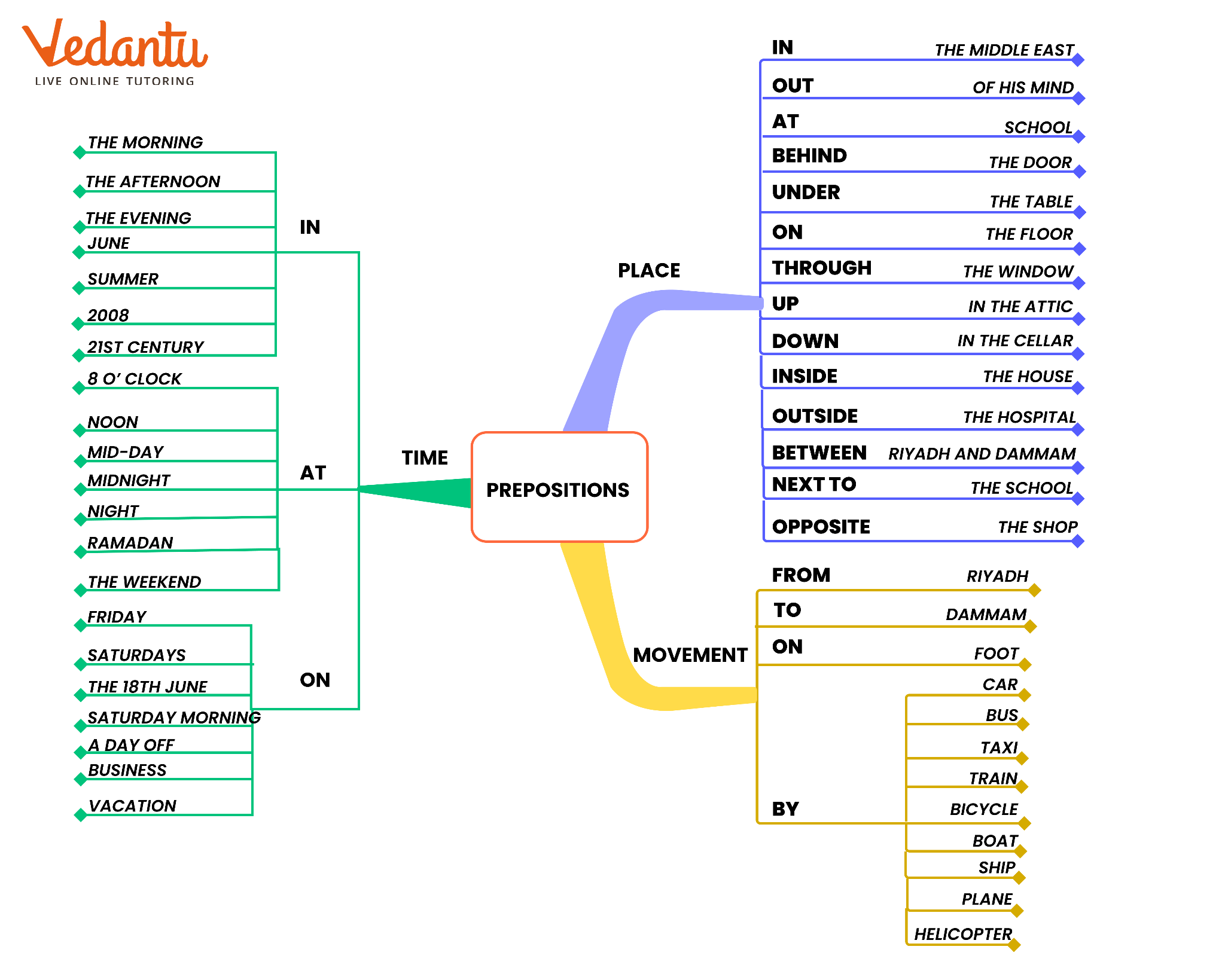
The table gives different types of Prepositions with examples and its usage.
Daily Examples with Prepositions
Location: The cat is on the roof.
Time: We will meet at 5 PM.
Direction: She walked to the store.
Agent/Instrument: The book was written by the author.
Common Mistakes
Confusing similar prepositions (e.g., in vs. on).
Using prepositions unnecessarily or incorrectly.
Practice Tips
Identify: Find prepositions in sentences.
Use: Practice making sentences with different prepositions.
Review: Check your usage and learn from your mistakes.
Review Your Learning On Prepositions
What is the function of a preposition in a sentence?
Give examples of prepositions indicating location and time.
How can prepositions be used to describe direction?
Check Your Answers:
A preposition shows the relationship between a noun or pronoun and other parts of the sentence, indicating location, time, direction, or relationships.
Examples of location prepositions: in, on; Examples of time prepositions: are at, and before.
Prepositions describing direction include to, towards, over, and past.
Exercise 1: Fill in the Blanks with Appropriate Prepositions
Fill in the blanks with the most suitable preposition from the list provided:
The cat is sitting ___ the chair.
She will meet us ___ 4 PM.
The book is ___ the table.
They walked ___ the park yesterday.
The restaurant is located ___ Main Street.
I will finish my homework ___ dinner.
The children played ___ the garden all afternoon.
The keys are ___ the drawer.
We arrived ___ the airport just in time.
She put the vase ___ the shelf.
Answers:
The cat is sitting on the chair.
She will meet us at 4 PM.
The book is on the table.
They walked through the park yesterday.
The restaurant is located on Main Street.
I will finish my homework before dinner.
The children played in the garden all afternoon.
The keys are in the drawer.
We arrived at the airport just in time.
She put the vase on the shelf.
Exercise 2 – Underline and Identify the Prepositions
Instructions: Read the following sentences, underline the prepositions, and then write them in the space provided below each sentence.
The cat is hiding under the bed.
Preposition: under
She will arrive at the station by noon.
Prepositions: at, by
The keys are on the kitchen counter.
Preposition: on
They traveled through the mountains to reach the village.
Prepositions: through, to
The party will be at Sarah's house on Saturday.
Prepositions: at, on
I left the book in my backpack during class.
Prepositions: in, during
The children played in the park until sunset.
Prepositions: in, until
He walked across the bridge towards the city center.
Prepositions: across, towards
The cat jumped over the fence into the yard.
Prepositions: over, into
We have been waiting for the bus since 3 PM.
Prepositions: for, since
For more practice of Prepositions, students can refer to other preposition study material available on the Vedantu website enough to score high in exams.
Task for Students
Create sentences using each type of preposition (location, time, direction). Identify and underline the prepositions in your sentences.
Takeaways from the Topic Prepositions
Show Relationships: Prepositions link nouns and pronouns with other parts of the sentence, showing where something is, when it happens, or the direction of an action.
Different Types: Prepositions include those for location (e.g., in, on), time (e.g., at, before), and direction (e.g., to, towards).
Context Matters: The meaning of a preposition can change depending on the context. For example, "on" can mean a physical position or a time.
Common Use: Prepositions are used often in both writing and speaking, helping to make sentences clear and precise.
Practice Helps: Understanding and using prepositions correctly improves with practice. Try creating sentences and identifying prepositions to get better.
FAQs on Preposition Exercises for Practice and Concept Clarity
1. What is a preposition in English grammar?
A preposition is a word that shows the relationship between a noun or pronoun and another word in a sentence. It often indicates time, place, direction, or cause.
- Place: She is sitting on the chair.
- Time: We will meet at 5 PM.
- Direction: He walked into the room.
2. What is a preposition exercise?
A preposition exercise is a grammar activity designed to help learners practice using correct prepositions in sentences. These exercises commonly include:
- Fill-in-the-blanks with suitable prepositions
- Multiple-choice questions
- Error correction tasks
- Sentence rewriting using correct prepositions
3. How do you choose the correct preposition in a sentence?
To choose the correct preposition, you must understand the relationship between the words in the sentence. Follow these steps:
- Identify whether it shows time, place, movement, cause, or manner.
- Check common collocations (e.g., interested in, afraid of).
- Consider fixed expressions (e.g., at night, on Monday, in 2025).
4. What is the difference between in, on, and at?
The difference between in, on, and at depends on how specific the time or place is.
- In is used for larger areas or longer periods (in India, in 2026).
- On is used for surfaces and specific days (on the table, on Monday).
- At is used for exact points (at 6 PM, at the door).
5. What are common mistakes in preposition exercises?
Common mistakes in preposition exercises include using the wrong preposition in fixed expressions or translating directly from another language. Frequent errors include:
- Saying interested on instead of interested in
- Using discuss about instead of discuss
- Confusing in, on, and at for time and place
6. What are prepositions of time with examples?
Prepositions of time show when something happens and mainly include in, on, and at.
- In: in July, in 2024, in the morning
- On: on Friday, on my birthday
- At: at night, at 10 AM
7. What are prepositions of place with examples?
Prepositions of place describe the position of something and commonly include in, on, at, under, and between.
- The keys are on the table.
- The cat is under the bed.
- She is sitting between her friends.
8. What is the difference between to and for?
The difference between to and for lies in purpose and direction.
- To shows movement or direction (I am going to school).
- For shows purpose or benefit (This gift is for you).
9. How can I practice prepositions effectively?
You can practice prepositions effectively by combining exercises with real sentence usage. Effective methods include:
- Doing daily fill-in-the-blank exercises
- Reading English texts and noting prepositional phrases
- Writing your own sentences using target prepositions
- Reviewing common prepositional collocations
10. Can you give an example of a preposition exercise with answers?
Yes, a simple preposition exercise includes filling in blanks with the correct preposition.
- She arrived ___ the airport at 6 PM. (at)
- The book is ___ the table. (on)
- He was born ___ 2010. (in)
