







Common Bedroom Vocabulary Words with Meanings and Examples
Teaching kids about new objects can help them in widening their vocabulary. Reciting poems, reading stories, and learning new words are some of the conventional methods that are used to teach kids about the vocabulary in English. Needless to say, these methods are really helpful for imparting knowledge of any kind but teaching the commonly found objects can help enhance the conversational skill of a kid. One such example is teaching kids about bedroom vocabulary. Parents can teach kids about the names of the commonly found in the bedroom; this can help in developing an understanding of the things around them. The article mentions below a list of commonly found objects in the bedroom.
List of Objects Found in the Bedroom
Mentioned below is a list of commonly found things in the bedroom. Learning the name of such things can help kids to build up their bedroom vocabulary.
Bed: It used to sleep. It is generally made of wood and has 4 legs.
Lamp: It is also known as a night lamp. It is a device that is used to light the room.
Dressing table: A dressing table is a wooden table that has a mirror attached to it. It is generally used to get ready for the day.
Wardrobe: The wardrobe is also known as a closet; it is used to store clothes and other valuables.
Chest of drawers: A chest of drawers is a piece of furniture that is used for storage. It consists of an upright frame into which drawers are fitted.
Pillow: A pillow is a soft cushion that is used to rest our heads while sleeping.
Bedsheet: A bedsheet is generally fitted over the mattress. It makes the room beautiful.
Duvet: Duvet is known as a quilt. It is made of feathers and cotton.
Photo frame: A photo frame is a protective and decorative edging for a picture, for example, a painting or a photograph. A photo frame makes displaying the work easier and safer.
Bookcase: A bookcase is a piece of furniture that consists of shelves which we use to keep books.
Carpet: A carpet is a floor covering that is made up of thick woven fabric.
Table: A table is a piece of furniture that consists of a flat top and one or more legs, which provides a level surface for writing, eating, or working at.
Chair: A chair is basically an individual seat for a single person, generally with four legs.
Mentioned above are some of the common essentials that are found in the bedroom. The image mentioned below can help kids to better understand the bedroom vocabulary.
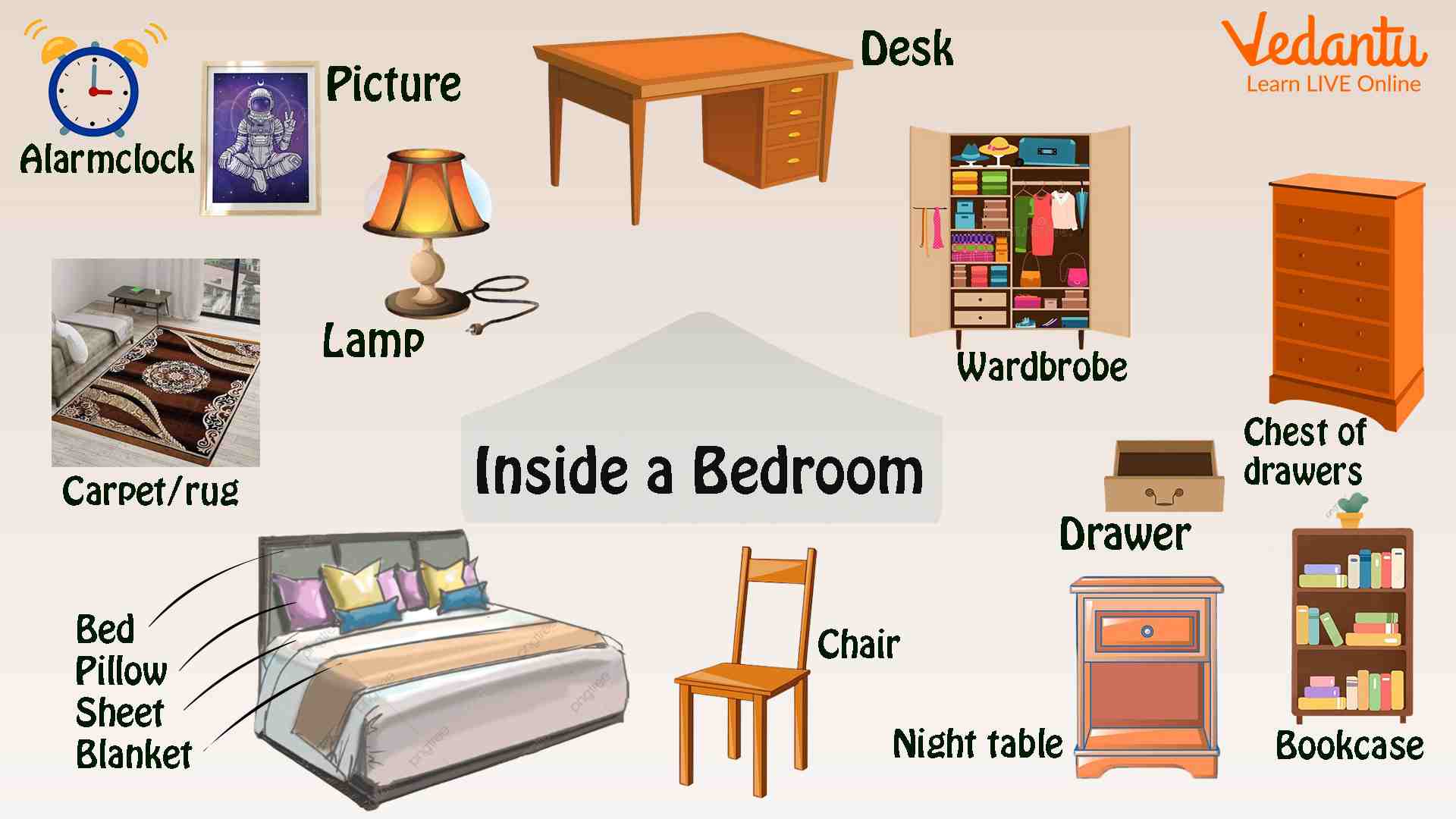
Things that are commonly found in the bedroom
Examples of Bedroom Vocabulary in Day-to-Day Conversation
As we have learnt the bedroom vocabulary, let us look into some of the examples where we can use the bedroom vocabulary in daily conversations.
Parents can ask them how many legs are in a bed? This will help kids to learn counting as well as learn the word bed.
Parents can also ask kids to paint a picture that can be hung on the bedroom wall.
Parents can ask their kids to set up an alarm using the alarm clock in the bedroom.
Another fun way to learn the bedroom vocabulary is to plan a game based on the vocabulary. Parents can print out the image of various objects found in the bedroom. They can then ask their kids to arrange them in alphabetical order.
This was the complete discussion on the bedroom vocabulary. In conclusion, let us summarise what we have learnt here. We have learnt the different objects that are commonly found in the bedroom. We have also listed some of the ways that can be used to teach bedroom vocabulary to the kids. We hope to have provided an insight on bedroom vocabulary and use. To learn more of such interesting topics, explore our website today!
FAQs on Bedroom Vocabulary for English Learners
1. What is bedroom vocabulary in English?
Bedroom vocabulary in English refers to the common words and phrases used to describe items, furniture, and activities in a bedroom. It includes names of furniture, bedding, and everyday objects learners use in daily life.
- Examples of bedroom furniture: bed, wardrobe, nightstand
- Bedding items: pillow, blanket, sheets
- Common objects: lamp, alarm clock, mirror
2. What are the most common bedroom items in English?
The most common bedroom items in English are bed, pillow, blanket, wardrobe, and nightstand. These words frequently appear in beginner English lessons.
- Bed – the main piece of furniture for sleeping
- Pillow – supports your head while sleeping
- Blanket – keeps you warm
- Wardrobe – stores clothes
- Nightstand – a small table beside the bed
3. How do you describe a bedroom in English?
You describe a bedroom in English by mentioning its size, color, furniture, and location of items. Use simple present tense and descriptive adjectives.
- Start with size: “It is a small bedroom.”
- Mention furniture: “There is a bed and a wardrobe.”
- Describe position: “The lamp is next to the bed.”
4. What is the difference between a bed and a mattress?
The difference between a bed and a mattress is that a bed is the complete structure, while a mattress is the soft part you sleep on.
- Bed – includes the frame, headboard, and mattress
- Mattress – the cushioned surface placed on the bed frame
5. What is the difference between a blanket and a duvet?
The difference between a blanket and a duvet is that a blanket is a single layer of fabric, while a duvet is a thick, soft quilt filled with feathers or synthetic material.
- Blanket – lighter and used for extra warmth
- Duvet – thicker and usually placed inside a duvet cover
6. What is a wardrobe in bedroom vocabulary?
A wardrobe is a tall piece of furniture used to store clothes in a bedroom. It usually has doors and may include shelves or a hanging rail.
- Used for hanging shirts, dresses, and coats
- May contain drawers for folded clothes
7. How do you use prepositions to describe bedroom items?
You use prepositions of place to show where bedroom items are located. Common prepositions include in, on, under, next to, and between.
- “The book is on the nightstand.”
- “The shoes are under the bed.”
- “The lamp is next to the bed.”
8. What are some common adjectives to describe a bedroom?
Common adjectives to describe a bedroom include small, spacious, tidy, messy, bright, and cozy. These descriptive words help create clear mental images.
- Spacious – large with plenty of space
- Cozy – comfortable and warm
- Messy – not neat or organized
9. How do you talk about daily bedroom routines in English?
You talk about daily bedroom routines using the simple present tense and common action verbs. These verbs describe regular habits.
- make the bed
- wake up
- set the alarm
- go to sleep
10. Why is learning bedroom vocabulary important for English learners?
Learning bedroom vocabulary is important because it helps learners describe their home environment and everyday routines clearly in English. Bedroom words are part of basic survival vocabulary.
- Improves speaking and writing skills
- Helps in real-life conversations and descriptions
- Builds foundation for learning home and furniture vocabulary
