







What Students Learn in English for Year 3 Lessons and Topics
Year 3 marks the beginning of a new session for your child. During this time they will learn to read and write a variety of things in English and also learn the basics of English grammar. We understand that the teachers and parents are in a constant thinking process on how to deliver the best learning for children. Thus, we have brought something special to address this concern.
We will start with what kids will learn in Year 3, and how can you teach English to Year 3 children at home.
Let us start with what they will be learning in English for Year 3.
What will Children Learn in English for Year 3?
Year 3 is dedicated to the learning of the child’s first year in the Key Stage level as a junior. During this time, children are observed to focus more on basic grammar, punctuation, and different styles of writing than on learning phonics. Given below is a list of activities your child will be focusing on more.
Learning to read different genres.
Writing in various formats.
Developing their understanding of various situational writing.
Focus on spelling and identification of new vocabulary words.
Learning of grammar and punctuation.
Overall developing their English skills.
Help Your Child at Home
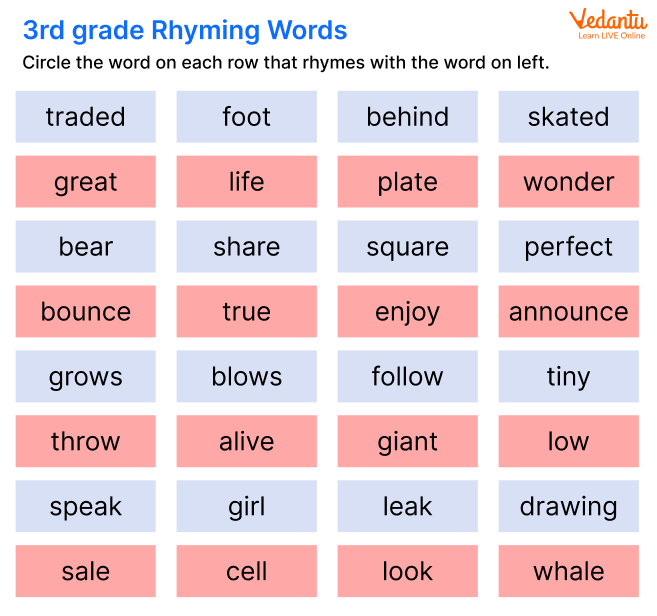
Spelling Words for Dictation
Here is a list of suggestions that are to be implemented while preparing your child for English in Year 3. Also, you can refer to the above list of spelling to test the spelling knowledge of your child.
1. Try Reading With Your Child
English as a language has a widened scope. We understand that the English we use while writing and the English we use in our speech are quite different. The same is to be taught to children. This can be simply done by encouraging them to read a variety of books and letting them identify the different styles of writing in those books.
2. Give Your Child an Opportunity to Write
Allow your children to write on their own. This will help them in language development, grammar, writing with punctuations, and also how to create special effects. How to encourage them to write?
Ask your child to create an adventurous storybook. They can write each chapter each month, in this way, you can track their writing progress at the end of the year, and also this will make the kids express their thoughts.
Make the kids write from A to Z about their favourite characters from any storybook.
Encourage them to make invite cards or greeting cards for different occasions.
Make the kids write a summary about any TV program or cartoon, whichever they like.
Reward them with some time on the computer for typing. This will make them aware of the technology and also make their typing skills develop.
3. Know Their Interests
As parents, know the interest of your child and, thereby, focus on it and help them grow in that. This will help them to develop other aspects as well.
This was a comprehensive idea about how you would prepare your child for the English language for Year 3. No doubt, this requires a lot of patience to make the children learn this English language, but the results would be worthwhile. So, engage your little ones in activities they like, and implement these ideas shared above for their efficient learning.
FAQs on English for Year 3 Complete Guide for Students
1. What is taught in English for Year 3?
English for Year 3 focuses on improving reading, writing, speaking, listening, grammar, and vocabulary skills at an elementary level. Pupils usually learn:
- Basic sentence structure (subject + verb + object)
- Common nouns, verbs, adjectives, and pronouns
- Simple punctuation such as full stops and capital letters
- Reading short passages and answering comprehension questions
- Writing short paragraphs and simple stories
2. What is a noun in Year 3 English?
A noun is a word that names a person, place, animal, or thing. In Year 3 English, students learn different types of nouns:
- Common nouns: girl, school, book
- Proper nouns: Ali, London, Monday
3. What is a verb and how do you use it in a sentence?
A verb is a word that shows an action or a state of being. Verbs tell us what someone or something does.
- Action verbs: run, eat, jump
- Being verbs: is, am, are
- She runs every morning.
- They are happy.
4. What is the difference between common nouns and proper nouns?
The difference between common nouns and proper nouns is that proper nouns name specific people or places and begin with capital letters.
- Common noun: city, teacher, river
- Proper noun: Kuala Lumpur, Mr. Tan, Nile River
5. How do you write a simple sentence in Year 3?
A simple sentence has one subject and one verb and expresses a complete idea. The basic structure is:
- Subject + Verb + Object
- The cat sleeps.
- Ali kicks the ball.
6. What are adjectives and how are they used?
An adjective is a word that describes a noun. It tells us more about a person, place, or thing.
- Size: big, small
- Colour: red, blue
- Feeling: happy, sad
7. What punctuation marks should Year 3 students know?
Year 3 students should know basic punctuation marks such as full stops, question marks, commas, and capital letters. These include:
- Full stop (.) – ends a sentence.
- Question mark (?) – ends a question.
- Comma (,) – separates items in a list.
- Capital letters – begin sentences and proper nouns.
8. How can Year 3 students improve their reading skills?
Year 3 students can improve reading skills by practising daily and understanding the text. Helpful strategies include:
- Reading short storybooks aloud
- Learning new vocabulary words
- Answering comprehension questions
- Identifying main ideas and characters
9. What is a pronoun and why is it important?
A pronoun is a word that replaces a noun to avoid repetition. Common pronouns include:
- He, she, it, they
- His, her, their
10. How do you write a short paragraph in Year 3 English?
A short paragraph in Year 3 English is a group of 3–5 sentences about one main idea. To write a good paragraph:
- Start with a topic sentence.
- Add two or three supporting sentences.
- End with a closing sentence.
