



The Right Coaching Should Make JEE Preparation Easier to Manage, Not More Complicated.
Bangalore gives students plenty of JEE coaching choices, but more options can make the decision confusing. Some institutes highlight results, others focus on faculty, while students and parents often try to compare teaching quality, doubt support, batch timings, travel, study material, and fees at once.
The better approach is to look beyond popularity and ask whether the programme fits the student’s actual preparation needs. A good JEE coaching system should help students understand concepts, practise regularly, clear doubts quickly, learn from tests, and still have enough time for independent study.
The preparation cycle should feel organised:
Learn → Practise → Identify Gaps → Clear Doubts → Test → Analyse → Improve
Explore Vedantu JEE Coaching in Bangalore
Checklist Before Choosing JEE Coaching in Bangalore
Before finalising a JEE coaching programme, check these important points:
Understand Your Current Preparation Stage
Know whether you need foundation building, complete JEE preparation, revision support or a focused dropper programme.
Check Teaching Quality and Concept Clarity
Choose a coaching system where teachers explain concepts clearly, build problem-solving skills and help you approach different types of questions.
Evaluate Doubt-Solving Support
Ensure there is a proper process to ask doubts, revisit difficult topics and get academic support whenever required.
Look at Test Pattern and Performance Analysis
Regular tests should help you identify weak chapters, understand mistakes and improve your preparation strategy.
Consider Batch Size and Learning Environment
A comfortable learning environment with proper interaction and academic guidance can improve consistency.
Calculate Travel Time and Self-Study Balance
Your daily schedule should leave enough time for revision, practice questions, assignments and rest.
Choose the Right Learning Format
Decide whether classroom, online or hybrid learning suits your study habits, routine and preparation style.
Compare Course Structure and Support System
Check syllabus coverage, study material, revision support, mentoring and progress tracking before joining.
Understand the Complete Fee and Scholarship Details
Compare the overall value of the programme, including tests, resources, support and available scholarship opportunities.
Make the Final Decision Based on Long-Term Fit
Choose a coaching option that helps you stay consistent, improve regularly and confidently continue your JEE preparation.
Simple Formula for the Right Choice:
Right Guidance + Consistent Practice + Regular Analysis + Student Effort = Better JEE Preparation
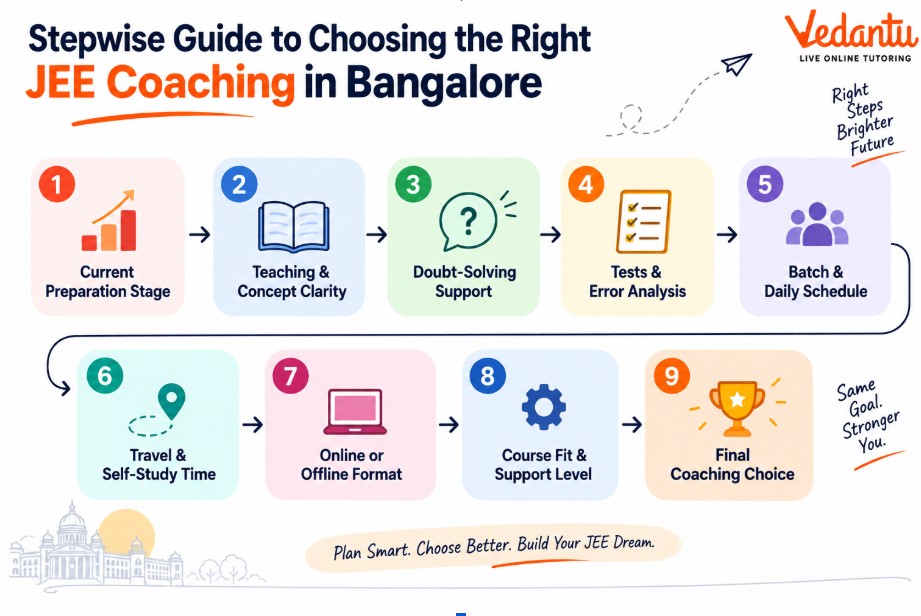
Stepwise Guide to Choosing the Right JEE Coaching in Bangalore
A good coaching decision becomes easier when you check the important factors in the right order.
Quick Decision Flow
Current Preparation Stage
↓
Teaching & Concept Clarity
↓
Doubt Support
↓
Tests & Error Analysis
↓
Batch & Schedule
↓
Travel & Self-Study Time
↓
Online or Offline Format
↓
Course Fit
↓
Final Choice
This keeps the decision centred on what the student actually needs every week.
Step 1: Match the Course With the Student’s Current Stage
A Class 11 student, a Class 12 student and a repeater should not follow the same preparation plan.
The solution is simple: choose the programme around the student’s starting point, not around what friends are joining.
Step 2: Choose Teachers Who Make the Student More Independent
Good teaching should eventually help students solve more questions without assistance.
A strong class should move through:
Understand the Concept → See the Application → Solve Independently
After a demo class, students can try a few questions from the same topic. If the concept feels clearer and they can attempt basic questions independently, the teaching style is probably working.
The goal isn't just to watch a teacher solve difficult questions. It is to become better at solving them yourself.
Step 3: Use a Doubt System That Prevents Backlogs
Most doubts come up during self-study, not during the lecture. A useful doubt system should provide a clear way to ask questions, subject-specific support and timely help.
Students can follow this simple routine:
Mark the question → Try again → Ask for help → Note the correct approach → Solve a similar problem
This turns doubt-solving into learning, not just collecting answers.
Step 4: Make Every Test Decide the Next Study Action
A mock test is useful only when the student understands why they lost marks.
The right cycle is:
Test → Analyse → Correct → Revise → Retest
A poor score should change the preparation plan, not simply create stress.
Step 5: Protect Time for Independent JEE Practice
Students cannot prepare for JEE by attending classes alone. They also need time for DPPs, numericals, previous-year questions, revision and mock analysis.
In Bangalore, travel can make this especially important. Calculate the full routine:
School + Commute + Coaching + Homework + Self-Study + Sleep
If coaching leaves almost no time for independent problem-solving, the schedule needs adjustment. The goal isn't maximum class hours. It is maximum effective preparation time.
Step 6: Choose Online or Offline Based on What Improves Consistency
Neither format is automatically better.
A simple rule works well:
Choose online when flexibility improves consistency.
Choose offline when structure improves consistency.
Step 7: Make Sure the Actual Batch Fits
The coaching brand may be strong, but the student experiences the specific batch every day. Before joining, understand the faculty, current chapter, test schedule, batch pace and catch-up support.
If the student is joining late, there should be a recovery plan:
Completed Chapters → Priority Backlogs → Catch-Up Support → Extra Practice → Deadline
Without this, a small delay can become a long-term backlog.
Step 8: Use Study Material in the Right Order
More books do not automatically mean better JEE preparation.
A practical sequence is:
Class Notes → Assigned Questions → DPPs → Previous-Year Questions → Higher-Level Problems
Finish the essential resources properly before adding more material. This keeps practice connected to what you're actually learning.
Step 9: Build JEE Advanced Preparation Gradually
JEE Main requires speed, accuracy and broad syllabus coverage.
JEE Advanced adds deeper application, multi-concept thinking and more unfamiliar problems.
A better progression is:
Strong Fundamentals → JEE Main Accuracy → Mixed Concepts → Advanced Application
Students should not jump directly to extremely difficult problems while basic concepts are still unstable.
Step 10: Turn Progress Tracking Into a Better Study Plan
Track a few useful indicators every month:
mock scores
accuracy
weak chapters
backlog
paper completion
subject-wise performance
Then act on the pattern. If Mathematics accuracy is good but speed is poor, add timed practice. If Physics remains weak across several tests, increase concept revision and chapter-wise practice.
Tracking should change preparation - not just produce another report.
A Quick JEE Coaching Checklist for Bangalore Families
Before enrolling, check whether the programme provides:
understandable teaching
regular doubt support
meaningful test analysis
suitable batch pacing
enough self-study time
manageable travel
Main + Advanced progression
structured study material
progress tracking
a learning format the student can follow consistently
If several major areas remain unclear, continue comparing.
Where Vedantu Can Fit Into This Decision
Once the student’s needs are clear, specific coaching options become easier to evaluate.
Vedantu is a strong option because Bangalore students can choose between offline JEE coaching and online JEE programmes, letting them pick a format that fits their routine rather than forcing everyone into the same structure.
Vedantu Bangalore centres offer JEE Main and Advanced programmes for Classes 11, 12 and Class 12 pass/dropper students, while Foundation courses are available for Classes 9 and 10.
Book a Visit to Vedantu Bangalore Centre
Vedantu Offline JEE Courses in Bangalore
Offline may suit students who need a fixed routine, centre-based structure, and regular accountability - provided travel does not reduce self-study too heavily.
Vedantu Online JEE Options for Students Who Need More Flexibility
Vedantu’s online JEE categories include Pro Courses, Prime Courses, Repeater, Foundation, Crash Course, One-to-One Online Coaching and JEE Test Series.
This is useful because a student who mainly needs testing shouldn't necessarily join a full course, while someone with major concept gaps shouldn't rely only on a test series.
For Bangalore students who lose significant time commuting, online learning can also convert travel time into revision, problem-solving or better rest.
Four Things to Confirm Before Making the Final Choice
Before paying for any JEE coaching programme, make sure four areas are clear:
Academic Fit: Does the teaching and course level suit the student?
Daily Fit: Can school, coaching, travel, self-study and sleep coexist?
Format Fit: Will online flexibility or offline structure create better consistency?
Long-Term Fit: Can the student realistically follow the programme for the entire preparation period?
If these four are right, the coaching decision becomes much easier.
Final Take
The right JEE coaching in Bangalore should solve preparation problems, not just add more classes. A good system should help students:
understand better → practise regularly → clear doubts → learn from tests → fix weak areas → improve steadily
For some students, offline coaching will provide the structure they need. For others, online preparation will protect valuable time and offer greater flexibility.
Vedantu can work for both routes, but the final choice should still start with the student.
Choose the programme that fits the student’s learning needs, routine and preparation stage - and can be followed consistently until exam day.
FAQs on What Should Students and Parents Check Before Choosing JEE Coaching in Bangalore?
1. Is online or offline JEE coaching better in Bangalore?
Both can work. Offline suits students who need routine, while online may suit disciplined students who want to reduce commute and protect self-study time.
2. What teaching style works best for JEE preparation?
A useful teaching style should make difficult concepts easier to understand and help students gradually solve questions independently. Clear explanations, step-by-step problem-solving, and regular application practice are more important than simply covering topics quickly.
3. How important is travel when choosing coaching in Bangalore?
Very important. Excessive commuting can reduce practice, revision and sleep.
4. Is a JEE test series enough?
It may be enough for students with strong concepts and an existing study plan. Students with major concept gaps usually need fuller academic support.
5. What is the strongest sign that coaching is working?
Concepts become clearer, repeated mistakes decrease, practice becomes more consistent, and the student knows what to improve next.



