









Key Differences in Frogs Morphology and Anatomy for NEET Students
Frog Morphology and Anatomy is a foundational topic in Biology, especially for NEET aspirants. This concept covers the external structure and internal organization of frogs, helping students build strong basics in animal classification and physiology. Understanding frog morphology and anatomy is crucial for NEET since it connects theory with real biological systems and forms the basis for analyzing comparative anatomy questions in the exam.
What is Frog Morphology and Anatomy?
Frog morphology refers to the study of the external features, shape, and appearance of frogs, while frog anatomy deals with their internal structure and organ systems. Frogs, being amphibians, exhibit several adaptations that help them live both on land and in water. The study of frog morphology and anatomy helps NEET aspirants grasp the structural basis for physiological functions and relate the concepts to other vertebrates.
Core Ideas and Fundamentals of Frog Morphology and Anatomy
External Morphology
The external morphology of a frog includes identifying its shape, body covering, head, trunk, limbs, eyes, and other visible parts. Frogs have a streamlined body, smooth, moist skin (often green or brown), and prominent eyes positioned on the top of their head to help them see above water. They lack a neck and tail as adults, and their forelimbs and hindlimbs are well adapted for leaping and swimming.
- Head: Triangular, with a wide mouth, nostrils, bulging eyes, and tympanic membrane (ear drum).
- Trunk: Bears forelimbs (short, four fingers) and hindlimbs (long, webbed toes for swimming).
- Skin: Moist, glandular, and used for cutaneous respiration in addition to lungs.
Internal Anatomy Overview
The anatomy of a frog involves the structure and organization of its internal organs, which are well-adapted for both terrestrial and aquatic life. Key organ systems include the digestive, circulatory, respiratory, excretory, and nervous systems. The viscera (internal organs) are neatly arranged within the body cavity.
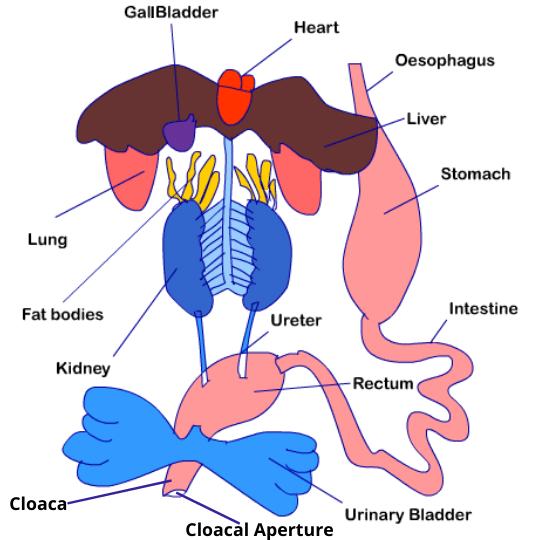
The diagram above shows the arrangement of the viscera in a frog, which is a common diagram asked in NEET-based questions. Proper labeling and understanding of these organs are essential for answering related MCQs.
Important Sub-Concepts Related to Frog Morphology and Anatomy
Digestive System
Frogs have a well-defined digestive tract starting from the mouth, buccal cavity, esophagus, stomach, small and large intestines, ending at the cloaca. Accessory glands include the liver and pancreas, both crucial for digestion and absorption.
Respiratory System
Respiration occurs through three main modes: skin (cutaneous respiration), lungs (pulmonary respiration), and the lining of the buccal cavity (buccopharyngeal respiration). The ability to use different modes is key for survival in changing environments.
Circulatory System
Frogs possess a closed circulatory system with a three-chambered heart (two atria and one ventricle), arteries, veins, and capillaries. Oxygenated and deoxygenated blood partially mix in the ventricle, a point often highlighted in comparative physiology.
Excretory System
Excretion mainly occurs through a pair of kidneys which open into the cloaca through ureters. The primary nitrogenous waste is urea, making frogs ureotelic.
Nervous System and Sense Organs
The brain is divided into forebrain, midbrain, and hindbrain. Frogs have well-developed eyes, tympanic membranes for hearing, and olfactory lobes for smell.
Key Features, Adaptations, and Relationships in Frog Morphology and Anatomy
- Frogs show adaptations for amphibious life - moist skin allows for cutaneous respiration, while lungs help on land.
- Webbed hindlimbs are specialized for jumping and swimming, providing locomotory advantage.
- The three-chambered heart is a transitional adaptation between aquatic and terrestrial respiration.
- Presence of a cloaca allows the passage of digestive, urinary, and reproductive products through a single opening.
Exam Relevance: Why Frog Morphology and Anatomy is Important for NEET
Frog morphology and anatomy is directly linked to several NEET questions, including diagram-based, analytical, and multiple-choice types. Understanding this topic helps students answer conceptual and applied questions on animal physiology, compare vertebrate features, and recognize evolutionary adaptations. It’s also foundational for mastering other systems in higher vertebrates and clarifies the basics of classification, physiology, and developmental biology.
How to Study Frog Morphology and Anatomy Effectively for NEET
- Start with clear diagrams - label all important parts and revise frequently.
- Break the topic into external features and each internal organ system for focused study.
- Make flashcards for key terms like types of respiration, heart chambers, and main organs.
- Practice MCQs that test labeling, functions, and adaptations.
- Regularly revise viscera diagrams and their functions, as visual questions are common in NEET.
- Discuss difficult points with peers or teachers for conceptual clarity.
- Relate frog anatomy to larger comparative questions across animal kingdoms.
Common Mistakes Students Make in Frog Morphology and Anatomy
- Confusing external and internal organ positions in diagrams.
- Mixing up the order of organs in the digestive or respiratory tract.
- Overlooking the function of skin in respiration (cutaneous respiration).
- Mislabelling heart chambers or the function of cloaca.
- Forgetting the amphibious adaptations that link external and internal features.
Quick Revision Points: Frog Morphology and Anatomy
- Frogs have a smooth, moist skin for cutaneous respiration.
- External features include head, trunk, forelimbs (four fingers), hindlimbs (webbed toes).
- Digestive tract: mouth - buccal cavity - esophagus - stomach - intestine - cloaca.
- Respiration occurs through skin, lungs, and buccal cavity lining.
- Heart is three-chambered: two atria, one ventricle.
- Main excretion: urea (ureotelic).
- Cloaca serves digestive, excretory, and reproductive systems.
- Always practice and revise viscera diagrams for quick recall.
FAQs on Frogs Morphology and Anatomy: NEET Biology Guide
1. What is the morphology of a frog as per the NEET syllabus?
The morphology of a frog refers to its external structure and form. NEET asks about these key features:
- Body division: Distinct head and trunk; no true neck or tail.
- Skin: Smooth, moist, and glandular; helps in cutaneous respiration.
- Limbs: Two pairs; hindlimbs are long and adapted for jumping and swimming.
- Eyes: Prominent, with nictitating membrane for protection.
- Mouth: Large, with no true teeth in lower jaw.
2. Describe the anatomy of a frog for NEET preparation.
The anatomy of a frog includes its internal structure and organ systems vital for NEET exams. Major systems include:
- Digestive system: Complete, starting from mouth to cloaca, includes stomach, intestine, and liver.
- Respiratory system: Includes lungs, buccal cavity, and skin (cutaneous respiration).
- Circulatory system: Contains a three-chambered heart (two atria and one ventricle) and closed circulation.
- Nervous system: Brain, spinal cord, and peripheral nerves.
- Excretory system: Paired kidneys and urinary bladder.
3. Which organs help frogs in respiration, as per the NEET syllabus?
Frogs perform respiration mainly through three organs as expected in NEET:
- Lungs: For pulmonary respiration (main mode in adults).
- Skin: Used for cutaneous respiration, especially underwater.
- Buccal cavity: Involved in buccopharyngeal respiration when the frog is inactive.
4. What external features distinguish a frog from other amphibians?
Frogs are recognised by their unique external features:
- No external ears; have tympanum instead.
- Large protruding eyes with a nictitating membrane.
- Long hind limbs for leaping and swimming.
- Webbed feet.
- Smooth, moist skin without scales.
5. Write short notes on the digestive system of a frog for NEET.
A frog's digestive system is adapted for a carnivorous diet and is commonly asked in NEET:
- Mouth: Large opening for capturing prey.
- Buccal cavity: Contains maxillary and vomerine teeth.
- Alimentary canal: Includes pharynx, oesophagus, stomach, small and large intestine, and ends at the cloaca.
- Digestive glands: Liver (secretes bile), pancreas (secretes enzymes).
6. How is the circulatory system of a frog structured according to NEET guidelines?
A frog’s circulatory system is of a closed type, designed for amphibious life and often tested in NEET.
- Heart: Three chambers – two atria, one ventricle.
- Blood vessels: Arteries, veins, and capillaries.
- Double circulation: Both pulmonary and systemic circuits are present, but there is some mixing of oxygenated and deoxygenated blood.
- Spleen: Involved in the storage and destruction of red blood cells.
7. Name the organ systems present in a frog’s body.
Frogs have several organ systems necessary for their survival and these are crucial for NEET Biology:
- Digestive system
- Respiratory system
- Circulatory system
- Nervous system
- Excretory system
- Reproductive system
- Muscular and skeletal systems
8. What is the function of the tympanum in a frog?
The tympanum in a frog is an external hearing structure vital for survival in its habitat.
- Acts as an eardrum to receive sound vibrations.
- Transmits vibrations to the internal ear.
- Essential for detecting predators and communicating during mating.
9. What are the adaptations of frog skin as covered in NEET?
Frog skin shows specialized adaptations important for amphibian life and NEET questions:
- Moist and glandular: Aids in cutaneous respiration.
- Mucous glands: Keep skin slippery, reduce water loss.
- Poison glands: Provide protection against predators.
- Camouflage: Coloration helps blend with surroundings.
10. How do the structure and function of a frog’s hind limbs help in locomotion?
The hind limbs of a frog are specially structured for efficient movement and are frequently tested in NEET:
- Long and muscular bones (femur, tibiofibula, tarsals) provide strength for leaping.
- Webbed toes facilitate swimming in water.
- Jointed structure aids in flexibility and shock absorption.
11. What is the significance of cutaneous respiration in frogs?
Cutaneous respiration allows frogs to breathe through their skin and is a key topic for NEET Biology.
- Vital for gas exchange, especially while underwater or during hibernation.
- Enables survival when lungs are not functional.
- Requires moist skin, which aids oxygen absorption and carbon dioxide release.
12. Describe the reproductive organs of a frog for NEET students.
The reproductive system of a frog consists of sex-specific organs relevant for the NEET syllabus:
- Male: Pair of testes producing sperm, vasa efferentia transporting gametes.
- Female: Pair of ovaries releasing eggs, oviducts for carrying eggs to the cloaca.
- Fertilisation: External, typically in water.
