







Early Life Education Missionary Journeys and Achievements of Saint Francis Xavier
Saint Francis Xavier was a Spanish Catholic missionary and one of the founding members of the Society of Jesus, also known as the Jesuits. He played a major role in spreading Christianity in Asia during the 16th century, especially in India, Japan, and parts of Southeast Asia. His missionary journeys, dedication to education, and commitment to social service made him one of the most influential religious figures in Christian history. The Saint Francis Xavier biography is important for students as it highlights his spiritual devotion, courage, and contribution to global missionary work.
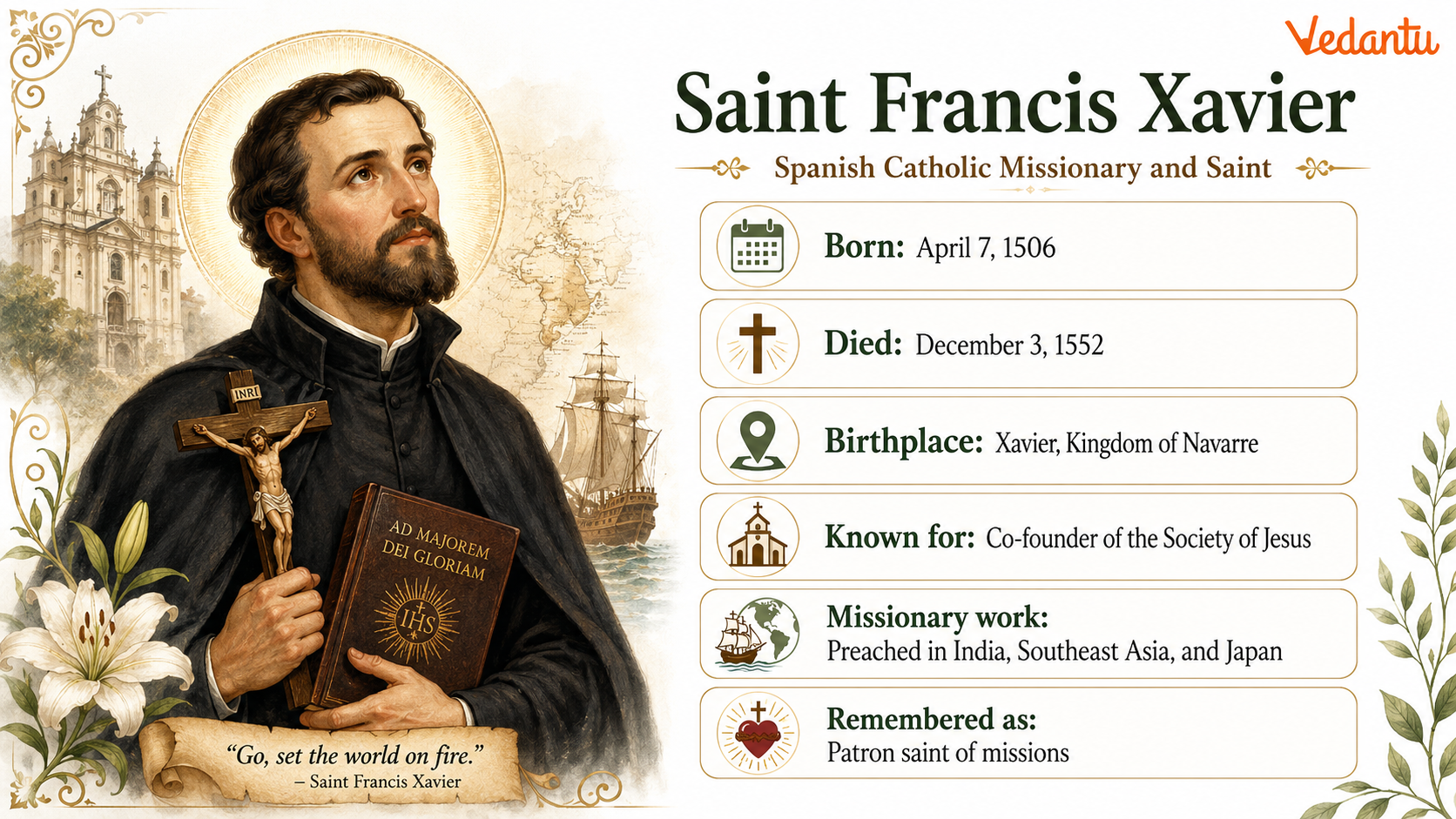
Who is Saint Francis Xavier?
Saint Francis Xavier was a Spanish missionary, Catholic priest, and co-founder of the Society of Jesus. Born in the Kingdom of Navarre, he became one of the most active Christian missionaries of the 16th century. He is remembered for his extensive missionary work in India, Japan, Malaysia, and other parts of Asia. He is especially significant in Indian history due to his work in Goa and along the coastal regions of South India. His life history reflects strong faith, dedication to service, and a deep commitment to education and humanitarian work.
Early Life and Family Background
The early life of Saint Francis Xavier shaped his spiritual and intellectual journey. He was born into a noble family in Spain and received a good education from a young age.
- Date of Birth: 7 April 1506
- Place of Birth: Castle of Xavier, Kingdom of Navarre, Spain
- Father: Juan de Jasso
- Mother: Maria de Azpilicueta
- Belonged to a noble and educated family
- Raised in a Catholic environment that influenced his religious beliefs
Education and Early Interests
Saint Francis Xavier received higher education in Paris, which greatly influenced his future mission. His education played a key role in shaping his spiritual calling.
- Studied at the University of Paris
- Earned a Master of Arts degree
- Met Ignatius of Loyola, who influenced him to dedicate his life to religious service
- Developed an interest in missionary work and teaching
In 1534, he and six others, including Ignatius of Loyola, took religious vows that later led to the formation of the Society of Jesus in 1540.
Career Journey and Major Life Events
Formation of the Jesuits
In 1540, the Pope officially recognized the Society of Jesus. Saint Francis Xavier became one of its first missionaries. His dedication to spreading Christian teachings took him far from Europe.
Mission in India
In 1542, he arrived in Goa, India, which was then under Portuguese rule. He worked among fishermen and local communities along the southern coast. He focused on:
- Teaching Christian prayers and values
- Helping the poor and sick
- Establishing schools and religious institutions
Mission in Southeast Asia and Japan
After India, he traveled to Malacca, the Moluccas, and Japan. In Japan, he introduced Christianity and worked to adapt his teachings to local culture. His efforts laid the foundation for future missionary work in East Asia.
Attempt to Enter China
Saint Francis Xavier wished to spread Christianity in China. However, he fell ill while waiting to enter the country and passed away before achieving this goal.
Timeline of Important Events
| Year | Event |
|---|---|
| 1506 | Born in Navarre, Spain |
| 1525 | Went to the University of Paris |
| 1534 | Took religious vows with Ignatius of Loyola |
| 1540 | Society of Jesus officially recognized |
| 1542 | Arrived in Goa, India |
| 1549 | Reached Japan for missionary work |
| 1552 | Died on Shangchuan Island near China |
| 1622 | Canonized as a Saint by the Catholic Church |
Major Achievements of Saint Francis Xavier
- Co-founder of the Society of Jesus
- Spread Christianity widely in India and Japan
- Established several educational and religious institutions
- Declared a Saint in 1622
- Recognized as the Patron Saint of Missions
Contributions of Saint Francis Xavier
Contribution to Education
- Promoted the establishment of schools in Goa
- Encouraged religious and moral education
Contribution to Society
- Worked among poor fishing communities
- Provided spiritual and social support
- Promoted charity and compassion
Ideology, Thoughts, and Values
Saint Francis Xavier believed in spreading faith through service, compassion, and education. His values reflected dedication and humility.
- Strong faith in Christianity
- Importance of education in shaping moral values
- Service to the poor and needy
- Dedication to missionary work despite hardships
Challenges and Struggles
- Long and dangerous sea journeys
- Language and cultural barriers in foreign lands
- Health problems during travels
- Difficulty entering China for missionary work
Later Life and Death
In his final years, Saint Francis Xavier focused on expanding his mission to China. However, he fell seriously ill while waiting on Shangchuan Island near China.
- Date of Death: 3 December 1552
- Place of Death: Shangchuan Island, China
- His body was later taken to Goa, India, where it is preserved in the Basilica of Bom Jesus
Legacy and Historical Significance
- One of the greatest Christian missionaries of the 16th century
- Patron Saint of missionaries
- Educational institutions worldwide named after him
- Feast day celebrated on 3 December
- Continues to influence Christian missionary activities globally
Lessons Students Can Learn from Saint Francis Xavier
- Dedication to one’s goals
- Service to society
- Courage to explore new places and cultures
- Value of education and moral development
- Perseverance despite challenges
Quick Facts About Saint Francis Xavier
| Field | Details |
|---|---|
| Full Name | Francisco de Jasso y Azpilicueta |
| Date of Birth | 7 April 1506 |
| Place of Birth | Navarre, Spain |
| Profession | Missionary, Priest |
| Known For | Missionary work in Asia |
| Organisation | Society of Jesus |
| Date of Death | 3 December 1552 |
Interesting Facts About Saint Francis Xavier
- He traveled thousands of kilometers by sea for missionary work.
- He is one of the first Jesuit missionaries to work in Asia.
- His body is kept in the Basilica of Bom Jesus in Goa.
- He learned local languages to communicate better with people.
- He is considered a pioneer of Christian missions in the Far East.
- Many schools and colleges across the world are named after him.
Conclusion
The Saint Francis Xavier biography reflects a life of faith, courage, and dedication to service. From Spain to India and Japan, he devoted his life to spreading education and religious teachings. His achievements and contributions have left a lasting impact on global missionary work and education. Studying his life history helps students understand the importance of perseverance, compassion, and commitment to one’s mission.
FAQs on Saint Francis Xavier Life History and Contributions
Saint Francis Xavier was a 16th-century Spanish missionary and one of the founding members of the Society of Jesus (Jesuits). Born on April 7, 1506, in Navarre, Spain, he became one of the greatest Christian missionaries in history. His life history is closely linked with the spread of Christianity in India, Japan, and Southeast Asia, making him an important figure in world religious history and exam-oriented studies.
Saint Francis Xavier is famous for spreading Christianity in Asia during the 16th century. As a leading Jesuit missionary, he traveled extensively and established Christian missions in several regions.
- Preached in Goa (India), Malacca, and Japan
- Helped strengthen the Catholic Reformation
- Known as the “Apostle of the Indies”
Saint Francis Xavier’s early life was shaped by political conflict and strong religious influence. He was born into a noble family in the Kingdom of Navarre. After his father’s death and the Spanish annexation of Navarre, his family faced hardships, which influenced his character and determination. His early life laid the foundation for his later religious commitment and missionary career.
Saint Francis Xavier received higher education at the prestigious University of Paris, where he studied philosophy. There he met Ignatius of Loyola, who inspired him to join religious life. In 1534, Xavier and Loyola, along with others, formed the foundation of the Society of Jesus (Jesuits), marking a turning point in his biography and career journey.
Saint Francis Xavier’s major achievements include establishing Christian missions across Asia and converting thousands to Christianity. His missionary work had long-lasting religious and social impact.
- Founded missions in Goa, Travancore, and Japan
- Strengthened the growth of the Jesuit Order
- Became one of the most influential missionaries in Christian history
Saint Francis Xavier faced many hardships including long sea voyages, language barriers, and cultural differences. He traveled under dangerous conditions and often lacked proper resources. Despite resistance and unfamiliar customs in foreign lands, he remained committed to his missionary mission, showing strong leadership and dedication.
Saint Francis Xavier has several interesting and exam-relevant facts associated with his life and legacy.
- He died on December 3, 1552, on Shangchuan Island, China
- His body is preserved in Basilica of Bom Jesus, Goa
- He was canonized as a saint in 1622 by the Catholic Church
Saint Francis Xavier holds special significance in Indian history due to his missionary activities in Goa during Portuguese rule. He played a key role in spreading Christianity along the western coast of India and supporting educational and religious institutions. His biography is often included in history and general knowledge exams related to colonial India.
Saint Francis Xavier was honored with sainthood by the Catholic Church. He was canonized in 1622 by Pope Gregory XV. He is also recognized as the Patron Saint of Missions, highlighting his global religious contributions and historical significance.
The legacy of Saint Francis Xavier lies in his global missionary work and lasting influence on Christianity in Asia. His life history reflects dedication, leadership, and cross-cultural engagement.
- Inspired generations of Jesuit missionaries
- Contributed to the spread of Christianity in India and Japan
- Remains an important figure in religious studies and exam preparation
