







Niccolo Machiavelli Early Life Education Famous Works and Political Contributions
Niccolo Machiavelli was a renowned Italian diplomat, political philosopher, historian, and writer of the Renaissance period. He is best known for his influential political work The Prince, which shaped modern political theory and introduced practical ideas about leadership and power. Machiavelli’s life history reflects the political instability of Italy during the 15th and 16th centuries. His writings on governance, statecraft, and human nature continue to be studied in political science, history, and philosophy courses across the world. Understanding Niccolo Machiavelli biography helps students explore the foundations of modern political thought.
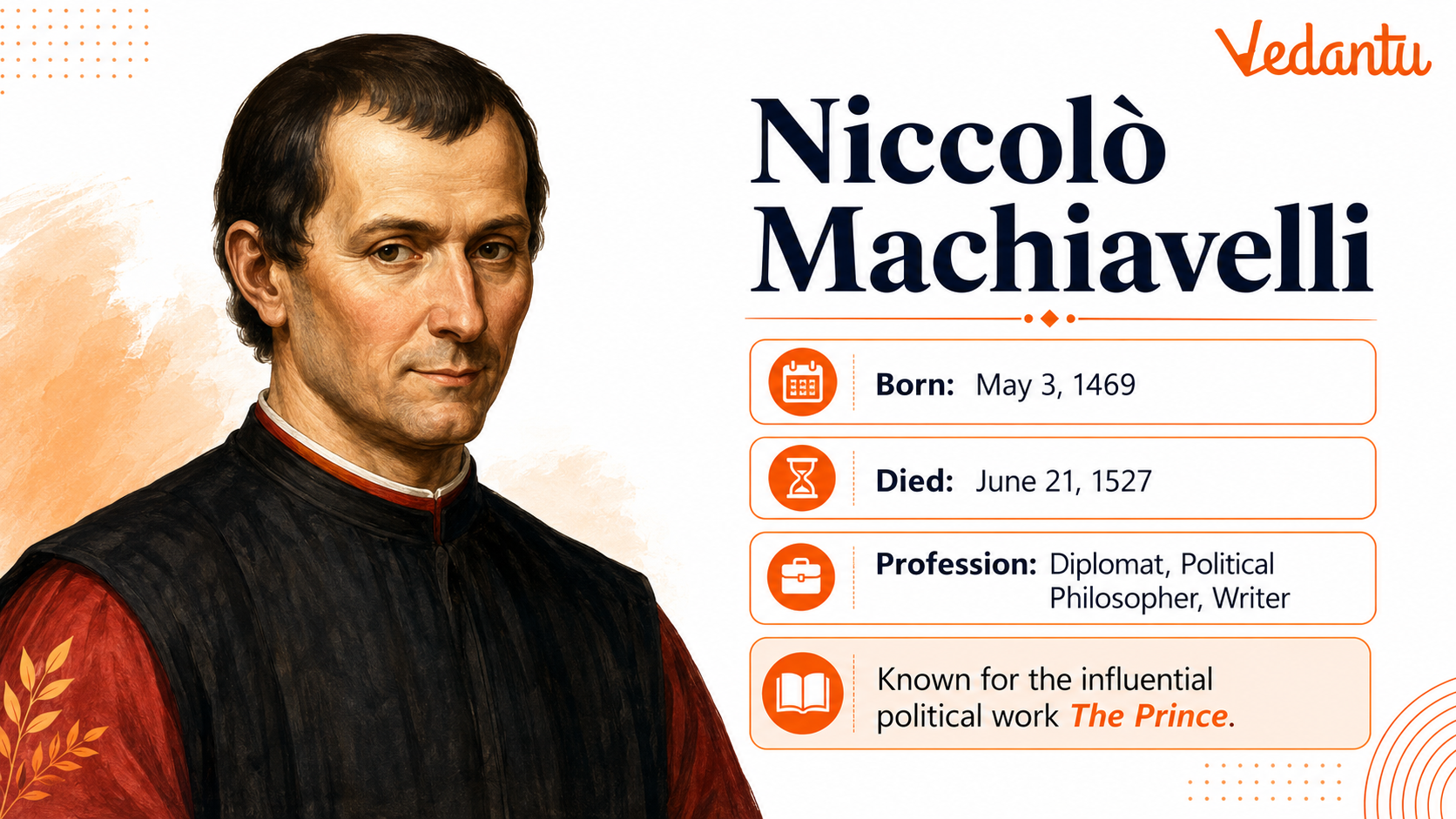
Who is Niccolo Machiavelli?
Niccolo di Bernardo dei Machiavelli was an Italian diplomat, political thinker, and writer born in 1469 in Florence, Italy. He served as a senior official in the Florentine Republic and is widely regarded as one of the founders of modern political science. Machiavelli is most famous for his book The Prince, which provides advice to rulers on how to acquire and maintain power. His realistic and sometimes controversial ideas about politics made his name synonymous with cunning political strategy. Today, Niccolo Machiavelli biography is studied by students preparing for competitive exams and those interested in history and political philosophy.
Early Life and Family Background
Niccolo Machiavelli was born during the Renaissance, a period of cultural and intellectual growth in Europe. His early life was influenced by the political changes happening in Florence.
- Date of Birth: 3 May 1469
- Place of Birth: Florence, Republic of Florence, Italy
- Father: Bernardo di Niccolo Machiavelli, a lawyer and scholar
- Mother: Bartolomea di Stefano Nelli
- He belonged to a modest but educated family with an interest in literature and classical texts.
- Growing up in Florence exposed him to political conflicts and diplomatic affairs at an early age.
Education and Early Interests
Niccolo Machiavelli received a humanist education typical of Renaissance Italy. His education focused on classical Latin literature, history, and philosophy.
- He studied Latin and read works of ancient Roman writers such as Livy, Cicero, and Tacitus.
- His interest in Roman history greatly influenced his political ideas.
- He developed strong skills in writing, analysis, and diplomacy.
- His early exposure to classical political systems shaped his later works on governance.
Career Journey and Major Life Events
Service in the Florentine Republic
In 1498, Machiavelli was appointed as the Second Chancellor of the Republic of Florence. He also served as a diplomat and undertook important missions to France, the Holy Roman Empire, and the Papacy.
Diplomatic Missions
During his diplomatic career, he met powerful leaders such as King Louis XII of France and Cesare Borgia. Observing their methods of ruling influenced his ideas about political power and leadership.
Exile and Writing Period
In 1512, the powerful Medici family returned to power in Florence. Machiavelli was dismissed from office, imprisoned briefly, and later exiled. During this period of hardship, he wrote his most famous works, including The Prince in 1513.
Later Years
Although he tried to regain political favor with the Medici rulers, he never fully returned to his earlier influential position. He continued writing political and historical works until his death.
Timeline of Important Events
| Year | Event |
|---|---|
| 1469 | Born in Florence, Italy |
| 1498 | Appointed Second Chancellor of Florence |
| 1512 | Removed from office after Medici return |
| 1513 | Wrote The Prince |
| 1527 | Died in Florence |
Major Achievements of Niccolo Machiavelli
- Authored The Prince, one of the most influential political books in history.
- Wrote Discourses on Livy, promoting republican government.
- Played a key role in reorganizing the Florentine militia.
- Contributed to modern political science with practical and realistic analysis.
- Recognized as a leading thinker of the Renaissance period.
Contributions of Niccolo Machiavelli
Contribution to Political Science
- Introduced a realistic approach to politics based on observation rather than idealism.
- Separated politics from morality and religion in his analysis.
- Focused on stability, power, and effective governance.
Contribution to Literature and History
- Wrote historical works such as History of Florence.
- Authored plays and essays reflecting Renaissance culture.
Ideology, Thoughts, and Values
Niccolo Machiavelli believed that rulers must focus on maintaining power and stability. His ideas were practical and based on real political situations.
- Emphasized the importance of strong leadership.
- Believed that rulers should be practical rather than idealistic.
- Argued that sometimes harsh measures are necessary for political stability.
- Supported republican values in his other writings.
Challenges and Struggles
- Lost his political position after the Medici family returned to power.
- Was imprisoned and accused of conspiracy.
- Lived in exile and financial difficulty.
- Faced criticism for his political ideas, which were considered controversial.
Famous Works of Niccolo Machiavelli
| Work | Importance |
|---|---|
| The Prince (1513) | Guide on political power and leadership |
| Discourses on Livy | Discussion on republican government |
| History of Florence | Historical account of Florence |
| The Art of War | Military organization and strategy |
Later Life and Death
In his later years, Machiavelli continued writing and sought to return to public service. However, he never regained his former political influence. He died on 21 June 1527 in Florence, shortly after the Medici were again expelled from the city.
Legacy and Historical Significance
- Considered a founder of modern political theory.
- His book The Prince remains widely studied in political science.
- Influenced later thinkers and leaders across Europe.
- His name gave rise to the term “Machiavellian,” referring to political cunning.
Lessons Students Can Learn from Niccolo Machiavelli
- The importance of practical thinking in leadership.
- Learning from history to understand present politics.
- Facing challenges with resilience.
- Developing analytical and critical thinking skills.
Quick Facts About Niccolo Machiavelli
| Field | Details |
|---|---|
| Full Name | Niccolo di Bernardo dei Machiavelli |
| Date of Birth | 3 May 1469 |
| Place of Birth | Florence, Italy |
| Nationality | Italian |
| Profession | Diplomat, Political Philosopher, Writer |
| Known For | The Prince |
| Date of Death | 21 June 1527 |
Interesting Facts About Niccolo Machiavelli
- He wrote The Prince while living in exile.
- The term “Machiavellian” comes from his name.
- He admired the political system of ancient Rome.
- He also wrote comedies and poems.
- His works were once banned by the Catholic Church.
- He is regarded as one of the key figures of the Renaissance.
Conclusion
Niccolo Machiavelli biography offers deep insight into the realities of political power and leadership. His life history reflects resilience during political change and exile. Through works like The Prince, he shaped modern political thinking and influenced generations of leaders and scholars. His contributions to political science and Renaissance literature make him an important historical figure. Studying Niccolo Machiavelli helps students understand governance, leadership, and the complex nature of politics in both past and present contexts.
FAQs on Niccolo Machiavelli Biography and His Life Achievements and Legacy
Niccolò Machiavelli was an Italian diplomat, political philosopher, and writer of the Renaissance period, best known for his influential political work The Prince. Born in 1469 in Florence, Italy, he served as a senior official in the Florentine Republic and played an important role in diplomatic missions. His biography reflects a life dedicated to political theory, governance, and practical statecraft, making him a key figure in modern political thought.
Niccolò Machiavelli is famous for writing The Prince, a groundbreaking book on political leadership and power. In this work, he explained how rulers can gain and maintain authority, often emphasizing realism over morality. His ideas introduced a new, practical approach to politics, and the term "Machiavellian" became associated with cunning and strategic leadership.
Niccolò Machiavelli’s early life was shaped by the cultural and political environment of Renaissance Florence. He was born on May 3, 1469, into a modest but educated family. His father, Bernardo Machiavelli, was a lawyer who encouraged learning. Growing up during a time of political instability in Florence influenced Machiavelli’s later views on leadership, power, and governance.
Niccolò Machiavelli received a strong humanist education focused on classical literature and Latin studies. Although there is limited detailed record of formal schooling, he studied works of ancient Roman writers like Livy and Cicero. This classical education deeply influenced his political philosophy and is clearly reflected in his famous writings and historical analysis.
Niccolò Machiavelli’s major achievements include his diplomatic service and his lasting contributions to political theory. His work laid the foundation for modern political science.
- Served as a diplomat and senior official in the Florentine Republic
- Authored The Prince (1513), one of the most influential political books in history
- Wrote Discourses on Livy, promoting republican ideas
Niccolò Machiavelli faced political downfall, imprisonment, and exile during his lifetime. In 1512, when the Medici family returned to power in Florence, he was removed from office, accused of conspiracy, and briefly imprisoned. After his release, he lived in exile, where he wrote The Prince in hopes of regaining political favor. These struggles strongly shaped his realistic views on politics and power.
Niccolò Machiavelli wrote several important works that remain central to political philosophy and Renaissance literature.
- The Prince – A guide on political leadership and statecraft
- Discourses on Livy – A defense of republican government
- The Art of War – A treatise on military organization
- Mandragola – A satirical play
Niccolò Machiavelli’s political ideas focus on realism, power, and practical governance rather than idealism. He believed that rulers must sometimes use strategy, manipulation, or force to maintain stability. He separated politics from morality, arguing that the success and security of the state are the highest priorities. These ideas significantly influenced modern political science and leadership theory.
Niccolò Machiavelli’s legacy lies in his role as a founder of modern political thought. His realistic analysis of power changed how politics was studied and practiced. Even centuries after his death in 1527, his biography and writings are widely studied in political science, history, and leadership courses, making him one of the most influential thinkers of the Renaissance.
Students can learn the importance of practical thinking, adaptability, and understanding political realities from Niccolò Machiavelli’s life history. His career shows how challenges and failures can lead to intellectual achievements. For school exams, essays, and competitive exam preparation, his biography highlights key themes such as leadership, governance, realism, and Renaissance political philosophy.
