







Louis XVI early life reign during the French Revolution and execution
The Louis XVI biography is closely connected with one of the most important events in world history - the French Revolution. Louis XVI was the last king of France before the monarchy was abolished in 1792. His reign was marked by financial crisis, political unrest, and growing demands for equality and representation. Though he attempted reforms, his inability to handle the revolutionary situation led to the fall of the French monarchy. Studying the Louis XVI life history helps students understand the causes and consequences of the French Revolution and the transformation of France into a republic.
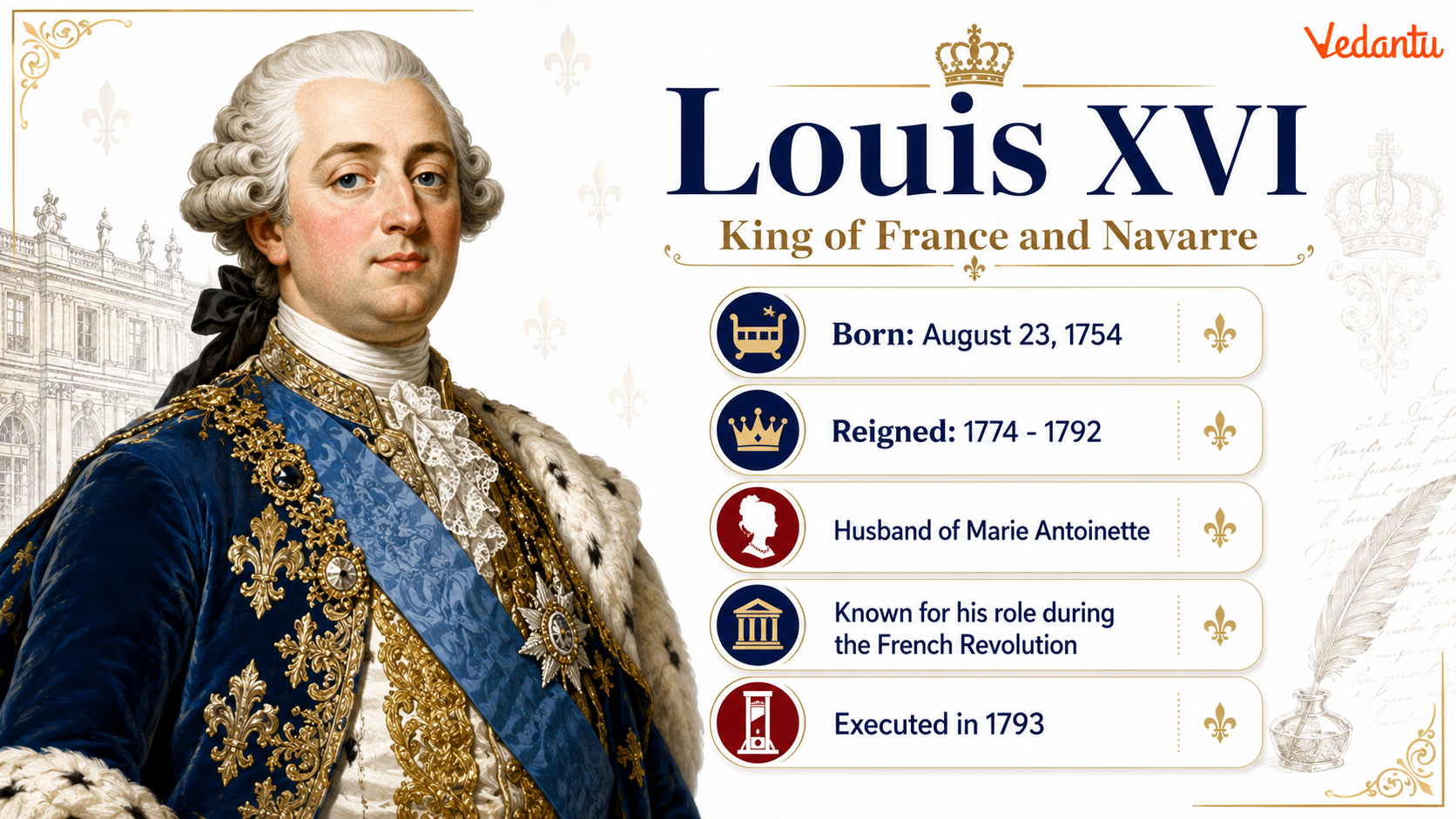
Who is Louis XVI?
Louis XVI, born as Louis-Auguste, was the King of France and Navarre from 1774 to 1792. He belonged to the Bourbon dynasty and became king after the death of his grandfather, Louis XV. Louis XVI is most famous for his role during the French Revolution, which ultimately led to his execution in 1793. He is remembered as the last absolute monarch of France before the establishment of the First French Republic. His reign is an important topic in history for understanding monarchy, revolution, and the rise of democratic ideals.
Early Life and Family Background
Louis XVI early life was shaped by royal traditions and strict court discipline. Born into the royal family, he was not originally expected to become king but later became the heir after the death of his elder brother.
- Date of Birth: 23 August 1754
- Place of Birth: Palace of Versailles, France
- Father: Louis, Dauphin of France
- Mother: Maria Josepha of Saxony
- Belonged to the powerful Bourbon royal family
- Became heir to the throne after his elder brother’s death in 1761
As a child, Louis was shy and serious. He was more interested in practical subjects and mechanical skills than in politics or court life.
Education and Early Interests
Louis XVI education was guided by private tutors, as was common for royal children. He received training in subjects necessary for a future ruler.
- Studied history, geography, languages, and religion
- Learned Latin and showed interest in English
- Developed a strong interest in locksmithing and mechanical work
- Received military training as part of royal education
Though intelligent and well educated, he lacked strong decision-making skills, which later affected his rule during times of crisis.
Career Journey and Major Life Events
Becoming King of France
Louis XVI became king in 1774 at the age of 19 after the death of his grandfather, Louis XV. At that time, France was facing serious financial problems due to wars and royal expenses.
Marriage to Marie Antoinette
In 1770, Louis married Marie Antoinette, an Austrian archduchess. The marriage was meant to strengthen the alliance between France and Austria. However, during the revolution, the royal couple became unpopular among the public.
Financial Crisis and Reform Attempts
France faced heavy debt due to the Seven Years' War and support for the American War of Independence. Louis appointed financial ministers like Turgot and Necker to introduce reforms. However:
- Attempts to tax the nobility were strongly opposed.
- The Estates-General was called in 1789 for the first time in 175 years.
- This led to the formation of the National Assembly and the beginning of the French Revolution.
French Revolution and Fall of Monarchy
As revolutionary ideas spread, Louis struggled to respond effectively. Key events included:
- Storming of the Bastille in 1789
- Adoption of the Declaration of the Rights of Man and of the Citizen
- Attempted escape known as the Flight to Varennes in 1791
- Suspension of the monarchy in 1792
He was later tried for treason by the revolutionary government.
Timeline of Important Events
| Year / Date | Event |
|---|---|
| 23 August 1754 | Birth of Louis-Auguste at Versailles |
| 1770 | Marriage to Marie Antoinette |
| 1774 | Became King of France |
| 1789 | French Revolution began; Estates-General called |
| 1791 | Flight to Varennes |
| 1792 | Monarchy abolished in France |
| 21 January 1793 | Execution of Louis XVI |
Major Achievements of Louis XVI
- Supported the American War of Independence, helping the American colonies gain freedom from Britain
- Attempted financial and administrative reforms
- Encouraged scientific exploration, including support for voyages like that of La Perouse
- Agreed to a constitutional monarchy in 1791 before abolition
Contributions of Louis XVI
Contribution to International Politics
- Played a key role in supporting American independence
- Influenced global politics by weakening British power
Contribution to French Political Change
- His reign led to the end of absolute monarchy in France
- Events during his rule paved the way for modern democracy in France
Ideology, Thoughts, and Values
Louis XVI believed in the traditional system of monarchy but showed some willingness to accept reforms.
- Supported royal authority and divine right of kings
- Accepted constitutional limits under pressure
- Valued religion and tradition
- Showed personal honesty but lacked political firmness
Challenges and Struggles
- Severe financial crisis and national debt
- Opposition from nobles against taxation reforms
- Growing public anger due to food shortages and high taxes
- Political instability during the French Revolution
- Trial and execution for treason
Later Life and Death
After the monarchy was abolished in 1792, Louis XVI was arrested and imprisoned. He was tried by the National Convention on charges of treason.
- Date of Death: 21 January 1793
- Place of Death: Paris, France
- Executed by guillotine at the age of 38
His execution marked the end of centuries of Bourbon rule and symbolized the triumph of revolutionary ideals in France.
Legacy and Historical Significance
- Last king of France before the First Republic
- Central figure in the French Revolution
- His reign transformed France from monarchy to republic
- Important topic in world history and political science
- Symbol of the fall of absolute monarchy in Europe
Lessons Students Can Learn from Louis XVI
- Importance of strong and timely decision making
- Need to understand public concerns and social inequality
- Value of financial responsibility in governance
- How leadership impacts the future of a nation
Quick Facts About Louis XVI
| Detail | Information |
|---|---|
| Full Name | Louis-Auguste de France |
| Date of Birth | 23 August 1754 |
| Nationality | French |
| Reign | 1774 - 1792 |
| Spouse | Marie Antoinette |
| Known For | Role in the French Revolution |
| Date of Death | 21 January 1793 |
Key Terms Related to Louis XVI
| Term | Meaning |
|---|---|
| Absolute Monarchy | A system where the king holds complete power |
| Estates-General | Representative assembly of the three estates of France |
| French Revolution | Revolution from 1789 that ended monarchy in France |
| Guillotine | Device used for execution during the revolution |
Interesting Facts About Louis XVI
- He was not originally expected to become king.
- He had a strong interest in locksmithing and mechanical crafts.
- France’s support of the American Revolution increased its financial crisis.
- He attempted to escape Paris during the revolution but was captured.
- His execution was one of the most dramatic events of the French Revolution.
- He was the only French king to be executed.
Conclusion
The Louis XVI biography reflects a period of major political transformation in France. His reign witnessed financial crisis, social unrest, and the powerful rise of revolutionary ideas. Although he attempted reforms, his leadership during the French Revolution ultimately led to the fall of the monarchy and his execution. The Louis XVI life history remains significant for understanding the shift from absolute monarchy to democratic governance and the lasting impact of the French Revolution on world history.
FAQs on Louis XVI Life History Achievements and Legacy
Louis XVI was the last king of France before the French Revolution and ruled from 1774 to 1792. Born on 23 August 1754 at the Palace of Versailles, he belonged to the Bourbon dynasty. His reign is a major part of European history because it ended with the abolition of the monarchy and his execution during the French Revolution.
Louis XVI is famous for his role in the French Revolution and for being executed by guillotine in 1793. His inability to solve France’s financial crisis and political unrest led to revolutionary movements that transformed France into a republic. His trial and execution on 21 January 1793 marked a turning point in modern political history.
Louis XVI was born into the French royal family and became heir to the throne after the death of his father and elder brother. As a child, he was shy and serious, receiving training suitable for a future king. He grew up in the royal court of Versailles under strict supervision and traditional monarchical values.
Louis XVI received a royal education focused on religion, history, languages, and political governance. He was particularly interested in geography and science but lacked strong leadership training. His education prepared him formally for kingship, yet he struggled with decision-making during times of crisis.
Louis XVI was married to Marie Antoinette, an Austrian archduchess, in 1770. Their marriage symbolized an alliance between France and Austria. The royal couple had four children, though only one survived to adulthood. Marie Antoinette also became a controversial figure during the French Revolution.
Louis XVI faced severe financial, political, and social crises during his reign. France was deeply in debt due to costly wars and royal spending. Key challenges included:
- Financial crisis caused by support for the American Revolution
- Heavy taxation on the common people
- Growing demands for political reform and equality
- Conflict with the Estates-General in 1789
Louis XVI’s actions and indecisiveness contributed to the outbreak of the French Revolution in 1789. He called the Estates-General to address financial problems, but disagreements led to the formation of the National Assembly. His attempted escape in the Flight to Varennes (1791) reduced public trust and strengthened revolutionary forces.
Louis XVI was executed by guillotine on 21 January 1793 in Paris. After the monarchy was abolished in 1792, he was tried by the revolutionary government for treason. His execution symbolized the end of absolute monarchy in France and the rise of republican governance.
Louis XVI’s legacy is closely linked to the fall of the French monarchy and the rise of democracy in France. His reign marked the transition from absolute monarchy to republicanism. The events during his rule influenced modern ideas of liberty, equality, and constitutional government across Europe and the world.
Several interesting facts make Louis XVI an important historical personality for exam preparation and general knowledge.
- He supported the American War of Independence against Britain
- He was skilled in locksmithing as a hobby
- He initially accepted a constitutional monarchy before being overthrown
- His execution was witnessed by thousands in Paris
