







Confucius Early Life Education Major Teachings and Contributions to Chinese Philosophy
Confucius was one of the most influential philosophers and teachers in world history. Born in ancient China, he developed a system of moral, social, and political thought that shaped Chinese civilization for more than two thousand years. His teachings focused on ethics, respect, education, good governance, and personal character. The study of the Confucius biography helps students understand the foundations of Chinese culture and the importance of values such as discipline, honesty, and respect in building a harmonious society.
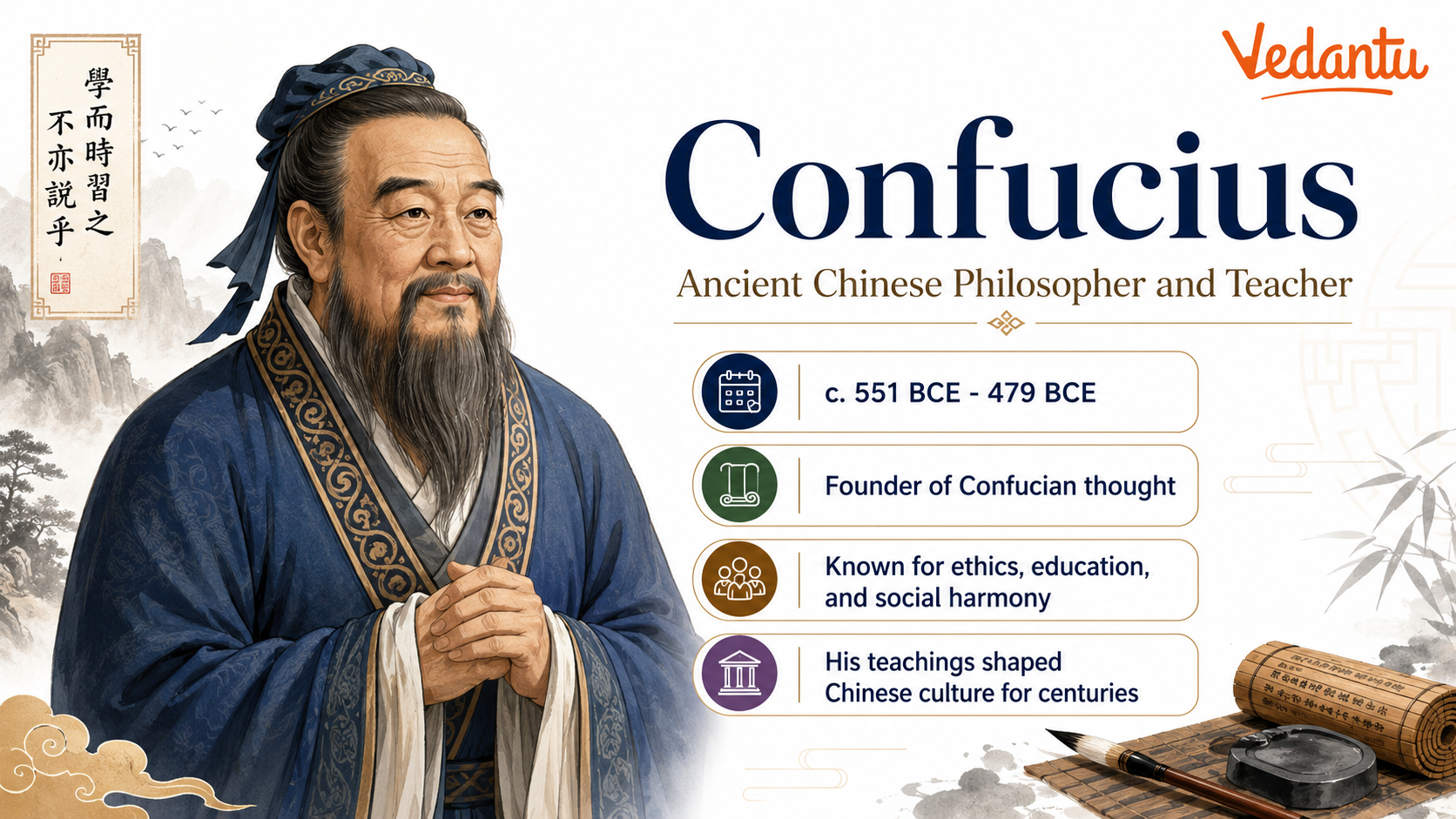
Basic Information About Confucius
| Category | Details |
|---|---|
| Full Name | Kong Qiu |
| Popular Name | Confucius or Kong Fuzi |
| Birth | 551 BCE, State of Lu, China |
| Death | 479 BCE, China |
| Nationality | Chinese |
| Profession | Philosopher, Teacher, Political Thinker |
| Known For | Founder of Confucianism |
Who is Confucius?
Confucius, whose original name was Kong Qiu, was a Chinese philosopher and teacher who lived during the Spring and Autumn Period of Chinese history. He is best known as the founder of Confucianism, a system of thought that emphasizes morality, family loyalty, respect for elders, education, and good governance. His ideas influenced Chinese society, politics, education, and culture for centuries and spread to countries like Korea, Japan, and Vietnam. The Confucius life history remains important for students studying philosophy, history, ethics, and world civilizations.
Early Life and Family Background
Confucius was born in 551 BCE in the State of Lu, which is in present-day Shandong Province, China. He grew up during a time of political instability and social disorder.
- His father, Kong He, was a military officer who died when Confucius was very young.
- He was raised by his mother in modest economic conditions.
- Despite poverty, he showed a deep interest in learning and ancient traditions from childhood.
- He admired old customs, rituals, and moral values of earlier Chinese rulers.
His early exposure to social inequality and political disorder influenced his desire to create a system based on morality and discipline.
Education and Early Interests
The Confucius education was largely self-driven. During his time, formal education was limited to the nobility, but he studied independently and worked hard to gain knowledge.
- He studied history, poetry, music, and rituals.
- He was deeply interested in moral philosophy and governance.
- He believed that education should be available to all, not just the rich.
- Later, he became one of the first teachers in China to accept students from different social backgrounds.
His love for learning shaped his role as a teacher and reformer.
Career Journey and Major Life Events
Beginning as a Teacher
Confucius started his career as a teacher. He gathered a group of students and taught them ethics, proper behavior, and political principles. He believed that moral character was the foundation of a strong society.
Government Service
Confucius later worked in government positions in the State of Lu.
- He served in minor administrative roles.
- Eventually, he became a Minister of Justice.
- He tried to implement reforms based on morality and fairness.
However, political opposition forced him to leave his position.
Years of Travel
After leaving office, Confucius traveled to different Chinese states for many years. He advised rulers on governance and ethical leadership, but most did not fully accept his ideas during his lifetime.
Return and Final Years
In his later years, he returned to Lu and focused on teaching and editing ancient texts. He continued to guide his disciples until his death in 479 BCE.
Timeline of Important Events
| Year | Event |
|---|---|
| 551 BCE | Birth of Confucius in the State of Lu |
| Early adulthood | Began career as a teacher |
| c. 500 BCE | Served in government positions in Lu |
| Later years | Traveled across Chinese states spreading his teachings |
| 479 BCE | Death of Confucius |
Major Achievements of Confucius
- Founded the philosophical system known as Confucianism.
- Established one of the earliest private schools in China.
- Promoted moral governance based on virtue rather than punishment.
- His teachings were compiled in the book The Analects by his disciples.
- Influenced Chinese civil service examination systems for centuries.
Contributions of Confucius
Contribution to Philosophy
- Developed ethical principles centered on Ren - kindness and humanity.
- Emphasized Li - proper conduct and rituals.
- Encouraged Xiao - filial piety or respect for parents and elders.
Contribution to Education
- Promoted education for all classes of society.
- Focused on character building along with academic learning.
Contribution to Governance
- Advocated rule by moral example rather than strict laws.
- Stressed the importance of honest and virtuous leaders.
Ideology, Thoughts, and Values
The core of Confucius contributions lies in his ethical teachings and moral philosophy.
- Humaneness - Treat others with kindness and compassion.
- Respect - Maintain respect within family and society.
- Integrity - Act with honesty and righteousness.
- Self-discipline - Improve oneself through continuous learning.
- Belief that social harmony begins with personal moral development.
Challenges and Struggles
- Lived during a period of political instability and conflict.
- Faced opposition from powerful political groups.
- Many rulers ignored his advice during his lifetime.
- Spent years traveling without achieving political success.
Although he did not see widespread acceptance of his ideas during his lifetime, his teachings became highly influential after his death.
Famous Works of Confucius
| Work | Importance |
|---|---|
| The Analects | Collection of sayings and ideas recorded by his disciples |
| Five Classics - traditionally associated | Ancient Chinese texts edited or preserved in Confucian tradition |
Later Life and Death
In his final years, Confucius returned to his home state and dedicated himself to teaching and preserving ancient traditions. He passed away in 479 BCE. After his death, his disciples continued spreading his teachings across China. Over time, Confucianism became the foundation of Chinese state philosophy and education.
Legacy and Historical Significance
- Regarded as one of the greatest philosophers in world history.
- His ideas shaped Chinese culture for over two thousand years.
- Influenced education systems and civil service examinations in China.
- Confucian temples and memorials exist in many countries.
- His teachings remain relevant in discussions of ethics and leadership.
Lessons Students Can Learn from Confucius
- Value of continuous learning and self-improvement.
- Importance of respecting parents, teachers, and elders.
- Power of moral character in leadership.
- Need for discipline and responsibility in daily life.
- Belief that a good society begins with good individuals.
Quick Facts About Confucius
| Particular | Details |
|---|---|
| Full Name | Kong Qiu |
| Birth Year | 551 BCE |
| Death Year | 479 BCE |
| Field | Philosophy and Education |
| Main Teaching | Moral living and social harmony |
| Famous Book | The Analects |
Interesting Facts About Confucius
- Confucius had more than 3,000 students, according to tradition.
- His birthday is still celebrated in parts of China and East Asia.
- Confucianism became the official state philosophy during the Han Dynasty.
- He believed that rulers should lead by moral example.
- Many modern schools and institutes are named after Confucius.
- His teachings continue to influence ethics and leadership studies worldwide.
Conclusion
The Confucius biography highlights the life of a thinker who transformed moral and social philosophy in ancient China. Though he faced challenges during his lifetime, his teachings on ethics, education, and good governance shaped civilizations for centuries. The Confucius legacy continues to inspire students and leaders around the world, reminding us that strong values and disciplined character are the foundations of a peaceful and successful society.
FAQs on Confucius Biography and Life History with Philosophy and Legacy
Confucius was a famous Chinese philosopher, teacher, and political thinker of ancient China. Born in 551 BCE in the state of Lu (present-day Shandong, China), he founded the ethical and philosophical system known as Confucianism. His life history focuses on moral values, good governance, social harmony, and respect for family, which deeply influenced Chinese civilization and East Asian culture for centuries.
Confucius is famous for his teachings on morality, education, and proper social relationships. His philosophy shaped Chinese society, government administration, and education systems for over 2,000 years. His ideas on filial piety, respect for elders, rituals, and ethical leadership remain important in world history and are widely studied for exams and general knowledge.
Confucius had a humble and disciplined early life that shaped his character and values. He was born into a modest family, and his father died when he was young. Despite financial difficulties, he showed a strong interest in learning and self-improvement, which later became central themes in his biography and teachings.
Confucius educated himself through dedicated study and practical experience. Although he did not attend a formal institution, he mastered subjects such as:
- History
- Poetry
- Music
- Rituals and traditions
He later became one of the first teachers in China to promote education for all, regardless of social class, making education a key contribution in his life history.
The main teachings of Confucius focus on moral conduct and social harmony. His philosophy, known as Confucianism, emphasizes:
- Ren (kindness and humaneness)
- Li (proper behavior and rituals)
- Yi (righteousness)
- Filial piety (respect for parents and elders)
These principles guided personal behavior, leadership, and governance in ancient China and remain important in ethical studies.
The most famous work associated with Confucius is the “Analects.” The Analects (Lunyu) is a collection of his sayings and conversations recorded by his disciples. He is also traditionally linked with editing classical Chinese texts such as the Book of Documents and the Book of Rites, which are important sources in Chinese literary and cultural history.
Confucius faced political struggles and lack of recognition during his lifetime. Although he worked as a government official in the state of Lu, his political reforms were not fully accepted. He traveled across different states seeking rulers who would apply his ideas on ethical governance, but he often faced rejection and disappointment.
Confucius made lasting contributions to philosophy, education, and governance. His key contributions include:
- Founding the moral system of Confucianism
- Promoting merit-based education
- Emphasizing ethical leadership and good governance
- Influencing the Chinese civil service examination system
These contributions shaped East Asian society and remain important in world history studies.
The legacy of Confucius lies in his deep and lasting impact on Chinese civilization. After his death in 479 BCE, his teachings became the foundation of state philosophy during the Han Dynasty. Confucian values influenced culture, family structure, education, and political systems across China, Korea, Japan, and Vietnam, highlighting his global historical significance.
Students can learn the importance of discipline, respect, and lifelong learning from Confucius. His biography teaches valuable lessons such as:
- Value of education and self-improvement
- Importance of moral character
- Respect for teachers, parents, and society
- Leadership based on ethics and responsibility
These principles make his life history highly relevant for school exams, essays, speeches, and character education.
