







Early Life Education Steel Empire and Philanthropic Contributions
Andrew Carnegie was a Scottish-American industrialist, businessman, and philanthropist who played a major role in the growth of the American steel industry in the late 19th century. Rising from poverty to become one of the richest men in history, Carnegie built the powerful Carnegie Steel Company and later dedicated most of his wealth to education, libraries, and public institutions. The Andrew Carnegie biography is an inspiring story of hard work, ambition, and generosity. His life history is often studied by students to understand industrial development, entrepreneurship, and the importance of giving back to society.
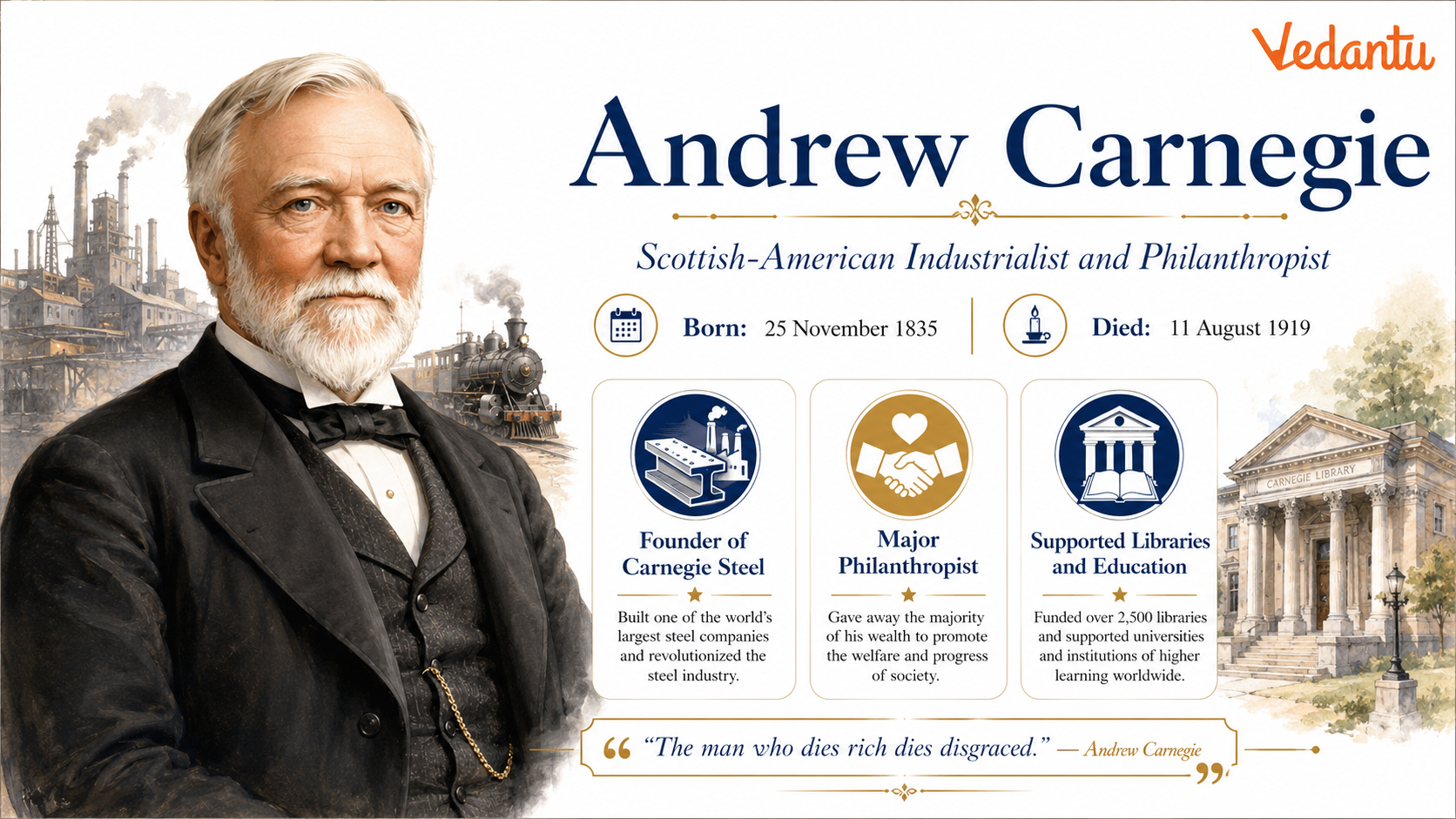
Basic Information About Andrew Carnegie
| Field | Details |
|---|---|
| Full Name | Andrew Carnegie |
| Date of Birth | 25 November 1835 |
| Place of Birth | Dunfermline, Scotland |
| Nationality | Scottish-American |
| Profession | Industrialist and Philanthropist |
| Famous For | Carnegie Steel Company and Large-scale Philanthropy |
| Date of Death | 11 August 1919 |
Who is Andrew Carnegie?
Andrew Carnegie was a leading figure in the American steel industry during the late 1800s. He is best known for building Carnegie Steel Company, which became the largest and most profitable steel company in the world at that time. After selling his company, he devoted his life to philanthropy and donated a large portion of his wealth to build libraries, universities, and research institutions. The Andrew Carnegie biography is important for students studying industrialization, economics, and social responsibility.
Early Life and Family Background
Andrew Carnegie was born into a poor working-class family in Scotland. His early life was marked by financial hardship, which shaped his strong desire for success and stability.
- Born on 25 November 1835 in Dunfermline, Scotland.
- Father, William Carnegie, was a handloom weaver.
- Mother, Margaret Carnegie, worked to support the family.
- Due to economic difficulties, the family migrated to the United States in 1848.
- Settled in Allegheny, Pennsylvania, where Carnegie began working at a young age.
Education and Early Interests
Andrew Carnegie did not receive much formal education because he had to work to support his family. However, he was highly self-educated and developed a strong interest in reading and learning.
- Worked as a bobbin boy in a cotton factory at the age of 13.
- Later became a telegraph messenger and quickly learned telegraphy.
- Borrowed books from a local benefactor’s private library, which greatly influenced his thinking.
- Developed strong skills in communication, business, and investment.
Career Journey and Major Life Events
Early Career in Railroads
Carnegie’s career began in the railroad industry. He worked under Thomas A. Scott of the Pennsylvania Railroad, where he learned management and investment skills.
Investments and Business Expansion
Carnegie invested in iron bridges, oil wells, and other industries. He understood the importance of steel in construction and transportation, especially for railroads.
Formation of Carnegie Steel Company
In the 1870s, he focused on steel production. By adopting new technologies like the Bessemer process, he reduced production costs and increased efficiency. His company became the largest steel producer in the world.
Sale to J.P. Morgan
In 1901, Carnegie sold his steel company to J.P. Morgan for about 480 million dollars. The company later became part of U.S. Steel Corporation. After this, Carnegie retired from business and focused entirely on philanthropy.
Timeline of Important Events
| Year | Event |
|---|---|
| 1835 | Born in Dunfermline, Scotland |
| 1848 | Moved to the United States |
| 1870s | Entered steel manufacturing business |
| 1892 | Formed Carnegie Steel Company |
| 1901 | Sold company to J.P. Morgan |
| 1919 | Died in Lenox, Massachusetts |
Major Achievements of Andrew Carnegie
- Built the largest steel company of his time.
- Became one of the richest individuals in modern history.
- Donated over 350 million dollars to charitable causes.
- Funded more than 2,500 public libraries worldwide.
- Established institutions like Carnegie Mellon University and Carnegie Hall.
Contributions of Andrew Carnegie
Contribution to Industry
- Modernized steel production in the United States.
- Encouraged mass production and cost efficiency.
Contribution to Education and Society
- Promoted access to free public libraries.
- Supported scientific research and peace initiatives.
- Wrote essays encouraging wealthy individuals to donate for public welfare.
Ideology, Thoughts, and Values
Andrew Carnegie strongly believed in the idea that the rich have a moral duty to use their wealth for the benefit of society. His essay The Gospel of Wealth explained his philosophy.
- Believed in hard work and self-improvement.
- Supported education as a tool for social progress.
- Encouraged philanthropy among wealthy individuals.
- Promoted peace and international cooperation.
Challenges and Struggles
- Grew up in poverty and had to work from a young age.
- Faced criticism for harsh labor conditions in his steel factories.
- The Homestead Strike of 1892 became a major controversy in his career.
Famous Works and Institutions
| Work / Institution | Importance |
|---|---|
| The Gospel of Wealth | Essay promoting philanthropy |
| Carnegie Libraries | Improved public access to knowledge |
| Carnegie Hall | Famous cultural and music venue |
| Carnegie Mellon University | Leading institution for higher education |
Later Life and Death
After retiring from business in 1901, Andrew Carnegie spent the rest of his life donating his wealth to public causes. He focused on education, world peace, and scientific research. He passed away on 11 August 1919 in Lenox, Massachusetts, USA. By the time of his death, he had given away most of his fortune.
Legacy and Historical Significance
- Remembered as a pioneer of the American steel industry.
- Set an example of large-scale philanthropy.
- Thousands of libraries and institutions continue to serve society.
- His ideas influenced modern corporate social responsibility.
Lessons Students Can Learn from Andrew Carnegie
- Hard work can change one’s life.
- Education is a powerful tool for success.
- Wealth should be used for the benefit of society.
- Continuous learning leads to growth.
Quick Facts About Andrew Carnegie
| Category | Details |
|---|---|
| Full Name | Andrew Carnegie |
| Birth | 25 November 1835 |
| Profession | Industrialist and Philanthropist |
| Famous For | Steel Industry and Philanthropy |
| Key Writing | The Gospel of Wealth |
| Death | 11 August 1919 |
Interesting Facts About Andrew Carnegie
- He worked full-time by the age of 13.
- He was once one of the richest people in the world.
- He funded over 2,500 libraries globally.
- He believed that dying wealthy was a disgrace.
- He supported peace efforts and established peace foundations.
- His life is often cited as an example of the American Dream.
Conclusion
The Andrew Carnegie biography reflects the journey of a poor immigrant who became a leading industrialist and later a generous philanthropist. His life history teaches the importance of hard work, innovation, and social responsibility. Through his achievements and contributions, especially in education and public welfare, Andrew Carnegie left a lasting legacy that continues to benefit society. His story remains an inspiring example for students and future leaders around the world.
FAQs on Andrew Carnegie Biography and Major Achievements
Andrew Carnegie was a Scottish-American industrialist and philanthropist who became one of the richest men of the 19th century through the steel industry. Born on November 25, 1835, in Dunfermline, Scotland, he later moved to the United States and built the powerful Carnegie Steel Company. His biography is widely studied for his rise from poverty to wealth and for his major contributions to education, libraries, and public institutions.
Andrew Carnegie is famous for building the American steel industry and for his large-scale philanthropy. He played a key role in expanding steel production in the United States during the Industrial Revolution and later donated most of his wealth for social causes. His life history is often cited in business studies and exam preparation.
Andrew Carnegie came from a poor family and immigrated to the United States as a child. His family moved to Pennsylvania in 1848 due to economic hardship in Scotland. As a young boy, he worked in a cotton factory and later as a telegraph messenger, showing early determination and ambition that shaped his career journey.
Andrew Carnegie had little formal education but educated himself through reading and self-study. He did not attend college; instead, he borrowed books from a local benefactor’s library, which deeply influenced his belief in public libraries. His self-education played a major role in his leadership and business success.
Andrew Carnegie built his steel empire by investing in railroads, iron, and eventually steel manufacturing. He adopted the Bessemer process to produce steel more efficiently and cheaply. In 1901, he sold Carnegie Steel Company to J.P. Morgan, which became part of U.S. Steel, making him extremely wealthy.
Andrew Carnegie’s major achievements include revolutionizing steel production and becoming a leading philanthropist. His achievements are important in economic and social history.
- Founder of Carnegie Steel Company
- Donated over $350 million for public welfare
- Funded the construction of more than 2,500 public libraries worldwide
Andrew Carnegie contributed greatly to education, peace, and scientific research through philanthropy. After retiring from business, he devoted his life to charitable activities and social reform.
- Established Carnegie Mellon University
- Founded the Carnegie Endowment for International Peace
- Supported schools, libraries, and cultural institutions
Andrew Carnegie faced poverty in childhood and criticism during his industrial career. As an immigrant worker, he struggled financially in his early years. Later, events like the Homestead Strike of 1892 brought criticism to his labor practices, making his biography complex and historically significant.
“The Gospel of Wealth” is an 1889 essay in which Andrew Carnegie explained his philosophy on wealth and philanthropy. In this famous work, he argued that rich individuals have a moral responsibility to distribute their wealth for the benefit of society. This writing remains important in discussions about social responsibility and leadership.
Andrew Carnegie’s legacy lies in both industrial growth and large-scale philanthropy. He is remembered as a symbol of the American Dream and as one of the greatest philanthropists in history. His life history is frequently studied in schools for essays, speeches, and competitive exams due to his lasting social impact and historical significance.
