






Where Do Titi Monkeys Live and What Do They Eat?
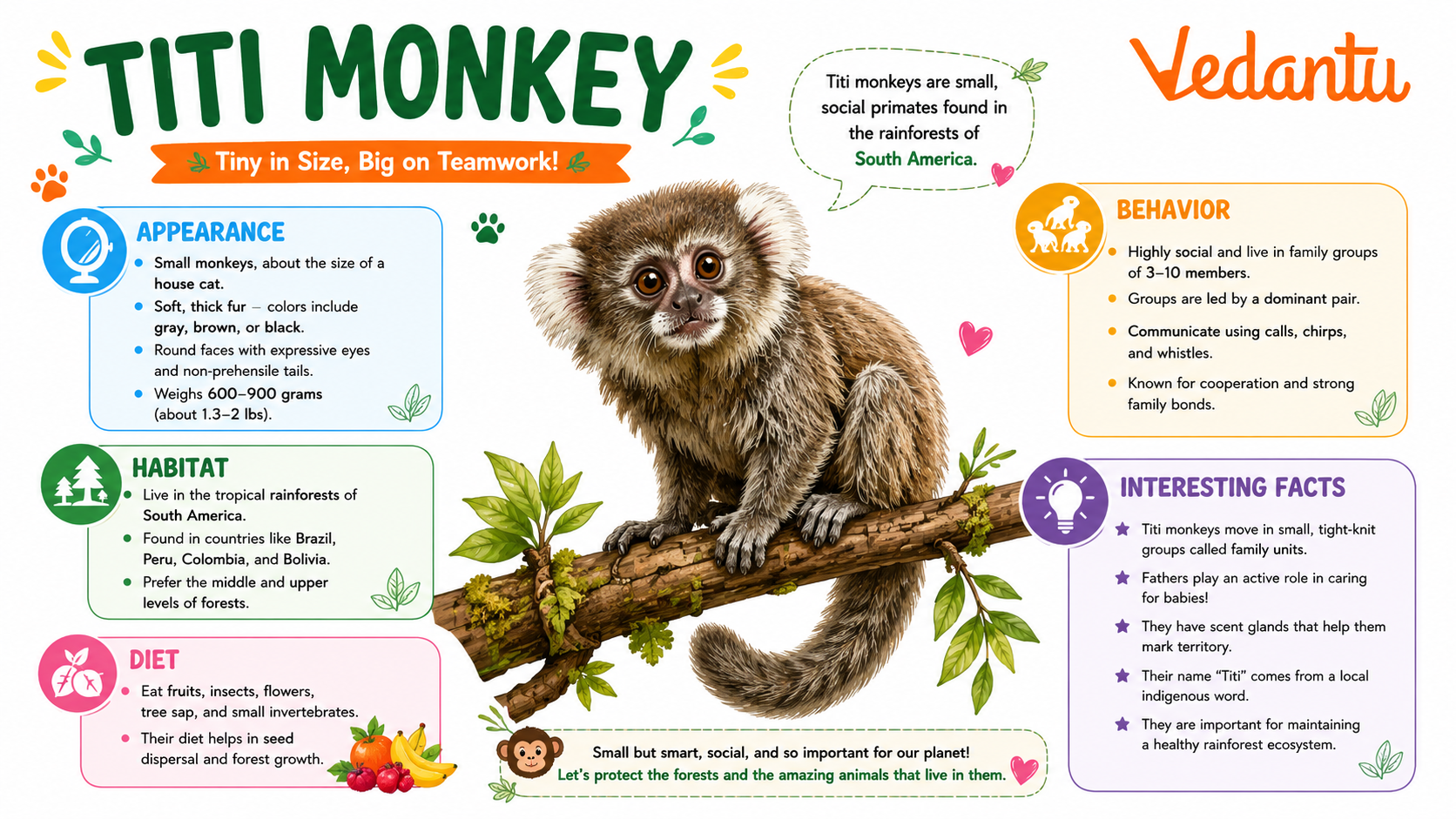
Titi monkeys are small, tree-living monkeys found in South America. Known for their soft fur, long tails, and strong family ties, these adorable primates are fascinating to learn about. One of the most interesting Titi Monkey facts is that they form lifelong pairs and often sit with their tails wrapped together. Let’s explore the Titi Monkey habitat, diet, characteristics, life cycle, and importance in nature in a fun and simple way.
Quick Facts About Titi Monkey
| Feature | Details |
|---|---|
| Common Name | Titi Monkey |
| Scientific Name | Callicebus (Genus) |
| Animal Group | Mammal (Primate) |
| Size | About 30–45 cm (body length) |
| Weight | 1–2 kg |
| Habitat | Tropical forests and woodlands |
| Diet | Fruits, leaves, insects |
| Lifespan | Up to 12–15 years (wild) |
| Conservation Status | Some species Near Threatened or Vulnerable |
Appearance and Physical Characteristics
- Small body with a long, fluffy tail.
- Soft and thick fur, often grey, brown, reddish, or black.
- Rounded face with expressive eyes.
- Tail is not prehensile (cannot grip), but helps in balance.
- Strong legs for jumping between trees.
Habitat and Distribution
- Found in Brazil, Peru, Colombia, Bolivia, and Paraguay.
- Prefer warm and humid climates.
- Spend most of their time in trees (arboreal lifestyle).
- Sleep in dense tree branches for safety.
Diet and Feeding Habits
- Eat fruits, berries, and seeds.
- Also feed on leaves and flowers.
- Occasionally eat insects.
- Search for food during the day.
They play an important role in spreading seeds across forests, which helps new plants grow.
Behaviour and Lifestyle
- Live in small family groups of 2–7 members.
- Usually form lifelong pairs.
- Active during the day (diurnal).
- Communicate using high-pitched calls.
- Very protective of their territory.
Sound or Call
Titi monkeys make loud, high-pitched calls in the morning. These calls help them mark their territory and communicate with nearby groups.
Life Cycle and Reproduction
- Birth: Female gives birth to one baby at a time.
- Infant Stage: The father carries the baby most of the time.
- Juvenile Stage: Young monkeys learn to climb and find food.
- Adult Stage: They form pairs and start their own families.
What Makes Titi Monkey Special?
Importance and Role in Nature
Amazing Titi Monkey Facts
- There are more than 30 different species of Titi monkeys.
- They are among the most monogamous primates.
- Their thick fur helps them stay warm in cool mornings.
- They rarely come down to the ground.
- Each group has its own territory.
- They use both sounds and body language to communicate.
Fun Facts for Kids
FAQs on Titi Monkey: Complete Guide to These Devoted Rainforest Primates
1. What is a Titi Monkey?
A Titi Monkey is a small, tree-dwelling monkey that lives in the forests of South America.
- Belongs to the New World monkey group
- Known for its soft fur and long tail
- Lives mostly in tropical rainforests
- Famous for strong family bonds
2. Where do Titi Monkeys live?
Titi Monkeys live in the warm forests of South America.
- Found in countries like Brazil, Peru, Colombia, and Bolivia
- Prefer rainforests and woodlands
- Spend most of their time high in the tree canopy
3. What do Titi Monkeys eat?
Titi Monkeys are mostly fruit-eating animals but enjoy other forest foods too.
- Main diet includes fruits and berries
- Also eat leaves and seeds
- Sometimes snack on insects
4. How big is a Titi Monkey?
A Titi Monkey is small and lightweight compared to many other monkeys.
- Body length: about 9–18 inches
- Tail length: often longer than its body
- Weight: around 1–3 pounds
5. Why are Titi Monkeys known for strong family bonds?
Titi Monkeys are famous for forming very close family groups.
- Usually live in small family units
- Parents stay together as a monogamous pair
- Fathers help carry and care for the baby monkey
- Often sit close and wrap tails together
6. Are Titi Monkeys endangered?
Some species of Titi Monkeys are considered threatened or endangered.
- Main threat is deforestation
- Loss of rainforest habitat
- Protected in some wildlife reserves
7. How do Titi Monkeys communicate?
Titi Monkeys communicate using sounds and body language.
- Make loud morning calls to mark territory
- Use high-pitched vocalizations
- Show affection by grooming and sitting close
8. What are the different types of Titi Monkeys?
There are many species of Titi Monkeys, each with unique colors and features.
- Belong to the genera Callicebus, Plecturocebus, and Cheracebus
- Some have red, brown, or gray fur
- Species vary by region and habitat
9. How long do Titi Monkeys live?
Titi Monkeys can live for many years, especially in safe environments.
- Average lifespan in the wild: about 12–15 years
- May live longer in zoos or protected areas
- Life depends on food supply and safety from predators
10. What makes Titi Monkeys special?
Titi Monkeys are special because of their loving behavior and unique lifestyle.
- Strong pair bonding between parents
- Fathers play a big role in raising babies
- Use tails for balance in trees
- Important part of the rainforest ecosystem
