






What Did Spinosaurus Eat and How Did It Live?
Spinosaurus was one of the most fascinating and unusual dinosaurs ever discovered. Living during the Late Cretaceous period, it is famous for its long crocodile-like snout and huge sail on its back. Unlike many other meat-eating dinosaurs, Spinosaurus was specially adapted for life near water. In fact, many scientists believe it was one of the first known swimming dinosaurs. Let’s explore amazing Spinosaurus facts, habitat, diet, characteristics, and life cycle in this fun learning page!
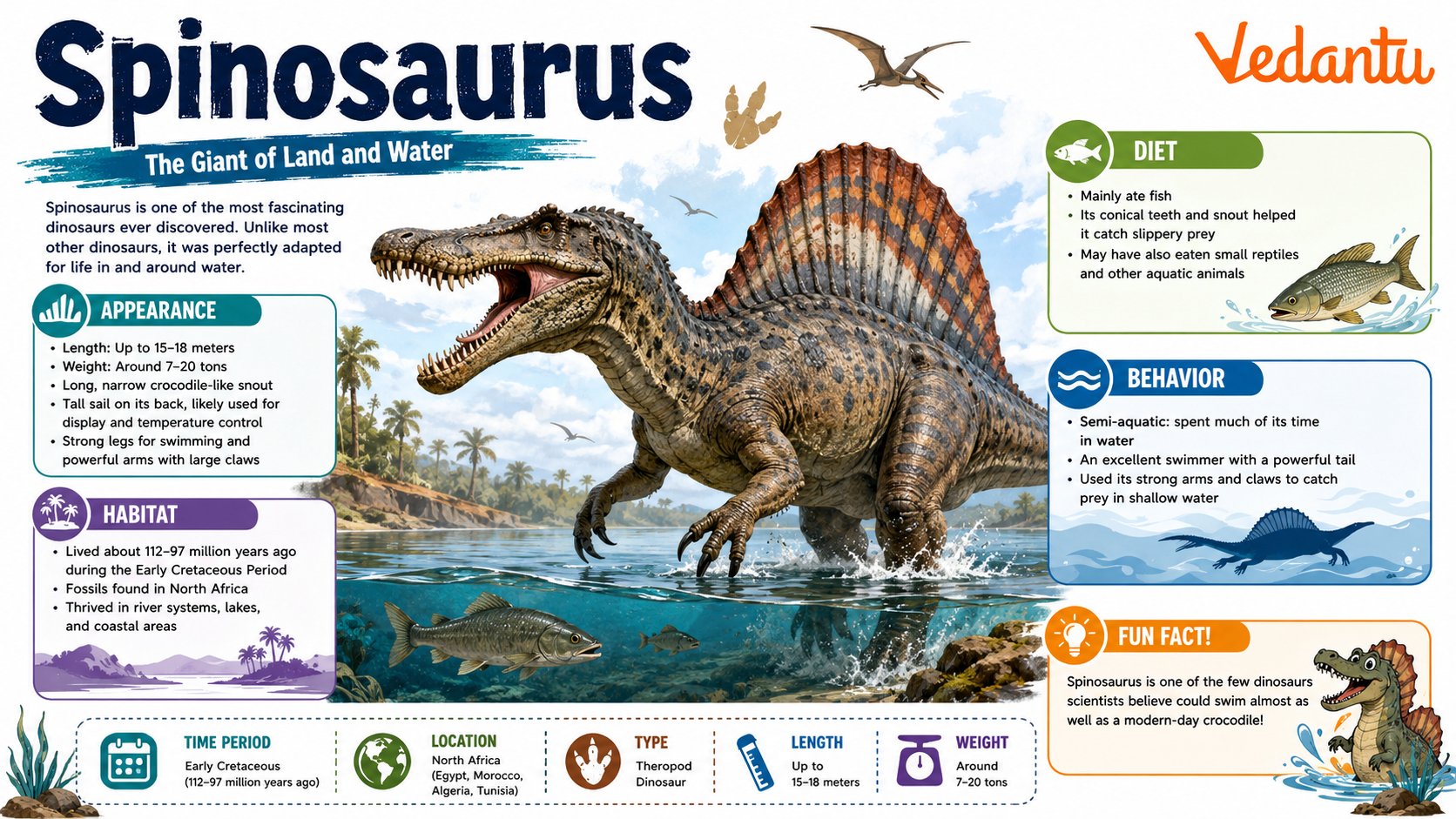
Quick Facts and Statistics
| Feature | Details |
|---|---|
| Common Name | Spinosaurus |
| Scientific Name | Spinosaurus aegyptiacus |
| Animal Group | Dinosaur (Theropod) |
| Period | Late Cretaceous (about 100–93 million years ago) |
| Length | Up to 15–18 meters |
| Weight | Around 7–9 tons |
| Diet | Carnivore (mainly fish) |
| Habitat | Rivers, swamps, and wetlands |
| Fossils Found In | North Africa (Egypt, Morocco) |
Appearance and Physical Characteristics
- Long, narrow snout like a crocodile.
- Sharp, cone-shaped teeth perfect for catching fish.
- Large sail on its back made of long spine bones.
- Strong front arms with large claws.
- Possibly webbed feet for swimming.
Spinosaurus Habitat and Distribution
- Lived in North Africa.
- Preferred river systems, lakes, and swampy areas.
- Warm, tropical climate.
- Shared its habitat with giant fish and other dinosaurs.
Fossils suggest that Spinosaurus spent much of its time near water. Its body was specially built to move easily in rivers and shallow seas.
Diet and Feeding Habits
In the food chain, Spinosaurus was a top predator in its river ecosystem.
Behaviour and Lifestyle
- Likely semi-aquatic and comfortable both on land and in water.
- Used its tail to swim powerfully.
- Probably hunted alone rather than in groups.
- May have used its sail for display or temperature control.
Spinosaurus Life Cycle
- Egg Stage: Hatched from eggs laid on land.
- Juvenile Stage: Young dinosaurs grew quickly to avoid predators.
- Adult Stage: Became massive river predators.
- Lifespan: Possibly lived 20–30 years or more.
What Makes Spinosaurus Special?
Importance and Role in Nature
- How dinosaurs adapted to aquatic environments.
- The diversity of carnivorous dinosaurs.
- Ancient river ecosystems of Africa.
- Evolution of swimming abilities in reptiles.
Amazing Spinosaurus Facts
- Its name means “spine lizard.”
- It had one of the longest skulls of any carnivorous dinosaur.
- Its sail could be over 1.5 meters tall.
- Fossils were first discovered in Egypt in 1912.
- Many original fossils were destroyed during World War II.
- New discoveries have changed what scientists think about it.
- Its tail was shaped like a fin to help in swimming.
Fun Facts for Kids
FAQs on Spinosaurus: The Giant River-Hunting Dinosaur
1. What is Spinosaurus?
Spinosaurus was a giant meat-eating dinosaur that lived during the Cretaceous Period and is known for the large sail on its back.
- Its name means "spine lizard"
- It lived about 95–100 million years ago
- It was one of the largest carnivorous dinosaurs
- Fossils were first discovered in North Africa
2. How big was Spinosaurus compared to T. rex?
Spinosaurus was bigger and longer than Tyrannosaurus rex, making it one of the largest predators ever.
- Length: up to 50–59 feet (15–18 meters)
- Weight: around 7–10 tons
- Longer body than T. rex
- Narrower skull but powerful jaws
3. Why did Spinosaurus have a sail on its back?
The large sail on Spinosaurus’ back may have helped it survive in different ways.
- Made of long spines connected by skin
- Possibly used for temperature control
- May have helped attract mates
- Could have been used to look bigger to enemies
4. What did Spinosaurus eat?
Spinosaurus mainly ate fish and was one of the first known semi-aquatic dinosaurs.
- Long, narrow snout like a crocodile
- Sharp, cone-shaped teeth for catching fish
- Ate large fish like Onchopristis
- May have eaten small dinosaurs too
5. Where did Spinosaurus live?
Spinosaurus lived in what is now North Africa during the Cretaceous period.
- Fossils found in Egypt, Morocco, and Tunisia
- Lived near rivers, swamps, and deltas
- Shared habitat with other large dinosaurs
- Preferred watery environments
6. Could Spinosaurus swim?
Yes, scientists believe Spinosaurus was a strong swimmer and spent much of its time in water.
- Had a long, paddle-like tail
- Dense bones helped with underwater diving
- Nostrils placed high on its snout
- Considered a semi-aquatic predator
7. When was Spinosaurus discovered?
Spinosaurus was first discovered in 1912 by German paleontologist Ernst Stromer.
- Fossils were found in Egypt
- Original fossils were destroyed in World War II
- New fossils were later found in Morocco
- Modern discoveries changed what we know about it
8. How is Spinosaurus different from other dinosaurs?
Spinosaurus is different because it adapted to life both on land and in water.
- Had a unique back sail
- Crocodile-like skull
- Paddle-shaped tail for swimming
- One of the only known aquatic dinosaurs
9. Did Spinosaurus fight T. rex?
Spinosaurus and Tyrannosaurus rex never fought in real life because they lived in different places and times.
- Spinosaurus lived in Africa
- T. rex lived in North America
- They lived millions of years apart
- Movie battles are fictional
10. Why is Spinosaurus important to scientists?
Spinosaurus is important because it helps scientists understand how dinosaurs adapted to water environments.
- Shows evolution of semi-aquatic dinosaurs
- Provides clues about Cretaceous ecosystems
- New fossils continue to change discoveries
- One of the most studied theropod dinosaurs
