






What Is a Sea Squirt? Habitat, Diet, Life Cycle, and Amazing Facts
Quick Facts and Statistics
| Feature | Details |
|---|---|
| Common Name | Sea Squirt |
| Scientific Class | Ascidiacea |
| Animal Group | Invertebrate (Tunicata) |
| Size | 1 cm to 10 cm (some species larger) |
| Habitat | Oceans worldwide, attached to rocks, docks, ships |
| Diet | Plankton and tiny particles |
| Movement | Free-swimming as larvae, fixed as adults |
| Special Feature | Squirts water when disturbed |
Appearance and Physical Characteristics
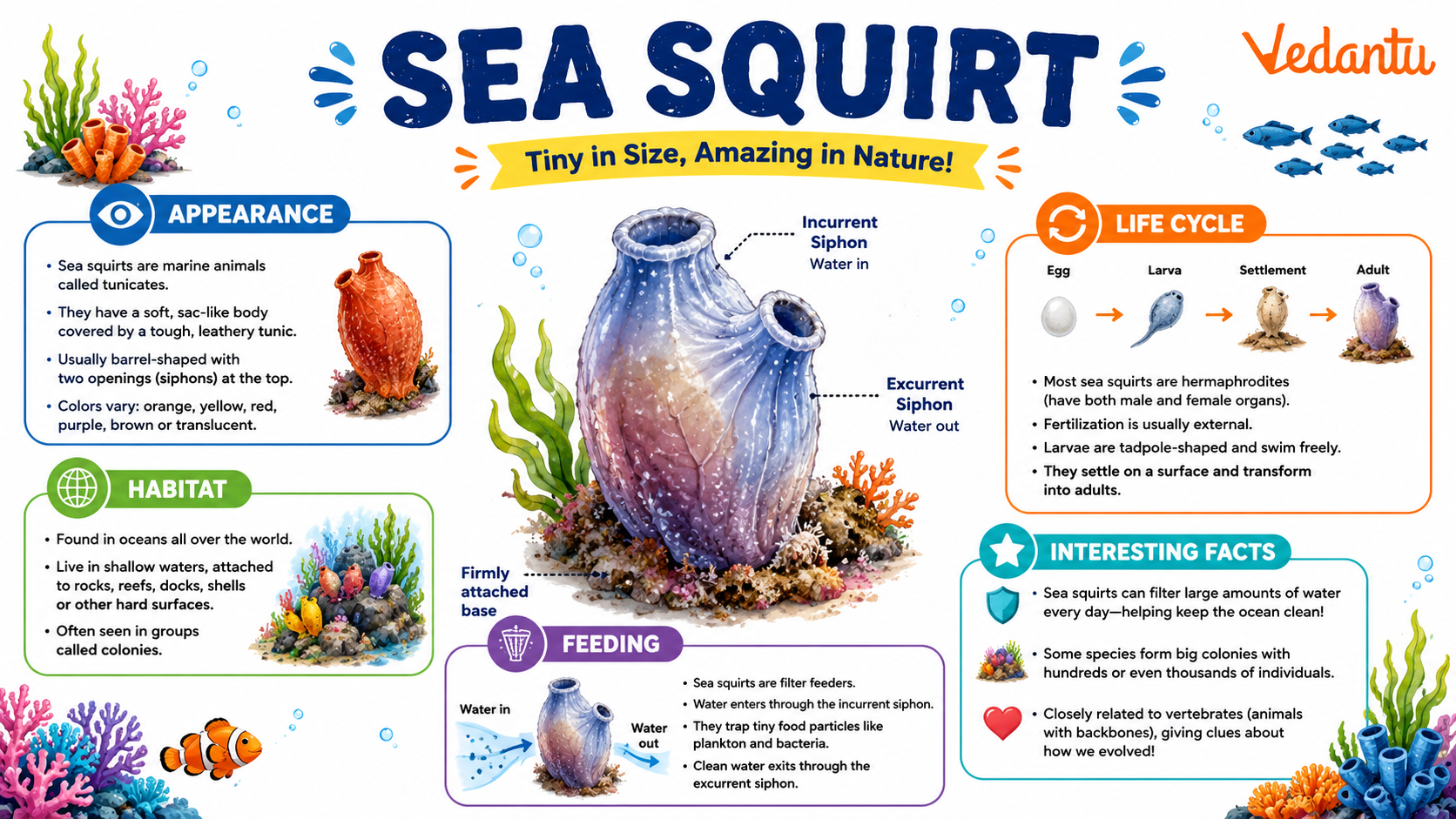
- Soft, jelly-like body covered by a tough outer layer called a tunic.
- Usually shaped like a small barrel or tube.
- Have two openings (siphons) on top.
- Colours include yellow, orange, red, purple, and transparent.
- No backbone (invertebrate).
Sea Squirt Habitat and Distribution
- Found in oceans all over the world.
- Live in shallow coastal waters and deeper seas.
- Attach to rocks, coral reefs, ship hulls, and piers.
- Prefer clean, salty seawater.
Sea Squirt Diet and Feeding Habits
- Eat plankton and microscopic organisms.
- Draw water in through one siphon.
- Filter out food using a special mucus net inside the body.
- Push clean water out through the second siphon.
This feeding method helps clean the water and plays an important role in marine ecosystems.
Behaviour and Lifestyle
- Adults are mostly stationary (do not move).
- Larvae swim freely for a short time before attaching to a surface.
- Shrink or squirt water when touched.
- Some species live alone; others form colonies.
Sea Squirt Life Cycle
- Egg Stage: Fertilised eggs develop in water.
- Larva Stage: Tadpole-like larvae swim freely using a tail.
- Attachment: Larva attaches to a hard surface.
- Transformation: Loses its tail and changes into a sack-like adult.
- Adult Stage: Stays fixed and feeds by filtering water.
The Sea Squirt life cycle is interesting because it changes from a swimming form to a fixed adult form.
What Makes Sea Squirt Special?
When disturbed, they forcefully squirt water out of their siphons.
Lose their tail and primitive backbone as they grow into adults.
Some produce chemicals to avoid predators.
Help filter and clean seawater naturally.
Types and Diversity
- Solitary Sea Squirts: Live alone, attached to surfaces.
- Colonial Sea Squirts: Live in groups, sharing a common outer layer.
- Pelagic Sea Squirts: Float freely in open ocean.
Importance and Role in Nature
Improve water clarity by filtering tiny particles.
Serve as food for fish, crabs, and sea stars.
Studied to understand evolution and development.
Help maintain healthy ocean ecosystems.
Amazing Sea Squirt Facts
- Sea squirts are also called ascidians.
- Some species are transparent.
- They can survive in both warm and cold seas.
- They have no brain but respond to touch.
- Some species can reproduce both sexually and asexually.
- Their outer tunic contains a cellulose-like substance.
Interesting Facts About Sea Squirt
- Their larvae look like tiny tadpoles.
- Ships sometimes carry sea squirts to new regions.
- Colonial species can form bright, colourful mats.
- They are part of the subphylum Tunicata.
Fun Facts for Kids
FAQs on Sea Squirt: Fascinating Facts About This Unique Marine Animal
1. What is a sea squirt?
A sea squirt is a small marine animal that lives in the ocean and sprays out water when touched.
- It is also called a tunicate.
- It has a soft, rubbery body covered by a tough outer layer called a tunic.
- Sea squirts are found attached to rocks, docks, and coral reefs.
- They are part of the ocean ecosystem and filter tiny food from water.
2. Why is it called a sea squirt?
A sea squirt gets its name because it squirts water when squeezed or disturbed.
- It pulls in seawater through one opening.
- It pushes water out through another hole.
- This squirting action helps it clean its body.
- The name describes its simple but fun behavior.
3. Is a sea squirt a plant or an animal?
A sea squirt is an animal, even though it looks like a plant.
- It cannot make its own food like plants.
- It eats tiny floating organisms called plankton.
- As a baby, it can swim like a tadpole.
- It belongs to the animal group called chordates.
4. Where do sea squirts live?
Sea squirts live in oceans all around the world.
- They are found in shallow and deep sea waters.
- They attach to rocks, coral reefs, boats, and docks.
- Some live alone, while others form colorful colonies.
- They prefer salty marine habitats.
5. How do sea squirts eat?
Sea squirts eat by filtering tiny food particles from seawater.
- They suck water in through an inhalant siphon.
- They trap plankton and small nutrients.
- Clean water exits through an exhalant siphon.
- This process is called filter feeding.
6. Are sea squirts related to humans?
Yes, sea squirts are surprisingly related to humans.
- They belong to the group Chordata.
- As larvae, they have a simple backbone called a notochord.
- Humans also develop from chordates.
- This makes sea squirts distant relatives of vertebrates.
7. What do baby sea squirts look like?
Baby sea squirts look like tiny tadpoles.
- They can swim freely in the water.
- They have a tail and a simple nerve cord.
- After finding a place to stick, they lose their tail.
- Then they grow into a stationary adult tunicate.
8. Are sea squirts harmful to humans?
Sea squirts are generally not harmful to humans.
- They do not bite or sting.
- Some species may feel rubbery or slimy to touch.
- They can grow on boats and cause minor problems for ships.
- Most are safe and harmless marine animals.
9. What colors can sea squirts be?
Sea squirts come in many bright and beautiful colors.
- They can be red, orange, yellow, purple, or blue.
- Some are see-through or transparent.
- Colonial sea squirts often form colorful patterns.
- Their colors help them blend into coral reefs.
10. Why are sea squirts important to the ocean?
Sea squirts are important because they help keep ocean water clean.
- They filter large amounts of seawater daily.
- They recycle nutrients in marine ecosystems.
- They provide food for fish and sea stars.
- Scientists study tunicates to learn about evolution and marine biology.
