






Why Do Mayflies Live for One Day? Habitat, Diet, and Behavior Explained
The mayfly is a fascinating insect known for its extremely short adult life. Found near rivers and lakes, mayflies spend most of their life underwater before emerging with delicate wings. These insects are among the oldest winged insects on Earth and play an important role in freshwater ecosystems. In this page, explore interesting mayfly facts, mayfly habitat, diet, life cycle, and why they are important to nature.
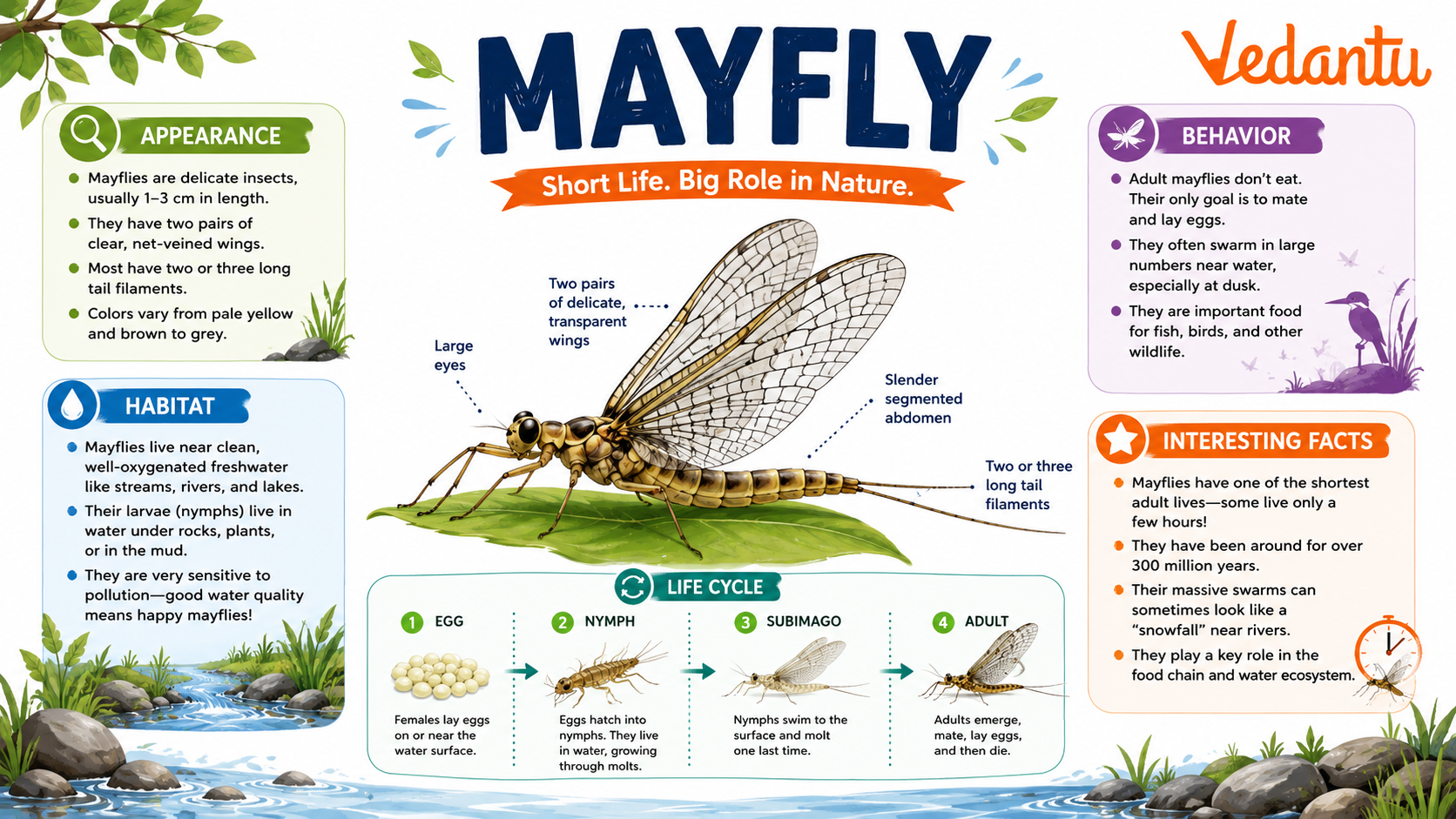
Quick Facts About Mayfly
| Feature | Details |
|---|---|
| Common Name | Mayfly |
| Scientific Order | Ephemeroptera |
| Animal Group | Insect |
| Size | 0.5 to 1.5 inches (varies by species) |
| Lifespan | Nymph stage: months to years; Adult stage: a few hours to 1–2 days |
| Habitat | Freshwater rivers, streams, lakes, ponds |
| Diet | Algae and organic matter (nymph stage) |
| Special Feature | Two pairs of transparent wings and long tail filaments |
Appearance and Physical Characteristics
- Slender, soft body with a small head and large compound eyes.
- Two or three long thread-like tails (called cerci).
- Two pairs of transparent wings, with the front pair larger than the back pair.
- Thin legs; front legs are often longer in males.
- Colours range from pale yellow and brown to grey.
Mayfly Habitat and Distribution
- Mayflies live near freshwater habitats like rivers, streams, lakes, and ponds.
- The young stage (nymph) lives underwater.
- Found on every continent except Antarctica.
- Prefer clean, oxygen-rich water.
Because mayflies are sensitive to pollution, their presence is a strong sign of clean and healthy water. Scientists often study mayfly habitat conditions to check the quality of freshwater ecosystems.
Diet and Feeding Habits
Nymph Stage (Underwater)
- Feed mainly on algae.
- Eat decaying plants and organic particles.
- Some species feed on tiny aquatic organisms.
Adult Stage (Above Water)
- Most adult mayflies do not eat.
- Their main goal is reproduction.
- They live only long enough to mate and lay eggs.
Behaviour and Lifestyle
Mayfly Life Cycle
- Egg: Female lays hundreds to thousands of eggs on the water surface.
- Nymph (Larva): Lives underwater for months or even years, growing and molting many times.
- Subimago: A unique winged but immature stage seen only in mayflies.
- Adult (Imago): Final stage; lives for a few hours to 1–2 days.
The mayfly life cycle is an example of incomplete metamorphosis, but it includes a rare extra stage called the subimago.
What Makes Mayflies Special?
Importance and Role in Nature
- Serve as a major food source for fish, birds, and amphibians.
- Help recycle nutrients in freshwater ecosystems.
- Support fishing industries as fish rely on them.
- Used by scientists to study water pollution.
Amazing Mayfly Facts
Fun Facts for Kids
- Mayflies do not have mouths as adults.
- They dance in the air during mating swarms.
- Fish love to eat them.
- They start life underwater like tiny aquatic creatures.
- Their long tails help them balance while flying.
FAQs on Mayfly Insect: Life Cycle, Lifespan, and Amazing Facts
1. What is a mayfly?
A mayfly is a small flying insect known for its very short adult life and delicate wings.
- Belongs to the insect order Ephemeroptera
- Lives near freshwater rivers, lakes, and streams
- Has two or three long tail filaments
- Is famous for living only a short time as an adult
2. How long does a mayfly live?
A mayfly’s adult life usually lasts from a few hours to one or two days.
- Most of its life is spent underwater as a nymph
- The adult stage is mainly for mating and laying eggs
- Some species live less than 24 hours as adults
3. Why are mayflies called “one-day insects”?
Mayflies are called one-day insects because their adult stage lasts only a very short time.
- The word Ephemeroptera means “short-lived”
- Adults usually survive for just a few hours to one day
- They do not eat during adulthood
4. Where do mayflies live?
Mayflies live near clean freshwater habitats around the world.
- Found in rivers, streams, ponds, and lakes
- Nymphs live underwater for months or years
- Adults stay close to water for breeding
5. What do mayflies eat?
Mayfly nymphs eat tiny plants and organic material found in water.
- Feed on algae and plant matter
- Sometimes eat small aquatic organisms
- Adult mayflies usually do not eat
6. What is the life cycle of a mayfly?
The mayfly life cycle has three main stages: egg, nymph, and adult.
- Egg: Laid on the surface of water
- Nymph: Lives underwater for months or even years
- Adult: Emerges with wings to mate and lay eggs
7. Are mayflies harmful to humans?
Mayflies are not harmful to humans and do not bite or sting.
- They do not carry dangerous diseases
- They cannot bite because adults lack working mouthparts
- Large swarms may be annoying but are harmless
8. Why are mayflies important to the ecosystem?
Mayflies play a key role in freshwater ecosystems and food chains.
- Provide food for fish, birds, and amphibians
- Help recycle nutrients in rivers and streams
- Indicate clean and unpolluted water
9. When do mayflies usually appear?
Mayflies usually appear in large numbers during warm months, especially late spring and summer.
- Common in May and June in many regions
- Emerge during warm, calm evenings
- Often gather around lights near water
10. How can you identify a mayfly?
You can identify a mayfly by its slender body, clear wings, and long tails.
- Has two large, upright triangular wings
- Possesses two or three long tail filaments
- Soft, delicate body structure
