






What Are Deuterostomes? Definition, Body Development, and Common Examples
Deuterostomes are a major group of animals that include some of the most advanced and familiar creatures on Earth — such as humans, fish, birds, and starfish. The word “deuterostome” means “second mouth,” which describes how their bodies develop in the early embryonic stage. Understanding deuterostomes helps students learn about animal classification, evolution, and how complex body systems formed over time. Let’s explore the amazing world of deuterostome characteristics, types, habitat, and importance.
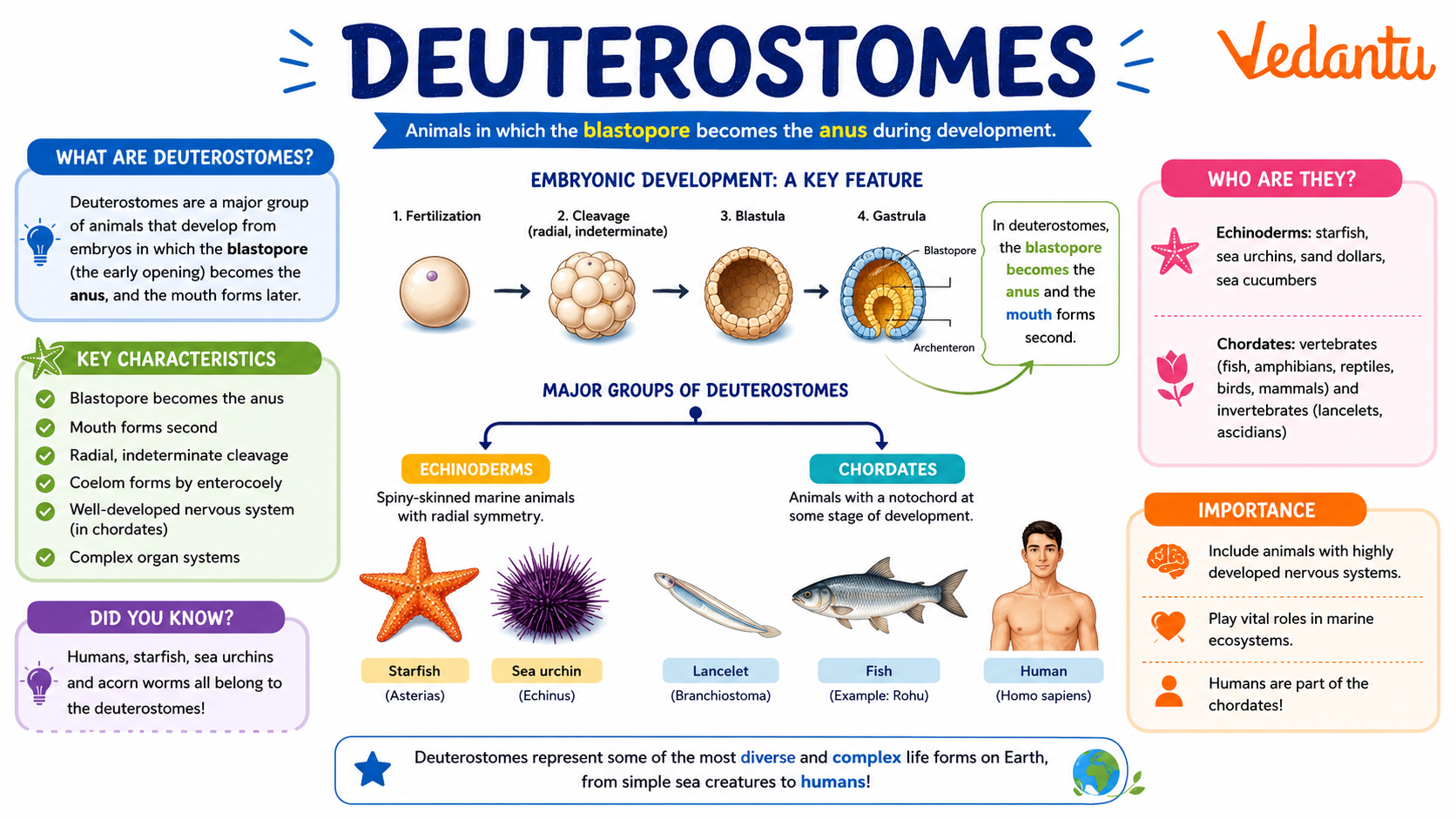
Quick Facts About Deuterostomes
| Feature | Details |
|---|---|
| Group Name | Deuterostomia |
| Meaning | “Second mouth” |
| Level | Superphylum (Animal Kingdom) |
| Main Phyla | Chordata, Echinodermata, Hemichordata |
| Symmetry | Bilateral (mostly), radial in adult echinoderms |
| Examples | Humans, fish, birds, starfish, sea urchins |
Deuterostome Characteristics
In deuterostomes, the first opening formed during embryonic development becomes the anus. The mouth forms later from a second opening.
- Blastopore develops into the anus (mouth forms later).
- Radial and indeterminate cleavage during early cell division.
- Coelom (body cavity) forms by enterocoely.
- Usually show bilateral symmetry.
- Have well-developed organ systems in many members.
Types and Diversity of Deuterostomes
Includes animals with a notochord at some stage. Examples: humans, mammals, birds, reptiles, amphibians, and fish.
Marine animals with spiny skin and radial symmetry as adults. Examples: starfish, sea urchins, sea cucumbers.
Worm-like marine animals. Example: acorn worms.
Primitive chordates like tunicates and lancelets.
Habitat and Distribution
Deuterostomes are found all over the world in different environments.
- Land: Mammals, birds, reptiles, and amphibians.
- Freshwater: Many fish and amphibians.
- Marine: All echinoderms and hemichordates.
- Air: Birds and bats (chordates).
Body Structure and Appearance
Since deuterostomes include many different animals, their body appearance varies widely.
- Chordates often have a backbone or spinal cord.
- Echinoderms have spiny skin and a water vascular system.
- Most show bilateral symmetry.
- Complex organ systems like heart, brain, and digestive tract are common in advanced groups.
Life Cycle and Development
Egg and sperm combine to form a zygote.
Radial and indeterminate cell division begins.
Blastopore forms and becomes the anus.
Mouth forms later; organs and body systems develop.
The deuterostome life cycle may vary greatly between species, but early embryonic development follows this common pattern.
What Makes Deuterostomes Special?
Importance of Deuterostomes
- Maintain ecological balance in land and marine ecosystems.
- Provide food resources (fish, livestock).
- Help scientists study evolution and embryology.
- Essential to biodiversity on Earth.
Amazing Deuterostome Facts
Fun Facts for Kids
- You are a deuterostome!
- Starfish and humans are distantly related.
- Blue whales, the largest animals, are deuterostomes.
- Some deuterostomes live only in the ocean.
- Their development pattern helps scientists classify animals.
FAQs on Deuterostome Explained: Meaning, Characteristics, and Examples
1. What is a Deuterostome?
A deuterostome is a group of animals in which the first opening in the embryo becomes the anus instead of the mouth.
- The word Deuterostome means “second mouth.”
- During early development, the blastopore turns into the anus.
- The mouth forms later in a different spot.
- Examples include humans, starfish, and sea urchins.
- They are important in animal classification and evolutionary biology.
2. Which animals are classified as Deuterostomes?
Animals classified as deuterostomes include vertebrates and some marine invertebrates.
- Chordates (humans, mammals, birds, fish)
- Echinoderms (starfish, sea urchins, sand dollars)
- Hemichordates (acorn worms)
- Many are found in the ocean ecosystem.
- They share similar embryonic development patterns.
3. How are Deuterostomes different from Protostomes?
The main difference between deuterostomes and protostomes is how their bodies develop in the embryo stage.
- In deuterostomes, the blastopore becomes the anus.
- In protostomes, the blastopore becomes the mouth.
- Deuterostomes show radial cleavage during cell division.
- Protostomes show spiral cleavage.
- This difference helps scientists study animal evolution.
4. Why are humans considered Deuterostomes?
Humans are considered deuterostomes because of how they develop before birth.
- In human embryos, the first opening becomes the anus.
- The mouth develops later.
- Humans belong to the group Chordata.
- This links humans to other animals like fish and amphibians.
- It shows our place in biological classification.
5. What are the main characteristics of Deuterostomes?
The main characteristics of deuterostomes are related to their early development and body structure.
- The blastopore becomes the anus.
- They show radial symmetry in early cell division.
- They develop a body cavity called a coelom.
- Many have complex organ systems.
- They are studied in embryology and zoology.
6. What is the meaning of the word Deuterostome?
The word deuterostome means “second mouth” in Greek.
- “Deutero” means second.
- “Stome” means mouth.
- The name describes how the mouth forms after the anus.
- It explains their unique development process.
- This term is used in animal taxonomy.
7. Are all Deuterostomes vertebrates?
No, not all deuterostomes are vertebrates because some do not have a backbone.
- Vertebrates like humans and fish are deuterostomes.
- Echinoderms like starfish do not have backbones.
- Hemichordates are also invertebrate deuterostomes.
- Both vertebrates and invertebrates share similar embryonic traits.
- This grouping is based on developmental biology.
8. Where do most Deuterostomes live?
Most deuterostomes live in marine environments, but some live on land and in freshwater.
- Echinoderms live only in the ocean.
- Fish live in oceans and rivers.
- Amphibians, reptiles, birds, and mammals live on land.
- They adapt to different ecosystems and habitats.
- Their diversity shows their evolutionary success.
9. Why are Deuterostomes important in evolution?
Deuterostomes are important in evolution because they include humans and many advanced animals.
- They help scientists understand animal ancestry.
- They show how complex organs evolved.
- They connect simple marine animals to vertebrates.
- They are studied in comparative anatomy.
- Their fossils give clues about ancient life forms.
10. What is the role of embryonic development in Deuterostomes?
Embryonic development defines a deuterostome because it determines how the body forms.
- The blastopore becomes the anus.
- Cells divide in a pattern called radial cleavage.
- The body cavity forms through enterocoely.
- These steps happen in early embryology stages.
- This process helps classify animals into major groups like Deuterostomia.
