






Cockatoo Facts About Behavior, Lifespan, Diet, and Talking Ability
Cockatoos are beautiful and intelligent birds known for their curved beaks, loud calls, and striking head crests. These charming parrots are popular around the world because of their playful nature and ability to mimic sounds. Found mainly in Australia and nearby islands, cockatoos are social birds that live in flocks. Let’s explore amazing Cockatoo facts, their habitat, diet, characteristics, and why they are so special in the bird world.
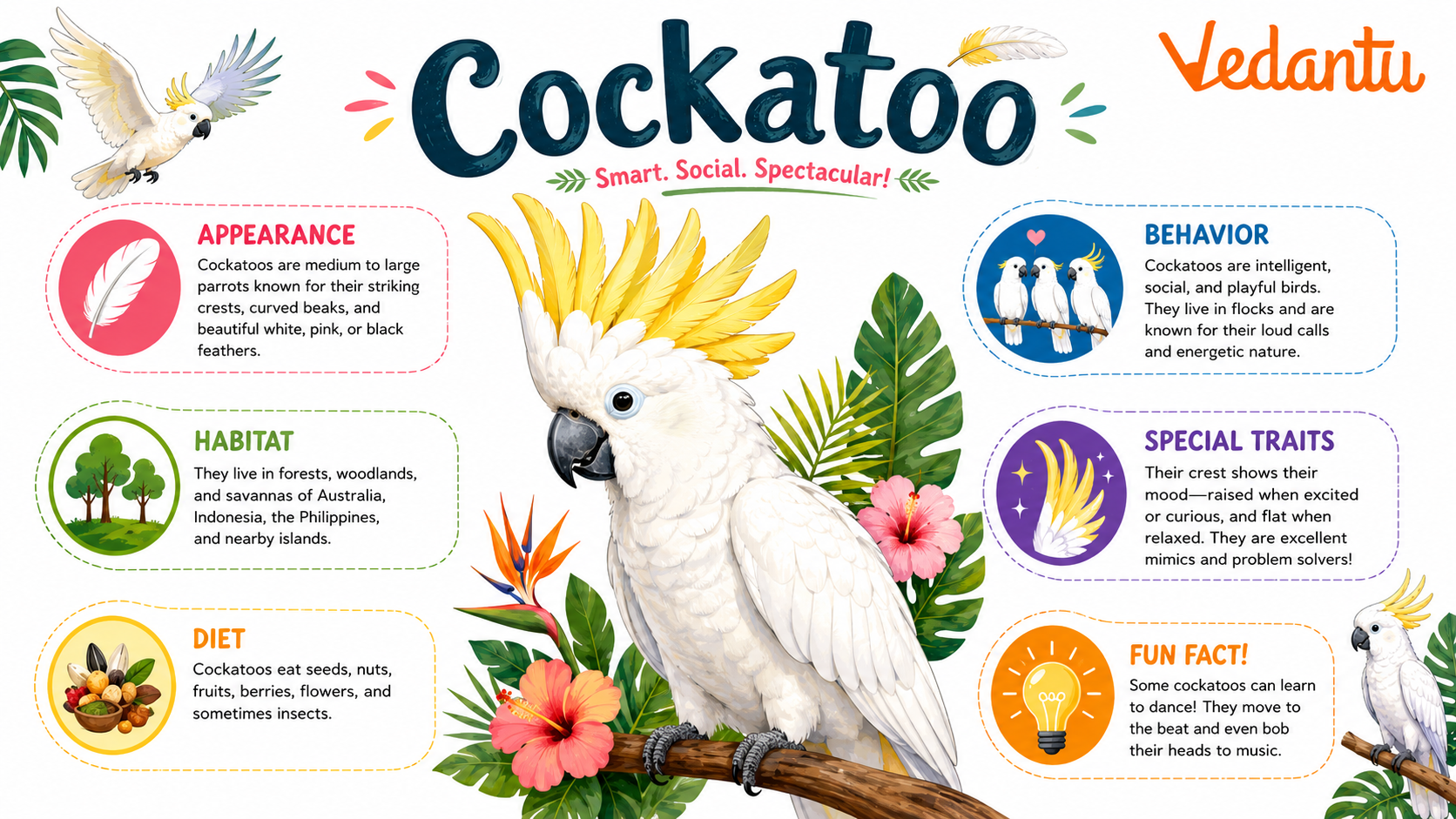
Quick Facts About Cockatoo
| Feature | Details |
|---|---|
| Common Name | Cockatoo |
| Scientific Family | Cacatuidae |
| Animal Group | Bird (Parrot family) |
| Size | 30–60 cm long |
| Weight | 300–1,200 grams |
| Lifespan | 40–70 years (some live longer) |
| Diet | Seeds, nuts, fruits, roots |
| Habitat | Forests, woodlands, grasslands |
| Found In | Australia, Indonesia, Philippines |
Appearance and Physical Characteristics
- Strong, curved beak for cracking nuts and seeds.
- Large, expressive crest on the head that can rise or fold down.
- Mostly white, pink, grey, or black feathers.
- Sharp claws for gripping branches.
- Bright eyes with excellent vision.
Cockatoo Habitat and Distribution
- Tropical and subtropical forests
- Open woodlands
- Grasslands and savannas
- Coastal regions
Cockatoos usually build nests inside tree hollows. They prefer warm climates and areas with plenty of food sources.
Cockatoo Diet and Feeding Habits
Mostly herbivorous.
Seeds, nuts, fruits, berries, roots.
Can crack very hard nutshells easily.
Uses feet to hold food while eating.
Cockatoos play an important role in spreading seeds, which helps new plants grow in forests.
Behaviour and Lifestyle
- Very social birds that live in large flocks.
- Active during the daytime (diurnal).
- Loud and vocal – they use calls to communicate.
- Highly intelligent and curious.
- Can mimic human speech and sounds.
Life Cycle of a Cockatoo
- Egg Stage: Female lays 1–3 eggs in a tree hollow.
- Hatching: Eggs hatch after about 20–30 days.
- Chick Stage: Parents feed and protect the chicks.
- Young Bird: Learns to fly and find food.
- Adult Stage: Becomes independent and forms its own pair.
The Cockatoo life cycle shows strong parental care, as both parents help in raising the chicks.
Flight Adaptations
- Strong and broad wings for powerful flight.
- Lightweight bones that help reduce body weight.
- Strong chest muscles for flapping.
- Tail feathers for balance and steering.
Sound and Call
- Warn other birds of danger.
- Call flock members.
- Express excitement or fear.
What Makes Cockatoo Special?
Importance and Role in Nature
Amazing Cockatoo Facts
- Some cockatoos can live up to 70 years.
- There are about 21 different species of cockatoos.
- They are among the most intelligent bird species.
- The Sulphur-crested Cockatoo is one of the most famous species.
- They use tools in some situations.
- Cockatoos can recognize themselves in mirrors.
Fun Facts for Kids
FAQs on Cockatoo Bird: Complete Guide to Traits, Habitat, and Care
1. What is a cockatoo?
A cockatoo is a type of smart, social parrot known for its curved beak and colorful crest feathers.
- Belongs to the parrot family (Cacatuidae)
- Famous for its expressive head crest
- Native to Australia, Indonesia, and nearby islands
- Known for being loud, playful, and intelligent birds
2. Where do cockatoos live in the wild?
Cockatoos live mainly in warm regions of Australia and Southeast Asia.
- Found in rainforests, woodlands, and savannas
- Some species live in mountains and coastal areas
- Often seen in large flocks in open fields
- Build nests in tree hollows
3. What do cockatoos eat?
Cockatoos are omnivores that eat a mix of plant foods and sometimes insects.
- Seeds and nuts
- Fruits and berries
- Roots and bulbs
- Occasionally insects and larvae
4. Why do cockatoos have a crest on their head?
A cockatoo’s crest helps it show emotions and communicate with other birds.
- Raised when excited or surprised
- Flattened when calm or relaxed
- Used to attract a mate
- Helps warn others of danger
5. How long do cockatoos live?
Cockatoos are long-living birds that can survive for many decades.
- In the wild: about 20–40 years
- In captivity: up to 60–70 years
- Some species live even longer with proper care
- Considered one of the longest-living parrots
6. Are cockatoos good pets?
Cockatoos can be loving pets but need lots of care and attention.
- Very intelligent and social
- Require daily mental stimulation
- Can be very loud and noisy
- Need large cages and time outside to play
7. Can cockatoos talk like other parrots?
Yes, cockatoos can mimic words and sounds, but they are not the best talkers among parrots.
- Can learn simple words and phrases
- Often copy household sounds
- Better known for being noisy and expressive
- Use body language and crest movements to communicate
8. What are the different types of cockatoos?
There are many species of cockatoos with different colors and sizes.
- Sulphur-crested Cockatoo
- Umbrella Cockatoo
- Galah (Rose-breasted Cockatoo)
- Black Cockatoo
- Moluccan Cockatoo
9. Why are cockatoos so loud?
Cockatoos are loud because they use strong calls to communicate across long distances.
- Call to stay in touch with their flock
- Warn others about predators
- Show excitement or boredom
- Naturally have powerful vocal cords
10. Are cockatoos endangered?
Some cockatoo species are endangered due to habitat loss and illegal trade.
- Threatened by deforestation
- Affected by illegal pet trade
- Protected by wildlife conservation laws
- Conservation groups work to save rare species like the Yellow-crested Cockatoo
