




Ribosomes are sites of which reaction?
A) Respiration
B) Photosynthesis
C) Protein synthesis
D) Fat synthesis
Answer
 Verified
639.9k+ views
Hint: Ribosomes can bind to codons and are also able to read them. For reading the codons they move along the thread of mRNA and read every codon for the formation of a chain of specific organic compounds.
Complete answer:
Ribosomes are membrane-bound structures present in all types of living cells and serve as the primary site of biological protein synthesis or specifically the translation process. They do this by linking amino acids together in a sequence that is specified by mRNA i.e. messenger RNA. Within the cells, ribosomes are found in two forms, either lying freely in the cytoplasm or attached to the endoplasmic reticulum. Ribosomes are present in both prokaryotic and eukaryotic types of cells but they are little different in the two as in the case of prokaryotes they are 70s type while in eukaryotes, they are of 80s type.
Additional information:
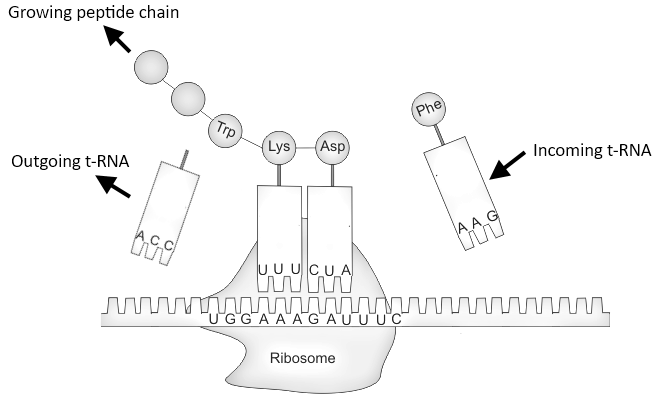
Protein synthesis takes place primarily in two steps – transcription and translation. In eukaryotic cells, the first step i.e. transcription occurs in the nucleus, and in this step, DNA is used as a template to synthesize a molecule of mRNA. After formation, the mRNA leaves the nucleus and reaches the ribosomes present in the cytoplasm where the second step i.e. translation is completed. In this step, the genetic code present on the mRNA is read by the ribosomes, and a chain of amino acids is formed accordingly. A representative diagram of protein synthesis has been given below –
So, the correct answer is ‘Protein synthesis’.
Note: Ribosomes are called ribonucleoprotein complexes because these are formed of RNAs and proteins and are regarded as a highly complex cellular machine. 70s ribosomes are composed of two subunits 50s and 30s while the subunits in 80s ribosomes are 60s and 40s. Here, the letter ‘s’ represents the Svedberg unit which is actually a measure of the rate of sedimentation during centrifugation.
Complete answer:
Ribosomes are membrane-bound structures present in all types of living cells and serve as the primary site of biological protein synthesis or specifically the translation process. They do this by linking amino acids together in a sequence that is specified by mRNA i.e. messenger RNA. Within the cells, ribosomes are found in two forms, either lying freely in the cytoplasm or attached to the endoplasmic reticulum. Ribosomes are present in both prokaryotic and eukaryotic types of cells but they are little different in the two as in the case of prokaryotes they are 70s type while in eukaryotes, they are of 80s type.
Additional information:
Protein synthesis takes place primarily in two steps – transcription and translation. In eukaryotic cells, the first step i.e. transcription occurs in the nucleus, and in this step, DNA is used as a template to synthesize a molecule of mRNA. After formation, the mRNA leaves the nucleus and reaches the ribosomes present in the cytoplasm where the second step i.e. translation is completed. In this step, the genetic code present on the mRNA is read by the ribosomes, and a chain of amino acids is formed accordingly. A representative diagram of protein synthesis has been given below –
So, the correct answer is ‘Protein synthesis’.
Note: Ribosomes are called ribonucleoprotein complexes because these are formed of RNAs and proteins and are regarded as a highly complex cellular machine. 70s ribosomes are composed of two subunits 50s and 30s while the subunits in 80s ribosomes are 60s and 40s. Here, the letter ‘s’ represents the Svedberg unit which is actually a measure of the rate of sedimentation during centrifugation.
Recently Updated Pages
Master Class 11 English: Engaging Questions & Answers for Success

Master Class 11 Social Science: Engaging Questions & Answers for Success
Master Class 11 Maths: Engaging Questions & Answers for Success
Master Class 11 Biology: Engaging Questions & Answers for Success
Master Class 11 Physics: Engaging Questions & Answers for Success
Master Class 11 Chemistry: Engaging Questions & Answers for Success
Trending doubts
Explain the Treaty of Vienna of 1815 class 10 social science CBSE
What is the Total Duration of Football Match?
The shortest day of the year in India
In which year voting age was reduced from 21 to 18?
10 examples of evaporation in daily life with explanations
What planets have no moons Which one has only one moon class 10 physics CBSE