








Phylum Porifera Structure and Types Explained for NEET Preparation
Phylum Porifera is a fundamental topic in Biology for NEET aspirants, as it introduces students to the most basic multicellular animals, commonly known as sponges. Understanding Phylum Porifera is crucial for building strong foundational concepts in animal kingdom classification and differentiating between lower and higher organisms. NEET often tests questions based on unique features, structure, and significance of this phylum, making it an essential topic for effective problem-solving in the exam.
What is Phylum Porifera?
Phylum Porifera comprises simple, multicellular aquatic animals widely known as sponges. These organisms are characterized by their porous bodies which allow water to circulate through them, facilitating feeding, respiration, and excretion. Porifera represents the most primitive group in the animal kingdom and displays a unique body plan without true tissues or organs. Sponges mostly inhabit marine environments, though a few are found in freshwater. Their name is derived from Latin - ‘porus’ meaning pore and ‘ferre’ meaning to bear, referring to their pore-bearing bodies.
Core Fundamentals of Phylum Porifera
Major Characteristics
Phylum Porifera members exhibit a range of distinctive features. These form the basis for their identification and classification in the animal kingdom.
- They possess a porous body with numerous tiny openings called ostia on the surface, allowing water entry.
- Body symmetry is either asymmetrical or radially symmetrical.
- Exclusively aquatic, mostly marine, but a few live in freshwater.
- They lack true tissues and organs - organization is at the cellular level.
- Possess a central cavity called spongocoel, and a large opening at the top called osculum for water exit.
- Body supported by a skeleton made of spicules or spongin fibers.
- Feeding, respiration, and excretion all occur through the water canal system called the aquiferous system.
Diagram of Phylum Porifera
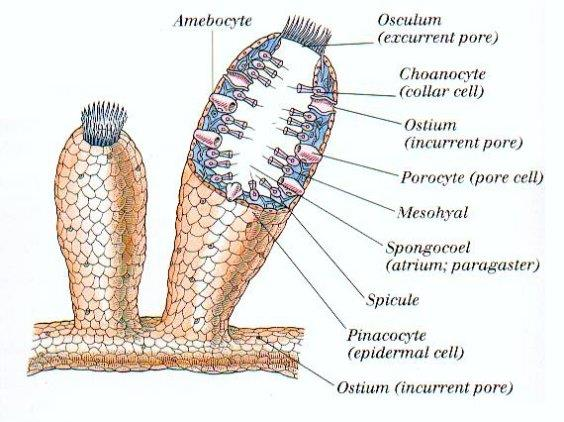
The diagram above shows the basic structure of a sponge from Phylum Porifera, highlighting its pores, osculum, canal system, and supporting spicules.
Cell Types and Body Structure
Poriferans exhibit simple body construction with several key cell types:
- Pinaocytes: Flat cells covering the outer surface.
- Choanocytes (Collar cells): Line the inner chambers, each with a flagellum for creating water currents and trapping food.
- Amoebocytes: Move through the body, transporting nutrients and producing spicules or spongin fibers.
Important Sub-Concepts Related to Phylum Porifera
1. Canal System (Aquiferous System)
The aquiferous or canal system is the defining feature of Porifera, consisting of a network of canals and chambers through which water flows. This system is responsible for food collection, respiration, and excretion. There are three main types:
- Ascon type: Simplest, with a central spongocoel lined by choanocytes.
- Sycon type: Body wall folded, with radial canals and improved water filtration.
- Leucon type: Most complex, with a multitude of chambers and canals, maximizing filtering efficiency.
2. Skeleton and Spicules
Sponges have an internal skeleton made up of either mineral spicules (silica or calcium carbonate) or organic spongin fibers. The nature of the skeleton is a key character for classifying sponges into different classes within Porifera.
3. Reproduction in Porifera
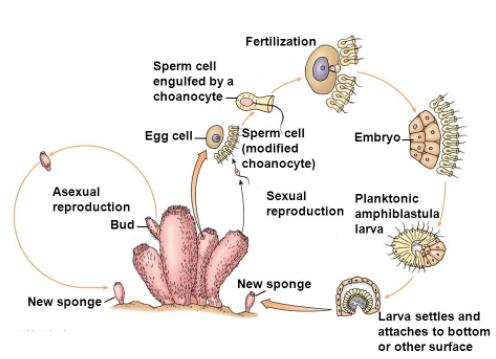
Sponges are capable of both asexual and sexual reproduction. Asexual methods include budding and gemmule formation (common in freshwater sponges), while sexual reproduction involves the fusion of gametes. Fertilization is usually internal, and development passes through a larval stage (amphiblastula or parenchymula), which is motile and helps in dispersion.
Principles, Rules, and Relationships in Porifera
Phylum Porifera illustrates key biological principles that NEET aspirants should grasp for a strong conceptual base:
- Cellular level of organization, showing how multicellularity can exist without true tissues or organs.
- Aquiferous system demonstrates the dependence of basic life processes on water flow.
- Relationship between structure (canal systems & spicules) and function (filter feeding, support).
- Amphiblastula or parenchymula larvae highlight life cycles and dispersal strategies.
Features and Importance of Phylum Porifera
- Foundational phylum for understanding the animal kingdom’s evolution and diversity.
- Demonstrates the earliest form of multicellular life, with unique adaptations for survival.
- Commercial use: Some sponges are harvested for bathing and cleaning due to their absorbent skeleton.
- Ecological role: Filter feeders maintain water quality and serve as habitat for small marine animals.
- Models for studying cellular communication, regeneration, and evolution of tissues.
Why is Phylum Porifera Important for NEET?
Understanding Phylum Porifera is key for NEET Biology because several questions are framed to test the basics of animal classification, structural organization, and unique features of sponges. The topic also helps students distinguish Porifera from other animal phyla and supports answering assertion-reason or statement-based MCQs. Mastery of this concept helps build a clear understanding of body plans, level of organization, and evolution - themes that recur in other parts of the syllabus.
How to Study Phylum Porifera Effectively for NEET
- Start by understanding the basic features and characteristics of Porifera with diagrams for better visualization.
- Use labelled diagrams of structural components and canal systems to solidify memory.
- Summarize and compare types of canal systems for quick revision.
- Focus on unique keywords like ‘aquiferous system’, ‘ostia’, ‘osculum’, ‘choanocytes’, and ‘amphiblastula’ as they often appear in MCQs.
- Solve previous NEET questions and practice assertion-reason and odd-one-out type MCQs using Porifera facts.
- Create summary notes highlighting differentiating features from other animal phyla such as Coelenterata and Ctenophora.
Common Mistakes Students Make in Phylum Porifera
- Confusing Porifera’s cellular level of organization with tissue level seen in higher phyla.
- Misidentifying canal system types (ascon, sycon, leucon) in diagrams or examples.
- Overlooking keywords like spongocoel, osculum, ostia, and spicules in quick revision.
- Neglecting the ecological and evolutionary importance of sponges while focusing only on structure.
- Not practicing enough MCQs based on assertion-reason or diagram identification related to Porifera.
Quick Revision Points - Phylum Porifera
- First multicellular animals; possess a porous body with ostia.
- Cellular level of organization, no true tissues or organs.
- Aquiferous (canal) system for filter feeding, respiration, and excretion.
- Skeleton made of spicules (calcareous/siliceous) or spongin fibers.
- Types of canal systems: Ascon, Sycon, Leucon.
- Exhibit both sexual and asexual reproduction; larval forms are motile.
- Main examples: Sycon, Spongilla, Euspongia.
- Important for NEET: structure, function, canal system, cell types, and evolutionary position.
FAQs on Phylum Porifera in NEET Biology: Complete Overview
1. What is Phylum Porifera in biology for NEET?
Phylum Porifera is the simplest animal group, often called sponges, and is a key topic in NEET Biology.
Key features include:
- Multicellular, aquatic animals with porous bodies
- Lack true tissues and organs
- Body supported by a skeleton of spicules or spongin
- Found mainly in marine environments, a few freshwater species
2. What are the main characteristics of Phylum Porifera for NEET exam?
Phylum Porifera shows distinct features crucial for NEET:
- Body with pores (ostia) and canals for water flow
- Cellular level of organization (no tissues or organs)
- Skeleton made of spicules or spongin fibres
- Asymmetrical or radially symmetrical shape
- Mostly marine and sessile (attached to substratum)
- Asexual reproduction (budding) and sexual reproduction (gametes)
3. What is the canal system in Porifera?
The canal system in Porifera is a unique water transport mechanism crucial for NEET.
- Water enters through ostia (tiny pores)
- Passes into canals (incurrent and radial)
- Flows into the central cavity called spongocoel
- Exits through the osculum (large opening)
- Helps in food collection, respiration and removal of waste
4. Name some common examples of Porifera studied for NEET.
Several Porifera species are frequently asked in NEET MCQs:
- Sycon (Scypha)
- Spongilla
- Euspongia (Bath sponge)
- Euplectella (Venus' flower basket)
5. How do sponges reproduce in Phylum Porifera?
Sponges in Phylum Porifera show both asexual and sexual reproduction methods in the NEET syllabus.
- Asexual: By budding or fragmentation
- Sexual: Most are hermaphrodites with internal fertilization
- Development is often indirect (larval stage present)
6. Why are Porifera called sponges?
Porifera are called sponges because their body structure is full of pores and canal systems, giving a sponge-like appearance.
- Their bodies absorb water efficiently
- Composed of fibrous proteins or spicules
- This porous nature is unique to Phylum Porifera
7. What are the types of canal systems found in Phylum Porifera?
There are three major types of canal systems in Porifera, important for NEET:
- Ascon type – simplest structure
- Sycon type – intermediate complexity
- Leucon type – most complex
8. Write two important functions of choanocytes in Porifera.
Choanocytes (collar cells) perform crucial roles for NEET Biology:
- Generate water current for movement of food, gases, and wastes
- Capture and digest food particles through phagocytosis
9. What is the skeleton of Porifera made of?
Skeletons in Porifera (sponges) are formed for support and shape.
The main components are:
- Spicules (calcareous or siliceous)
- Spongin fibres (protein-based)
10. Give examples of marine and freshwater Porifera species for the NEET exam.
Porifera includes both marine and freshwater species asked in the NEET exam.
- Marine: Sycon (Scypha), Euspongia, Euplectella
- Freshwater: Spongilla
11. Why are sponges classified under Phylum Porifera?
Sponges are categorised into Phylum Porifera because of their unique body structure with numerous pores and the absence of true tissues.
- Body perforated by ostia and canal system
- Lack of specialised organs
- Cellular level of organisation
12. What is the economic importance of Porifera for NEET syllabus?
Porifera have economic value, which is noted in NEET syllabus points.
- Bath sponges (Euspongia) used for cleaning
- Research models in evolutionary biology and water filtration
- Role in marine ecology as habitat providers
