








Menstrual Cycle Phases and Hormonal Regulation for NEET Students
The menstrual cycle is an essential biological process in human females, playing a key role in reproduction. Understanding this topic is crucial for NEET aspirants, as it frequently appears in exam questions and supports learning in human physiology. This topic not only builds conceptual clarity but also connects to several other chapters in Biology, making it an important foundation for success in NEET exams.
What is the Menstrual Cycle?
The menstrual cycle refers to the regular, natural changes that occur in the female reproductive system to prepare for possible pregnancy. Lasting about 28 days on average, this cycle involves a series of hormonal and physiological changes primarily in the ovaries and uterus. Understanding the menstrual cycle helps students grasp how fertility is regulated and why menstruation occurs, laying the groundwork for topics like hormonal regulation and reproductive health.
Core Ideas and Fundamentals of the Menstrual Cycle
Phases of the Menstrual Cycle
The menstrual cycle can be divided into four main phases: menstrual, follicular, ovulatory, and luteal. Each phase is characterized by specific hormonal changes and physiological events in the ovaries and uterus.
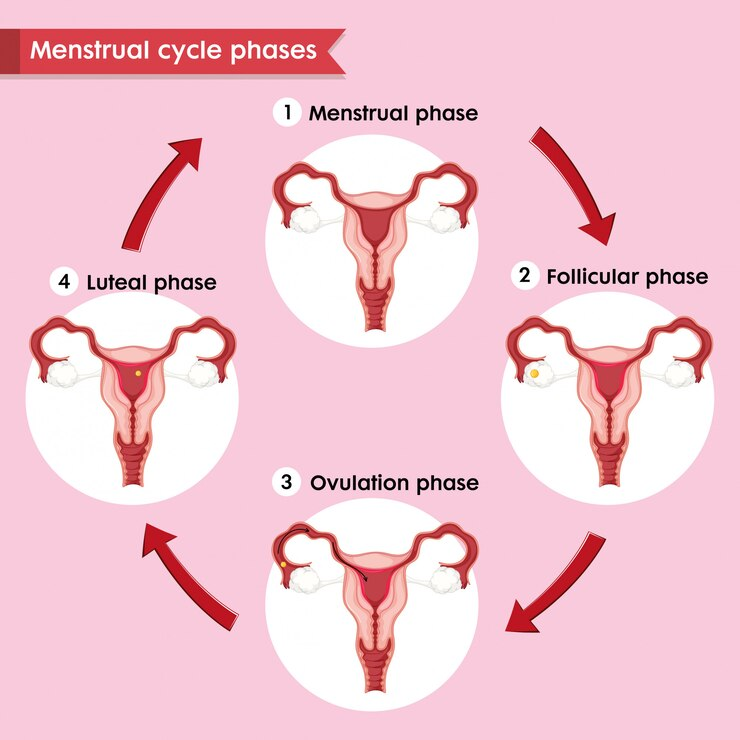
- Menstrual Phase (Days 1-5): Shedding of the uterine lining (endometrium) occurs, resulting in menstrual bleeding.
- Follicular Phase (Days 1-13): The pituitary gland releases FSH, stimulating the growth of ovarian follicles. Estrogen levels rise, helping build a new endometrial lining.
- Ovulatory Phase (Day 14): A surge in LH leads to the release of a mature ovum (egg) from the ovary - this is ovulation.
- Luteal Phase (Days 15-28): The ruptured follicle forms the corpus luteum, which secretes progesterone to maintain the endometrial lining for possible implantation.
Hormonal Regulation
The menstrual cycle is governed by a delicate interplay of hormones including FSH, LH, estrogen, and progesterone. These hormones are produced by the hypothalamus, pituitary gland, and ovaries, and each has a specific role in the cycle's progression.

Important Sub-concepts Related to the Menstrual Cycle
Role of Hormones
FSH and LH from the pituitary control the growth and release of the ovum, while estrogen and progesterone from the ovaries regulate the development and shedding of the uterine lining. Disruptions in these hormones can lead to menstrual irregularities.
Ovulation and Fertility Window
Ovulation, the release of the egg, usually occurs around the 14th day in a 28-day cycle. The days around ovulation are considered the most fertile period for conception. Understanding this window is useful for NEET questions and for comprehending reproductive health.
Corpus Luteum and Its Fate
After ovulation, the ruptured follicle transforms into the corpus luteum, which produces progesterone. If fertilization does not occur, the corpus luteum degenerates, leading to the next menstrual phase.
Key Relationships and Graphical Representation
The menstrual cycle is marked by cyclical changes in hormone levels, ovarian events, and uterine lining thickness. The graph below (see above in images) illustrates how these elements interact throughout the cycle.
- FSH rises at the beginning to stimulate follicle development.
- Estrogen increases as the follicle matures, peaking just before ovulation.
- LH surges, triggering ovulation at mid-cycle.
- Progesterone increases after ovulation, supporting the endometrium.
- Without fertilization, hormone levels drop, prompting menstruation.
Characteristics and Features of the Menstrual Cycle
- Typically lasts 28 days, but can range from 21 to 35 days among individuals.
- Starts at puberty (menarche) and continues until menopause.
- Regulated by complex hormonal feedback mechanisms.
- Vital for female fertility and reproductive health.
Why is the Menstrual Cycle Important for NEET?
The menstrual cycle is frequently tested in NEET because it encapsulates key physiological, hormonal, and reproductive processes. A strong grasp of this concept enables students to solve direct questions on phases, hormones, and their effects, as well as integrated questions involving feedback mechanisms and reproductive disorders. It also lays the groundwork for understanding broader topics such as endocrine regulation, fertility, contraception, and reproductive health.
How to Study the Menstrual Cycle Effectively for NEET
- Begin with a simple overview of the menstrual cycle and its phases before studying hormonal regulation in detail.
- Refer to clear diagrams - study both the sequence of phases and hormone graphs to visualize the process.
- Make concise notes of phases, hormones, and their major functions.
- Practice MCQs specifically on phase identification, hormone action, and feedback mechanisms as these are common in NEET.
- Reinforce key points through quick revisions, flowcharts, and self-quizzing.
- Understand clinical applications (like menstrual disorders) if mentioned in your syllabus, as real-life applications are sometimes asked.
Common Mistakes Students Make While Studying the Menstrual Cycle
- Confusing the timing and features of different cycle phases.
- Mixing up the roles or secretion peaks of hormones like FSH, LH, estrogen, and progesterone.
- Forgetting the direction of hormonal feedback (positive vs negative feedback).
- Not practicing enough diagram-based or assertion-reason questions.
- Ignoring the integration of menstrual cycle concepts with related topics such as contraception and reproductive disorders.
Quick Revision Points: Menstrual Cycle
- Average menstrual cycle length: 28 days.
- Menstrual phase - shedding of endometrium (days 1-5).
- Follicular phase - follicle matures; estrogen rises (days 1-13).
- Ovulation triggered by LH surge (around day 14).
- Luteal phase - corpus luteum forms; progesterone peaks (days 15-28).
- FSH and LH from pituitary; estrogen and progesterone from ovaries.
- Without fertilization, corpus luteum degenerates, hormone levels fall, leading to menstruation.
- Crucial for understanding human reproduction and related NEET questions.
FAQs on Menstrual Cycle NEET Biology: Key Concepts Explained
1. What is the menstrual cycle?
The menstrual cycle is a recurring biological process in females that prepares the body for pregnancy, regulated by hormones and essential for NEET Biology exams. The key features include:
- Lasts about 28 days on average
- Involves periodic changes in the ovaries and uterus
- Main phases: menstrual phase, follicular phase, ovulation, and luteal phase
- Governed by FSH, LH, estrogen, and progesterone
2. What are the phases of the menstrual cycle?
The menstrual cycle consists of four main phases every NEET student should know:
- Menstrual Phase: Shedding of the uterine lining (days 1-5)
- Follicular (Proliferative) Phase: Development of follicles and regeneration of endometrium (days 6-13)
- Ovulation: Release of a mature egg around day 14
- Luteal (Secretory) Phase: Formation of corpus luteum and preparation for potential pregnancy (days 15-28)
3. Which hormones control the menstrual cycle?
The menstrual cycle is regulated by four key hormones that coordinate ovarian and uterine changes crucial for NEET Biology:
- Follicle-Stimulating Hormone (FSH) - stimulates follicle development
- Luteinizing Hormone (LH) - triggers ovulation
- Estrogen - builds up endometrial lining
- Progesterone - maintains the endometrium post-ovulation
4. What is ovulation and when does it occur in the menstrual cycle?
Ovulation refers to the release of a mature egg from the ovary, a process critical for fertility and central to NEET-level Biology.
- Occurs around day 14 of a typical 28-day cycle
- Triggered by a sudden increase in LH (Luteinizing Hormone)
- Marks the midpoint and highest fertility phase
5. What happens during the menstrual phase?
The menstrual phase is the first stage of the menstrual cycle involving the shedding of the endometrial lining.
- Bleeding lasts 3-5 days (average)
- Old uterine lining is expelled out
- Triggered by a sharp drop in estrogen and progesterone
6. How does the menstrual cycle relate to fertility?
The menstrual cycle's phases directly influence female fertility by controlling ovulation and uterine readiness.
- Fertile window: Typically days 10–17 of the cycle (around ovulation)
- Egg is available for fertilization only during this period
- Hormonal balance is crucial for successful conception
7. What causes irregularities in the menstrual cycle?
Irregularities in the menstrual cycle can result from various physiological and environmental factors, many of which are relevant for NEET students:
- Hormonal imbalances (FSH, LH, estrogen, progesterone)
- Stress, diet, excessive exercise
- Thyroid disorders or polycystic ovary syndrome (PCOS)
- Chronic diseases or sudden weight changes
8. Why is the menstrual cycle important for NEET Biology?
The menstrual cycle is a fundamental concept in NEET Biology as it connects reproductive physiology, hormonal control, and clinical applications.
- Forms the basis for reproduction questions
- Tested in MCQs for hormonal sequence, phase details, and clinical implications
- Essential for understanding contraception and fertility disorders
9. What is the role of progesterone during the menstrual cycle?
Progesterone's main role is to maintain the endometrial lining after ovulation, which is crucial to NEET exam content.
- Secreted by corpus luteum during the luteal phase
- Prepares uterus for possible implantation
- If fertilization does not occur, levels fall and menstruation begins
10. What is the function of the corpus luteum in the menstrual cycle?
The corpus luteum is a temporary endocrine structure that forms after ovulation and is important for NEET-based understanding of reproductive biology.
- Secretes progesterone (and some estrogen)
- Supports endometrial preparation for embryo implantation
- Degenerates if there is no fertilization, triggering menstruation
11. What is the duration of a normal menstrual cycle?
The average menstrual cycle lasts about 28 days, but can normally range from 21 to 35 days.
- Day 1 is marked by the start of menstrual bleeding
- The length can vary due to age, hormones, and lifestyle factors
12. State the changes that occur in the uterus during the menstrual cycle.
The uterus undergoes cyclic changes during the menstrual cycle in both structure and function, relevant for NEET topics:
- Menstrual phase: Endometrial lining breaks down and is shed
- Proliferative phase: Lining regrows and thickens due to estrogen
- Secretory phase: Lining becomes glandular and vascular under progesterone
