








How Does Immunity Work in NEET Biology?
Immunity is a key concept in Biology, central to understanding how our body defends itself against infections and diseases. As an essential topic for NEET aspirants, Immunity forms the backbone of various Biology questions and helps students connect different areas like health, diseases, and human physiology. Building a strong foundation in Immunity is vital for scoring well in NEET and for grasping complex interrelated biological processes.
What is Immunity?
Immunity is the ability of an organism to resist and fight off infections and foreign substances. In simple terms, it means the power of the body to defend itself from harmful invaders like bacteria, viruses, and other pathogens. The immune system uses a complex network of cells, tissues, and organs to identify and destroy these harmful agents, while protecting the body’s own cells.
Core Ideas and Fundamentals of Immunity
Understanding Immunity starts with learning the core types and mechanisms our body uses to protect itself. Here are some fundamental principles every NEET student should know:
Types of Immunity
- Innate Immunity - Present from birth and provides immediate, non-specific defense against pathogens.
- Acquired (Adaptive) Immunity - Develops during lifetime and provides specific defense after exposure to an antigen.
How the Immune System Works
The immune system distinguishes self from non-self. When it detects foreign invaders (pathogens), it initiates a series of responses tailored to eliminate the threat. This includes barriers like skin, chemical signals, and specialized cells like lymphocytes.
Important Sub-Concepts in Immunity
Several key sub-concepts fall under the broad topic of Immunity. Students should understand how these interrelate for comprehensive NEET preparation.
Innate Immunity
Innate immunity is the body’s first line of defense. It consists of physical barriers (skin, mucous membranes), physiological barriers (temperature, pH), phagocytic cells (macrophages), and inflammation. It does not depend on prior exposure to pathogens and acts quickly but non-specifically.
Acquired Immunity
Acquired immunity is more sophisticated and activated when innate immunity is insufficient. It involves the recognition of specific antigens and creates memory for quicker response upon repeated exposure. The main components are B-lymphocytes (humoral immunity) and T-lymphocytes (cell-mediated immunity).
Active and Passive Immunity
- Active Immunity - Body produces its own antibodies after exposure to antigens (e.g., through infections or vaccination).
- Passive Immunity - Ready-made antibodies are transferred to the body (e.g., from mother to baby through placenta or breast milk, or via immunoglobulin injections).
Antigens and Antibodies
Antigens are foreign substances that trigger an immune response. Antibodies are proteins produced by B-cells that bind specifically to antigens and help in their neutralization or destruction.
Lymphoid Organs and Cells
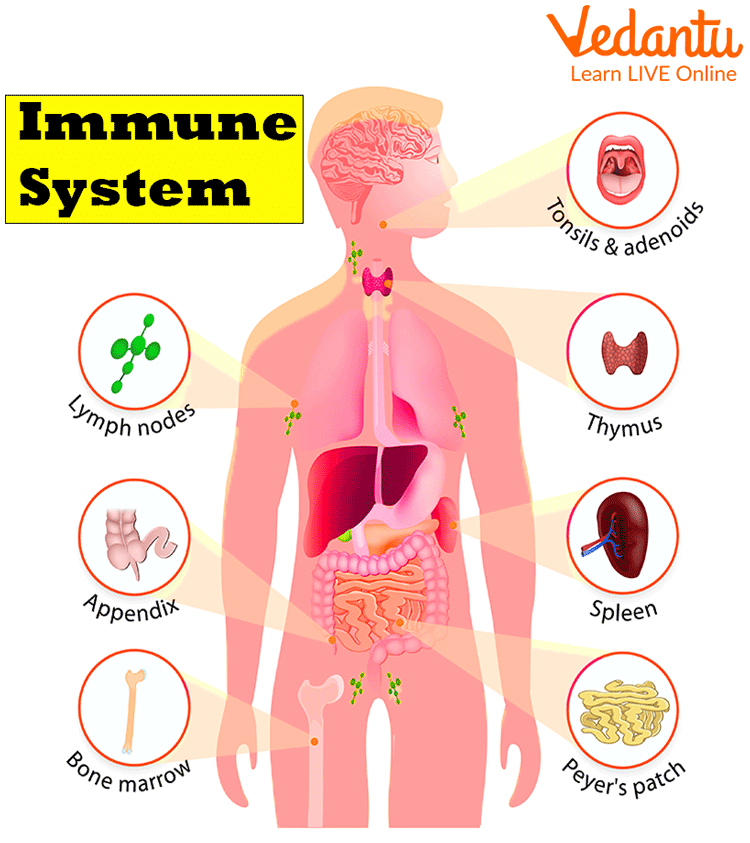
Primary lymphoid organs include the bone marrow and thymus, where lymphocytes are produced and mature. Secondary organs like lymph nodes, spleen, and tonsils provide sites for immune responses to occur.
Key Relationships and Principles in Immunity
There are important interactions and basic relationships that underpin how immunity works in the body. Though there are no standard formulas, understanding these relationships is crucial.
| Type of Immunity | Nature of Response | Key Components |
|---|---|---|
| Innate Immunity | Non-specific, immediate | Barriers, phagocytes, inflammation |
| Acquired Immunity | Specific, delayed, with memory | B-cells, T-cells, antibodies |
This table clearly distinguishes innate and acquired immunity, helping students remember the main differences and their biological significance for NEET questions.
Importance of Immunity for NEET Aspirants
Immunity is one of the most frequently tested topics in NEET, appearing in questions about disease defense, vaccines, and the immune system’s functioning. Mastery of this concept equips students with the knowledge to solve related MCQs as well as understand disease mechanisms, human health, and biological defense strategies. Additionally, Immunity connects with other units like Microbes in Human Welfare and Biotechnology, making it a cornerstone for exams and further Biology studies.
How to Study Immunity Effectively for NEET
- Start with a basic textbook explanation of immunity before moving to detailed notes.
- Draw or review diagrams and flowcharts, especially for types of immunity and immune system cells.
- Use tables to compare key features (like innate vs acquired, active vs passive immunity).
- Practice NEET previous year MCQs to see how concepts are asked in exams.
- Revise terminology (antigens, antibodies, lymphocytes, etc.) frequently.
- Relate immunity concepts to common diseases and vaccinations for better retention.
- Regularly review and self-test with flashcards or quizzes.
Common Mistakes to Avoid in Immunity
- Confusing innate and acquired immunity characteristics.
- Mixing up active and passive immunity sources.
- Forgetting the role or location of lymphoid organs in immune responses.
- Misunderstanding the difference between antigens and antibodies.
- Neglecting to link theory with real-life examples (e.g., vaccines, natural infections).
Quick Revision Points for Immunity
- Immunity = body’s defense against disease-causing agents.
- Innate immunity is present from birth, non-specific, immediate response.
- Acquired immunity is specific, has memory, develops after exposure.
- B-lymphocytes produce antibodies (humoral immunity).
- T-lymphocytes are crucial for cell-mediated immunity.
- Active immunity involves own antibody production, passive immunity is transferred.
- Antigens trigger an immune response, antibodies neutralize them.
- Primary lymphoid organs: bone marrow and thymus. Secondary: lymph nodes, spleen.
FAQs on Biology Immunity for NEET: Complete Student Overview
1. What is immunity in biology (NEET) and why is it important?
Immunity is the body's defence mechanism against foreign substances and pathogens, and is a key topic in NEET Biology.
Key points:
- Immunity helps protect the body from diseases by recognizing and attacking microbes
- It involves the immune system, including cells, tissues, organs, and molecules
- Essential for maintaining health, disease prevention, and recovery
- Understanding immunity is crucial for medical aspirants and the NEET exam
2. What are the types of immunity according to the NEET syllabus?
Immunity can be broadly classified into two main types, as per the NEET syllabus.
- Innate Immunity: Present from birth, offers non-specific defense against pathogens
- Acquired Immunity: Develops during lifetime, is pathogen-specific, and involves memory
- Also includes active (via infection/vaccination) and passive (via antibodies) immunity types
3. What is the difference between innate and acquired immunity (for NEET)?
Innate immunity is non-specific and present from birth, while acquired immunity is specific and develops after exposure to pathogens.
Main differences:
- Innate immunity is immediate, has no memory, and defends against all pathogens
- Acquired immunity is slower, highly specific, and includes immunological memory
- The NEET exam focuses on these distinctions in immunity concepts
4. What is active and passive immunity in biology?
Active immunity is acquired when a person produces their own antibodies, while passive immunity is when antibodies are provided from another source.
Examples:
- Active immunity: Vaccination, natural infection
- Passive immunity: Maternal antibodies to baby, antibody injections
NEET often asks to distinguish these with examples.
5. What are antibodies and what is their role in the immune system?
Antibodies are proteins that identify and help neutralize antigens, playing a crucial role in acquired immunity.
Functions of antibodies:
- Bind specifically to antigens on pathogens
- Promote destruction of microbes (via agglutination, precipitation, neutralization)
- Facilitate phagocytosis by immune cells
- Are a central focus in NEET Immunity chapters
6. What are the components of the human immune system?
The human immune system consists of specialized cells, tissues, and organs that defend the body against pathogens.
Main components:
- White blood cells (leukocytes)
- Lymphoid organs (thymus, spleen, lymph nodes, tonsils)
- Antibodies and lymphocytes (B cells and T cells)
- Physical barriers such as skin and mucous membranes
7. How does vaccination work in immunity (NEET perspective)?
Vaccination is a method of developing active acquired immunity by exposing the body to a harmless form of pathogen.
Process:
- A vaccine contains weakened or inactivated pathogen/antigen
- Stimulates the immune system to produce antibodies
- Creates immunological memory for future protection
- NEET frequently covers vaccine mechanisms and examples
8. Name the barriers involved in innate immunity.
Innate immunity utilizes several types of barriers to prevent pathogen entry.
Major barriers include:
- Physical barriers: Skin, mucous membranes
- Physiological barriers: pH, temperature, saliva, tears
- Cellular barriers: Phagocytic cells, natural killer cells
- Cytokine barriers: Interferons produced during infections
The NEET exam tests knowledge of all these barrier types.
9. What is the role of lymphocytes in the immune response?
Lymphocytes are white blood cells critical for the adaptive immune response in humans.
Types of lymphocytes:
- B lymphocytes (B cells): Produce antibodies
- T lymphocytes (T cells): Directly destroy infected cells (Cytotoxic T cells), regulate immune response (Helper T cells)
- Both are extensively tested in NEET syllabus topics on immunity.
10. What are autoimmune diseases? Give examples relevant for NEET.
Autoimmune diseases are disorders where the immune system attacks the body’s own cells, tissues, or organs.
Examples:
- Rheumatoid arthritis
- Type 1 diabetes mellitus
- Myasthenia gravis
NEET students should understand basic mechanisms and examples of autoimmunity.
11. Which cells are called the first line of defense in innate immunity?
Phagocytic cells like neutrophils and macrophages act as the first line of defense in innate immunity.
Key details:
- Rapidly ingest and destroy microbes
- Provide immediate non-specific response
- This topic is core to NEET immunity questions
12. Define immunisation. How does it help in disease prevention?
Immunisation is the process of making a person resistant to disease by introducing vaccines or antigens.
Main points:
- Triggers immune system to develop specific defenses
- Provides long-term protection against infections
- Highly significant in NEET exam for public health and immunity topics
