








DNA Double Helix: NEET Key Features and Functions Explained
DNA Structure is a key foundational topic in Biology and a common NEET exam favorite. Understanding the structure of DNA helps NEET aspirants grasp the basics of genetics, heredity, and molecular biology. This concept page will explain DNA structure in a clear, student-friendly manner, help you understand its importance, and provide effective strategies to master it for NEET.
What is DNA Structure?
DNA, or Deoxyribonucleic Acid, is a long, double-stranded molecule that holds the genetic instructions for the development, functioning, and reproduction of all living things. The structure of DNA refers to how its chemical components are arranged, making it capable of storing and transferring genetic information. In NEET Biology, a strong grasp of DNA structure is essential because it underlies all major topics in genetics and molecular biology.
Core Principles and Fundamentals of DNA Structure
The Double Helix Model
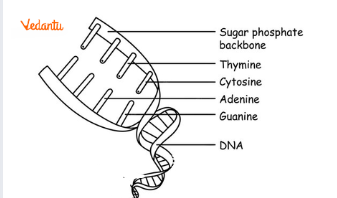
DNA exists as a double helix, which means it looks like a twisted ladder. This model was first proposed by James Watson and Francis Crick, based on the work of Rosalind Franklin and Maurice Wilkins. The double helix allows DNA to pack vast amounts of genetic information into a tiny space in the cell nucleus.
Components of DNA
Each DNA molecule is made up of two long chains of nucleotides. A nucleotide has three main parts:
- A five-carbon sugar called deoxyribose
- A phosphate group
- A nitrogenous base (Adenine, Thymine, Cytosine, or Guanine)
Base Pairing Rule
Nitrogenous bases pair in a very specific way: Adenine (A) always pairs with Thymine (T), and Guanine (G) always pairs with Cytosine (C). These pairs are held together by hydrogen bonds, maintaining the stability of the DNA double helix structure.
Antiparallel Strands
The two DNA strands run in opposite directions — one runs from 5' to 3', and the other from 3' to 5'. This antiparallel arrangement is critical for DNA replication and function.
Important Sub-Concepts Connected to DNA Structure
Types of DNA
DNA can exist in several structural forms, especially under different conditions. The three main types relevant for NEET are:
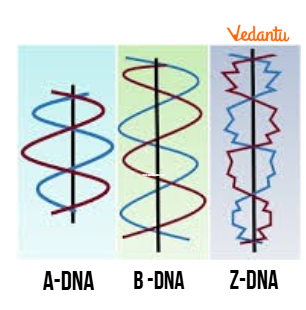
- B-DNA: The common, right-handed helix seen under physiological conditions.
- A-DNA: A more compact, right-handed helix formed under dehydrating conditions.
- Z-DNA: A left-handed helix that occurs in regions with alternating purines and pyrimidines.
Nucleosome and Packaging
To fit inside the nucleus, DNA wraps around proteins called histones, forming structures known as nucleosomes. This packaging is important for gene regulation and chromatin structure.
Relationships and Principles in DNA Structure
Chargaff’s Rule
Chargaff’s Rule states that in any double-stranded DNA, the amount of adenine (A) is equal to thymine (T), and the amount of guanine (G) is equal to cytosine (C). This relationship supports the base pairing rule and is frequently tested in NEET.
Hydrogen Bonding Between Bases
Adenine and thymine are held by two hydrogen bonds, while guanine and cytosine are held by three hydrogen bonds. This makes G-C pairs stronger and more stable than A-T pairs.
Key Features of DNA Structure
- Double helix with uniform diameter
- Long strands of repeating nucleotides
- Stable and self-replicating
- Specific base-pairing ensures accurate information transfer
- Highly compact yet accessible for gene expression
Why Is DNA Structure Important for NEET?
DNA structure is not only a theoretical concept but also forms the backbone for understanding advanced topics like DNA replication, transcription, and genetic engineering. Many NEET questions test your understanding of its structure, types, base pairing, and related principles. Mastery of this concept helps you tackle genetic problems confidently and strengthens your overall Biology preparation, as the principles of DNA structure often appear in multiple-choice questions and comprehension passages.
How to Study DNA Structure Effectively for NEET
- Start with diagrams and visualize the double helix and base pairing.
- Memorize the structure and functions of each component (sugar, phosphate, base).
- Practice drawing and labeling the DNA structure for better recall.
- Understand and apply Chargaff’s Rule to solve base composition problems.
- Use flashcards to remember types of DNA and their characteristics.
- Solve MCQs focused on structure, base pairing, and differences between DNA types.
- Revise regularly and test yourself with previous years' NEET questions from this topic.
Common Mistakes Students Make in DNA Structure
- Confusing bases (e.g., pairing A with C instead of T)
- Forgetting the antiparallel orientation of DNA strands
- Ignoring the distinction between types of DNA (A, B, Z)
- Overlooking the number of hydrogen bonds between base pairs
- Mixing up the sugar type in DNA (deoxyribose) with that in RNA (ribose)
Quick Revision Points for DNA Structure
- DNA is a double helix made of nucleotides.
- Each nucleotide contains deoxyribose sugar, phosphate, and a base.
- A pairs with T (2 hydrogen bonds), G pairs with C (3 hydrogen bonds).
- Strands run antiparallel (5' to 3', 3' to 5').
- Main forms: B-DNA (common), A-DNA, Z-DNA.
- Packaging involves DNA wrapping around histone proteins to form nucleosomes.
- Chargaff’s Rule applies: A=T, G=C in double-stranded DNA.
FAQs on DNA Structure: Complete NEET Biology Guide for Students
1. What is the structure of DNA?
DNA or Deoxyribonucleic Acid is a double-helix structure discovered by Watson and Crick, essential for NEET biology syllabus.
Main features of the DNA structure:
- Double-helix shape formed by two polynucleotide strands
- Strands run antiparallel (5’ to 3’ and 3’ to 5’)
- Nitrogenous bases: Adenine (A), Thymine (T), Guanine (G), Cytosine (C)
- Bases connected via hydrogen bonds (A pairs with T, G pairs with C)
- Phosphate and deoxyribose sugar backbone
2. What are the components of DNA?
DNA is made of three main components important for NEET:
- Deoxyribose sugar
- Phosphate group
- Nitrogenous bases (Adenine, Thymine, Guanine, Cytosine)
3. Why is DNA called a double helix?
DNA is called a double helix because it has two long strands twisted around each other.
- The two polynucleotide chains coil to form a helical structure
- Held together by hydrogen bonds between complementary bases
- This shape is critical for the storage and transfer of genetic information, a key topic in the NEET exam
4. What are the base pairing rules for DNA?
Base pairing in DNA follows the Chargaff's rule which is essential for NEET:
- Adenine (A) always pairs with Thymine (T)
- Guanine (G) always pairs with Cytosine (C)
- Pairings held by hydrogen bonds (A=T has 2 bonds, G≡C has 3 bonds)
- Ensures uniform diameter and stability of the double helix
5. Who discovered the structure of DNA?
The structure of DNA was discovered by James Watson and Francis Crick in 1953, a milestone highlighted in NEET.
- Built on research by Rosalind Franklin and Maurice Wilkins
- Their model explained DNA’s double helix and genetic function
- This discovery revolutionized understanding of heredity and molecular biology for all NEET aspirants
6. What is the function of DNA in living organisms?
DNA stores and transmits genetic information in all living organisms.
- Carries instructions for protein synthesis
- Ensures inheritance of traits from parents to offspring
- Controls cell growth, function and reproduction
- Central dogma and genetic code concepts in NEET biology
7. What is the difference between DNA and RNA?
DNA and RNA are two nucleic acids with key differences for NEET:
- DNA: double-stranded; RNA: single-stranded
- Sugar in DNA: deoxyribose; in RNA: ribose
- Bases: DNA (A, T, G, C); RNA (A, U, G, C)
- Function: DNA stores genetic information; RNA helps in protein synthesis
8. How many types of nitrogenous bases are present in DNA?
There are four types of nitrogenous bases in DNA, important for the NEET syllabus:
- Adenine (A) – purine
- Guanine (G) – purine
- Cytosine (C) – pyrimidine
- Thymine (T) – pyrimidine
9. What is the significance of antiparallel strands in DNA?
Antiparallel orientation means one DNA strand runs 5’→3’ and the other 3’→5’, a feature stressed in the NEET exam.
- Enables correct base pairing
- Essential for DNA replication and proofreading
- Ensures overall stability and function of the double helix
10. What is a nucleotide in DNA?
A nucleotide is the basic structural unit of DNA, key for NEET understanding.
- Made of a deoxyribose sugar, phosphate group, and a nitrogenous base
- Joins to form a long polynucleotide chain
- Sequence of nucleotides determines genetic information
11. State the difference between a purine and a pyrimidine with respect to DNA.
Purines and pyrimidines are two types of nitrogenous bases in DNA, vital for NEET students.
- Purines: Adenine (A) and Guanine (G) – double-ring structure
- Pyrimidines: Cytosine (C) and Thymine (T) – single-ring structure
- Pairing: one purine always pairs with one pyrimidine to maintain the helix structure
