







What is GNM vs BSc Nursing, and Which is Better After 12th?
GNM (General Nursing and Midwifery) and BSc Nursing are two of the most popular nursing courses for students after Class 12. Both are professional programmes that train candidates to become qualified nurses and work in hospitals, clinics, community health centres, and other healthcare settings.
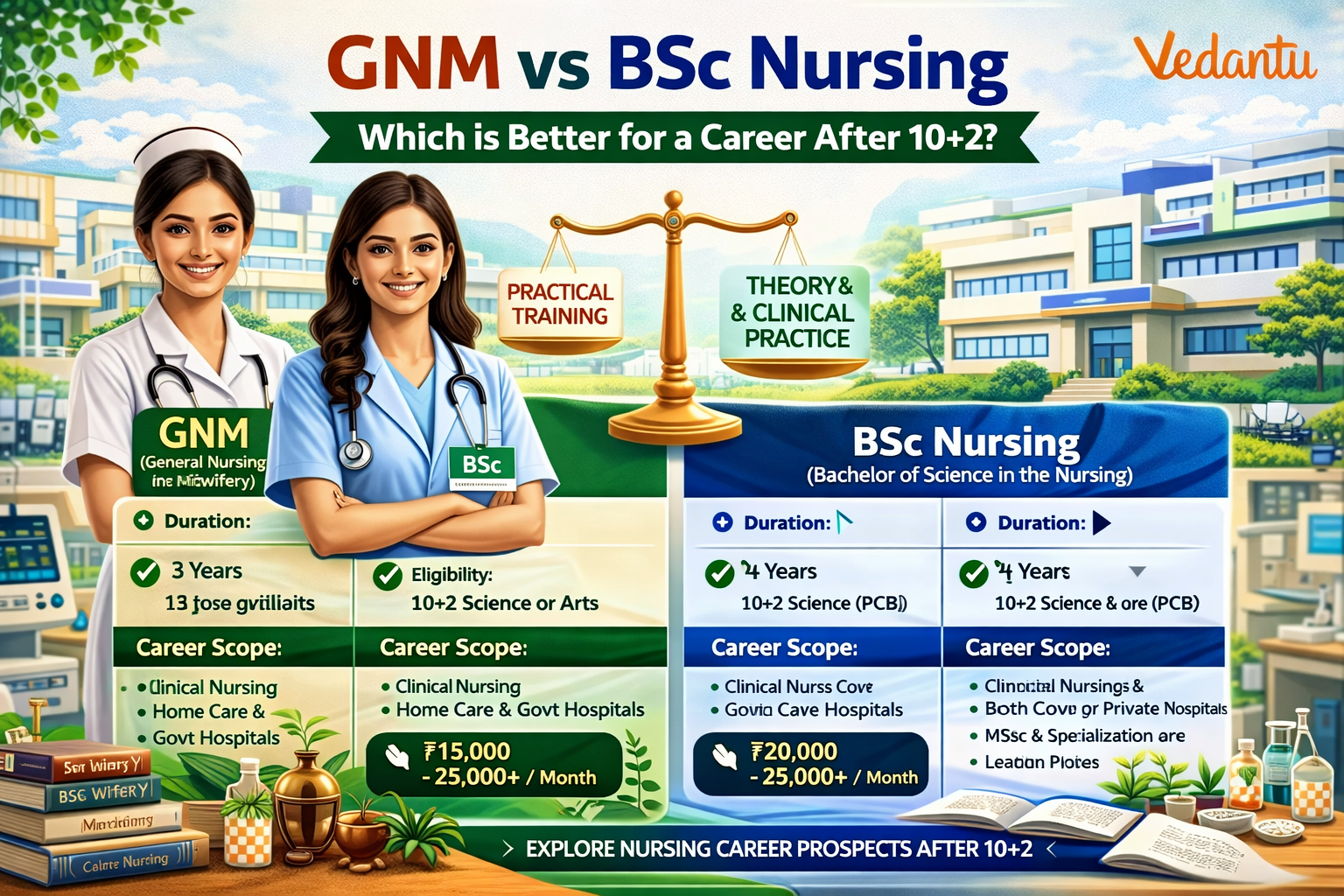
While both lead to a career in nursing, they differ in:
Course level (diploma vs degree)
Duration
Curriculum depth
Fees
Career growth and salary
Understanding these differences will help you choose GNM or BSc Nursing after 12th based on your background, budget, and long‑term goals.
GNM vs BSc Nursing: Quick Comparison
Basic Difference Between GNM and BSc Nursing
GNM is a diploma course in nursing and midwifery.
BSc Nursing is a full‑fledged undergraduate degree in nursing.
Key differences:
Duration:
GNM: 3–3.5 years, usually with a 6‑month internship.
BSc Nursing: 4 years of academic and clinical training.
Level:
GNM = Diploma
BSc Nursing = Bachelor’s degree
Curriculum depth:
Both cover core nursing subjects (Anatomy, Physiology, Pharmacology, Nursing Foundations, Medical‑Surgical Nursing, Community Health Nursing, etc.).
BSc Nursing also includes research methods, statistics, nursing education, administration, and health management, providing a broader academic foundation.
Cost:
BSc Nursing is generally more expensive due to its longer duration and broader curriculum.
After completing either course and fulfilling registration requirements, candidates can register with the State Nursing Council and work as registered nurses. Both pathways allow higher studies in nursing, but BSc Nursing offers a more direct route to postgraduate degrees.
GNM vs BSc Nursing Course Comparison
Eligibility Criteria: GNM vs BSc Nursing
Eligibility may vary slightly by state and institution, but broadly:
GNM Eligibility (General Outline)
Age: 17–35 years (as per INC/State norms)
Education:
Class 12 pass from a recognised board
Many institutes accept Arts, Science, or Health‑related streams as per the INC and state rules
Marks: Minimum aggregate as prescribed by the institution/INC
Health: Candidate should be medically fit
Many colleges allow Class 12 (Arts or Science) candidates for GNM if they meet the subject and board requirements.
BSc Nursing Eligibility (General Outline)
Age: Minimum 17 years; upper age limit depends on regulations
Education:
Class 12 with Science (PCB – Physics, Chemistry, Biology) and English from a recognised board
Marks:
45% or more in PCB, though some institutions may have higher cutoffs
Health: Candidate should be medically fit
Because it is a degree programme, BSc Nursing has stricter, more science‑oriented eligibility criteria compared to GNM.
GNM vs BSc Nursing: Fees and Cost of Study
The cost of GNM and BSc Nursing depends on:
whether the college is government or private
state/region and city type (metro vs non‑metro)
facilities, brand reputation, and clinical tie‑ups
GNM vs BSc Nursing Approximate Fee Range
*Figures are indicative; actual fees differ by institute and year.
Since BSc Nursing is a 4‑year degree, its overall cost (tuition + living expenses) is usually higher than GNM.
Before Deciding, You should:
Check official fee structures on each college’s website
explore scholarships, government schemes, and educational loans
Talk to the admissions/finance office for detailed cost breakdowns
Job Opportunities After BSc Nursing
BSc Nursing vs GNM career opportunities: BSc graduates are generally eligible for a wider range of roles and enjoy better long‑term growth.
Common Job Roles for BSc Nursing Graduates
Staff Nurse / Registered Nurse
Military Nurse / Defence Services Nurse
Nursing Officer / Ward In‑Charge
Department Supervisor / Nursing Supervisor
Nurse Educator / Lecturer (with experience and/or PG qualification)
Director of Nursing / Nursing Superintendent (with higher qualifications and experience)
Paramedic / Emergency Care Nurse
BSc Nursing is Usually Preferred For:
teaching posts in nursing colleges
research roles
senior clinical and administrative positions
This advantage is stronger when the candidate further pursues MSc Nursing or other PG programmes.
Job Opportunities After GNM
GNM vs BSc Nursing for jobs: GNM graduates also have good opportunities, particularly in core clinical and community roles.
Job Roles After GNM
General Ward Nurse / Staff Nurse
Nursing Trainer / Clinical Instructor (in some institutions)
Homecare Nurse
Community Health Nurse
Travel Nurse
Clinical Nurse Manager (with adequate experience)
Work Settings for GNM Graduates
Government and private hospitals
Nursing homes and long‑term care facilities
Community health centres (CHCs), PHCs, NGOs
Home health and outreach services
With experience, GNM nurses can move into supervisory roles or upgrade their qualification via Post Basic BSc Nursing.
Career Growth and Higher Studies After GNM
Can pursue Post Basic BSc Nursing (BSc Nursing PB)
With experience, you may qualify for distance/part‑time BSc Nursing options (as per current regulations)
Can take short‑term certificate courses in areas like:
Critical Care Nursing
Operation Theatre (OT) Nursing
Dialysis Nursing
Emergency and Trauma Care
Career Growth and Higher Studies After BSc Nursing
Can pursue MSc Nursing in specialisations such as:
Medical‑Surgical Nursing
Paediatric Nursing
Psychiatric / Mental Health Nursing
Community Health Nursing
Obstetrics and Gynaecological Nursing
Can later opt for a PhD in Nursing or advanced research roles
Eligible for teaching positions in nursing colleges (with PG and experience)
Can branch into related fields like:
Hospital Administration
Public Health / MPH
Health Management
Clinical Research
Because BSc Nursing is a degree, it offers a more straightforward pathway to postgraduate education, research, and leadership roles than GNM.
Learning Outcomes and Job Satisfaction
Both GNM and BSc Nursing aim to:
build strong clinical skills
develop patient care and communication abilities
prepare nurses to work in diverse healthcare settings
However:
BSc Nursing provides a more comprehensive academic foundation, especially in research and management, making graduates more competitive for teaching, research, and administrative positions.
GNM is more practice‑oriented, enabling quicker entry into the workforce, particularly in bedside care and community health.
Job Satisfaction in Nursing
Nursing can be highly rewarding if you:
are compassionate and patient
enjoy helping others
can handle pressure, emergencies, and irregular hours
It can also be:
physically demanding (long shifts, night duties)
emotionally challenging (handling critical cases, patient loss)
Job satisfaction depends on:
personal interest and attitude
work environment and support from colleagues
opportunities for learning, growth, and recognition
Essential Skills Required for a Nursing Career
Whether you choose GNM or BSc Nursing, these skills are crucial:
Effective Communication: Clear interaction with doctors, patients, and families.
Ability to Work Long Hours: Readiness for shifts, nights, and high workload.
Critical Thinking and Quick Decisions: Noticing changes in patient condition and reacting appropriately.
Attention to Detail: Small clinical observations can significantly impact treatment.
Empathy and Compassion: Providing emotional as well as physical care.
Teamwork: Coordinating with doctors, therapists, technicians, and support staff.
Developing these skills will help you succeed in any nursing role, regardless of the course you choose.
Salary Prospects: ANM vs GNM vs BSc Nursing
Starting salaries vary by institution, city, and experience, but broadly:
With experience and/or higher qualifications (like MSc Nursing), nurses can earn around ₹50,000–₹75,000 per month or more, particularly in:
senior clinical positions
specialised units (ICU, OT, NICU, etc.)
teaching posts
international roles
ANM vs GNM vs BSc Nursing: Which One Should You Choose?
Use this simple guidance to decide:
ANM (Auxiliary Nursing Midwifery)
Suitable for non‑science (Arts/Commerce) candidates who still want to enter nursing.
Can be followed by GNM, then Post Basic BSc Nursing.
GNM
Good for Science stream (with Biology) students who want early entry into the workforce.
Later, you can upgrade to BSc Nursing for better growth.
BSc Nursing
Best for Science (PCB) students aiming for:
strong academic depth
better long‑term career growth
clear postgraduate and international opportunities
BSc Nursing vs GNM for Government Jobs:
Both are eligible for many government nursing posts (depending on recruitment rules), but degree‑holders often have an advantage for higher posts, teaching roles, and promotions over time.
Conclusion: GNM or BSc Nursing: Which is Better?
Both GNM and BSc Nursing can lead to stable, respected careers in healthcare. The “better” option depends on:
Your academic background (Science vs non‑Science)
Your budget and time available for study
How soon do you want to start working
your long‑term goals (only clinical practice vs teaching, research, leadership)
Choose GNM if:
You want a shorter, more affordable diploma
You prefer quick employment after Class 12
Choose BSc Nursing if:
You can invest in a 4‑year degree
You want stronger long‑term growth, better salary potential, and clear PG options
Before taking a final decision, always:
Check the eligibility and fees of your target colleges
understand local and national job trends
Honestly assess your interest, stamina, and readiness for a demanding but deeply meaningful profession like nursing.
FAQs on GNM vs BSc Nursing: Which is Better for a Career After 10+2?
1. Which is better, GNM or BSc Nursing after 12th?
BSc Nursing is generally considered better for long-term career growth because it is a degree course. It offers better opportunities in higher studies, teaching, research, and leadership roles, while GNM is suitable for quicker entry into the workforce.
2. What is the main difference between GNM and BSc Nursing?
The main difference is that GNM is a diploma course, whereas BSc Nursing is an undergraduate degree. BSc Nursing includes advanced subjects like research, management, and statistics, making it more comprehensive than GNM.
3. Can I do BSc Nursing after GNM?
Yes, after completing GNM, you can pursue Post Basic BSc Nursing, which allows you to advance your qualification to the degree level and improve your career opportunities.
4. Which course has a higher salary, GNM or BSc Nursing?
BSc Nursing graduates usually earn higher salaries compared to GNM, especially in government hospitals, reputed private institutions, and international healthcare setups.
5. Is NEET required for GNM or BSc Nursing?
NEET is not mandatory for all nursing colleges. However, some institutions and universities may require entrance exams or merit-based admission, depending on their admission policies.
6. Can Arts students apply for GNM and BSc Nursing?
Arts students can apply for GNM in many institutes. However, BSc Nursing requires a science background with Physics, Chemistry, and Biology (PCB).
7. Which is better for government jobs, GNM or BSc Nursing?
Both GNM and BSc Nursing candidates are eligible for government nursing jobs, but BSc Nursing graduates often have an advantage for higher positions, promotions, and teaching roles.
8. What are the career options after GNM and BSc Nursing?
After GNM, candidates can work as staff nurses, community health nurses, or home care nurses. After BSc Nursing, candidates can explore roles such as nursing officer, educator, supervisor, or move into research and administration.
9. What is the duration of GNM and BSc Nursing courses?
GNM duration is around 3 to 3.5 years, including internship, while BSc Nursing is a 4-year degree programme with academic and clinical training.
10. Which course is easier, GNM or BSc Nursing?
GNM is generally considered easier as it focuses more on practical training. BSc Nursing has a higher academic load with theory, research, and advanced subjects.
11. Is BSc Nursing better than GNM for future growth?
Yes, BSc Nursing is better for future growth because it provides direct access to postgraduate courses like MSc Nursing and opens opportunities in research, teaching, and management.
12. Can I go abroad after GNM or BSc Nursing?
Both courses allow international opportunities, but BSc Nursing is more widely accepted globally and preferred for jobs abroad.
