




Stepwise Answers and PDF Download for Spectacular Wonders Class 8
Spectacular Wonders Question Answer – Let us do these activities before we read.
I. Look at the pictures given below and sort them into natural and man-made wonders.
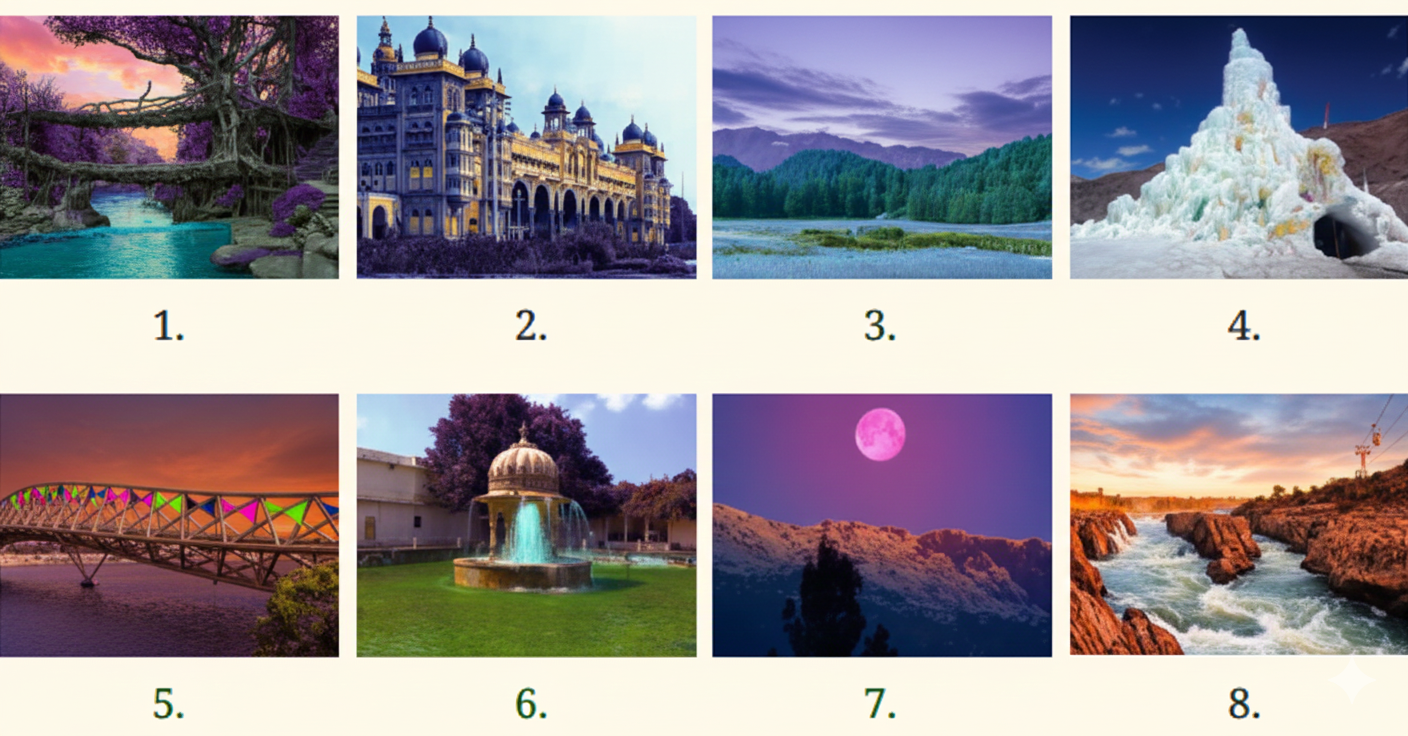
Natural: ______, ______, ______, and ______
Man-made: ______, ______, ______, and ______
Answer:
Natural Wonders: 3, 4, 7, 8
Man-made Wonders: 1, 2, 5, 6
II. Which of these wonders—man-made or natural—are more appealing and why? Share your answers with your classmates and teacher.
Answer:
Natural wonders feel more captivating because they reveal the true beauty, mystery, and strength of nature. Since they are not created by humans and have formed naturally over time, they appear more unique and fascinating.
III. Work in pairs. Write down two wonders of nature that have amazed you. Discuss what makes them impressive. Share your answers with your classmates and teacher.
Answer:
1. Niagara Falls – The thunderous sound and massive water flow are mesmerising.
2. Aurora Borealis – The dancing lights in the sky are magical and show nature’s artistic side.
IV. Work in groups of four. Complete the web chart given below with words that you associate with the phrase, ‘Nature’s Power’. Share your answers with your classmates and teacher.
Answer: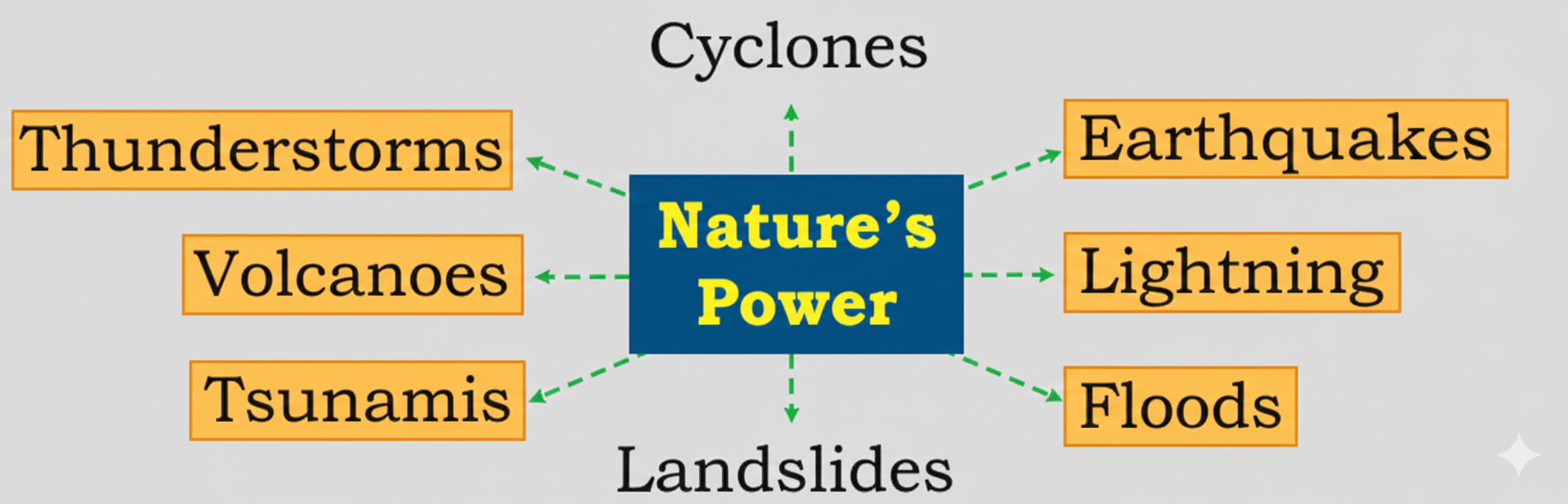
Spectacular Wonders Class 8 Question Answer – Let us discuss (Page 142)
I. Complete the information in the table given below. One example has been done for you. Share your answers with your classmates and teacher.
Answer:
Class 8 English Spectacular Wonders Question Answer – Let us think and reflect (Pages 142-144)
I- Read the given extracts and answer the questions that follow.
1. India is home to some of the most mystifying natural phenomena that surprise and spark our imagination.
(i) Replace the underlined phrase with one from the extract. India is the birthplace of several rare species of flora and fauna that thrive in its diverse ecosystems.
Answer:
home to
(ii) What does the phrase ‘nature’s unusual side’ suggest about the phenomena described?
Answer:
It shows that nature can produce rare, unusual, and unexpected sights or events that are unlike our everyday experiences, often leaving us surprised or amazed.
(iii) Complete the similarity by choosing the correct option,
spark: imagination : ______ : ______
A. inspiration; creativity
B. wonder; amazement
C. effort; reward
D. knowledge; books
Answer:
B. wonder: amazement
(iv) Identify whether the following statement is true or false.
Some natural phenomena can surprise people.
Answer:
True
2. Have you seen things disappearing in front of your eyes? Well, such things happen at times, when we keep things at some place, and just forget where we have kept them. But, what if there’s a sea that disappears?
This occurs in Odisha at a beach in the Balasore district where the sea mysteriously recedes—the famous Chandipur Beach, known for its unique ‘hide-and-seek’ behaviour with visitors.
(i) Complete the following sentence with a suitable reason.
The writer’s most likely purpose to introduce the information about the Chandipur Beach phenomenon with a question is to ______ (engage the reader’s curiosity and create a sense of suspense/draw the reader to learn more about the unusual phenomenon/set the tone for the surprising nature of the content that follows)
Answer:
capture the reader’s curiosity and build a sense of suspense.
(ii) Select the option that is correct for both Assertion (A) and Reason (R).
(A): Chandipur Beach in Odisha is known for its unique feature of the sea disappearing.
(R): The tides retreat drastically, exposing the Chandipur beach.
A. Both (A) and (R) are true, and (R) is the correct explanation of (A).
B. Both (A) and (R) are true, but (R) is not the correct explanation of (A).
C. (A) is true, but (R) is false.
D. (A) is false, but (R) is true.
Answer:
A. Both (A) and (R) are true, and (R) is the correct explanation of (A).
(iii) What does the term ‘unique’ suggest about the beach in Balasore?
A. very popular
B. one of its kind
C. ancient place
D. far from the city
Answer:
B. One of its kind
(iv) What does the writer want to convey with the use of the phrase ‘playing hide-and-seek with its visitors?
Answer:
The writer wants to highlight the surprising and almost magical way the sea disappears and returns at Chandipur Beach, much like a game of hide-and-seek, making it a truly unusual natural phenomenon.
II. Answer the following questions.
1. How are the Living Root Bridges a boon for the local people of Meghalaya?
Answer:
The Living Root Bridges are a blessing because they provide a sustainable and long-lasting way to cross rivers and streams, especially in the monsoon season. Grown naturally from tree roots, they are strong, durable, and showcase the skill and deep environmental understanding of the indigenous people.
2. Why is the Lonar Crater Lake considered a remarkable and rare site?
Answer:
It is the only crater in India created by a meteorite impact on basaltic rock and is the third-largest crater in the world. Its perfectly circular shape, rare saline lake, and mix of earthly and celestial features make it a remarkable geological wonder.
3. What might be the writer’s purpose of highlighting the awe-inspiring natural wonders of India?
Answer:
The writer wants to inspire a sense of wonder and respect for nature, showcase India’s diverse natural heritage, and encourage readers to be curious, environmentally aware, and interested in exploring these unique places.
4. The writer uses descriptive language and introductory questions for some of the natural phenomena. What impact does it have on the readers?
Answer:
It captures the reader’s attention, sparks curiosity, and makes the content more engaging. It also helps readers picture the wonders clearly and understand what makes them unique.
5. Which of these unusual phenomena did you find the most interesting and why?
Answer:
I found the Glowing Waters of Kerala the most fascinating because the sight of water glowing at night due to tiny living organisms feels both magical and scientifically intriguing. It beautifully blends mystery and wonder.
Spectacular Wonders Class 8 Questions and Answers – Let us learn (Pages 144-148)
I. Fill in the blanks with the correct expressions from the text given in the box below.
1. Which of these unusual phenomena did you find the most interesting and why?
Answer:
I found the Glowing Waters of Kerala the most interesting because the way water glows in the dark due to tiny living organisms feels magical and scientifically fascinating. It brings together beauty and mystery.
Spectacular Wonders Class 8 Questions and Answers – Let us learn (Pages 144-148)
I. Fill in the blanks with the correct expressions from the text given in the box below.
1. I have read many stories ______
2. Do you know when this little town ______?
3. His hard work has helped him ______
4. There are no simple solutions to the ______ of traffic jams.
5. He opened the ancient wooden box and stared at the treasure ______.
6. The garden is ______ in spring with lots of beautiful flowers in bloom.

Answer:
1. to name a few.
2. came into existence
3. to no end.
4. age-old problem
5. in disbelief.
6. in full glory
II. Select the correct synonyms from the box given below that match the list of words in 1-5. You may refer to a thesaurus.
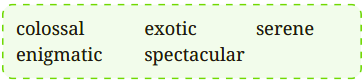
1. mysterious, puzzling, baffling
2. mighty, gigantic, huge
3. breath-taking, stunning, awe-inspiring
4. peaceful, calm, tranquil
5. unusual, peculiar, foreign
Answer:
1. enigmatic
2. colossal
3. spectacular
4. serene
5. exotic
III. The expressions ‘hide-and-seek’ and ‘flra and fauna’ are used in the text. These are called binomials—a pair of filed words joined by ‘and’ or ‘or’. The binomials are mostly synonyms, antonyms, rhyming words, same-sound words (alliterations), etc.
Match the binomials in Column 1 with their meanings in Column 2. You may refer to a dictionary.
Answer:
Use the binomials given in Column 1 in sentences of your own.
Odds and ends: While cleaning the attic, we discovered a box filled with small random items like old buttons, broken toys, and faded photographs.
On and off: It rained on and off the whole day, so we decided to delay the picnic.
Mix and match: You can mix and match different colours and patterns to create your own unique outfit.
All or nothing: For Riya, winning the competition was an all-or-nothing matter—she wasn’t ready to accept second place.
Part and parcel: Stress is part and parcel of preparing for board exams, though it can be handled with proper planning.
Pick and choose: You can’t pick and choose which rules you want to follow, you need to follow all of them.
Sooner or later: Sooner or later, the truth will come out, no matter how much you try to hide it.
Leaps and bounds: Her spoken English has improved by leaps and bounds ever since she joined the new language course.
IV. Study the highlighted words in the following sentences from the text.
The living root bridges are one of Meghalaya’s most beautiful…
…creating a striking visual contrast against the surrounding rugged terrain.
In the given sentences, the highlighted words ‘living’, ‘striking’, and ‘rugged’ are examples of verbs used as adjectives. Such verbs are called participles.
Participles are verb forms that can function as adjectives, and they come in two types: present participles (‘living’ and ‘striking’) usually ending in –ing, and past participles (‘rugged’) usually ending in -ed, -d, -t, -en, or –n. (though irregular verbs may vary) Present participles are used to describe ongoing or continuous actions.
For example,
People have seen these lights moving quickly in random directions, but often hanging out in one spot for a while before fading. Past participles usually describe actions that have already been completed.
For example,
When the vehicles are parked at the indicated spot, they begin moving forward at a speed of almost 20km/h.
Fill in the blanks using the present participle or past participle form of the verbs in the box given below.
1. The ______ marble monument looks even more spectacular in the moonlight.
2. The ______ view of the Himalayas from Darjeeling attracts visitors from all over the world.
3. The Sun Temple in Konark features intricately ______ stone wheels and walls.
4. ______ at a height of 182 m, the Statue of Unity is dedicated to Sardar Vallabhbhai Patel.
5. The ______ islands of the Andaman and Nicobar offer some of the cleanest beaches in India.
Answer:
1. glowing
2. amazing
3. carved.
4. Standing
5. Scattered
V. Study the highlighted word in the following sentence from the text.
Crossing the many waterways without bridges was difficult for people in the past, during monsoons.
In the given sentence, the highlighted word ‘crossing’ is one example of a verb used as a noun. Such a verb is called a gerund. Gerunds are verb forms that can function as nouns, and they end in –ing. They can serve as the subject, complement, or object in a sentence, as well as the object of a preposition.
For example,
Subject of a sentence:
Swimming is my favourite hobby.Subject complement:
Her passion is painting.Object of a verb:
I enjoy reading books in my free time.Object of a preposition:
She is interested in learning new languages.After certain verbs:
Shekar avoided talking about his weekend plans.
Underline the gerunds and participles in the following sentences. Write ‘G’ for gerunds and ‘P’ for participles in the space provided. One example has been done for you.
1. Dancing is a great way to express emotions. G
2. Travelling can broaden your perspective.
3. The falling leaves signalled the arrival of autumn.
4. She enjoys cooking new recipes for her family.
5. Reading helps improve your vocabulary.
6. He watched the shimmering stars in the night sky.
7. Forgetting the keys inside, Kanchan locked the door.
Answer:
1. Dancing is a great way to express emotions. → G
2. Travelling can broaden your perspective. → G
3. The falling leaves signalled the arrival of autumn. → P
4. She enjoys cooking new recipes for her family. → G
5. Reading helps improve your vocabulary. → G
6. He watched the shimmering stars in the night sky. → P
7. Forgetting the keys inside, Kanchan locked the door. → P
VI. Combine the following pairs of sentences using participles or gerunds.
You may use the clues given in brackets. One example has been done for you.
1. Nitesh entered the room. He saw his friend sitting in the corner, (participle)
Entering the room, Nitesh saw his friend sitting in the corner.
2. Smitha walked carelessly. She slipped on the doormat (participle)
3. Sleep for eight hours. It is good for health (gerund)
4. Ranjith felt happy about the result. He called his parents (participle)
5. Father encouraged Meena. Meena joined the course (gerund)
Answer:
1. Entering the room, Nitesh saw his friend sitting in the corner.
2. Walking carelessly, Smitha slipped on the doormat, (participle)
3. Sleeping for eight hours is good for health (gerund)
4. Feeling happy about the result, Ranjith called his parents, (participle)
5. Father encouraged Meena to join the course (gerund)
Spectacular Wonders Question Answer Class 8 – Let us listen (Pages 148-149)
I. You will listen to a brother and sister discuss a natural phenomenon. As you listen, mark the four true statements from 1-6 given below. (Refer to the NCERT Textbook Page 153 for transcript).

1. The brother was taken aback to see the posted pictures.
2. The brother admitted to not knowing about his sister’s favourite picture.
3. The sister stated that the rainbow mountain was like any other mountain.
4. The brother was aware of the reason for the formation of colours on the mountain.
5. The brother was surprised to learn about the mountain being covered with snow till recently.
6. The sister understood nature’s role in the beauty of the mountain.
True statements: 2, 4, 5, 6
Class 8 English Chapter 9 Question Answer – Let us speak (Page 149)
I. Work in groups of four. Make a presentation on a place of interest in and around your region that people like to visit. You may use the following guidelines to make your presentation.
Guidelines:
1. Slides 1-2: Choose any popular place of interest in your region.
2. Slides 3-4: Mention where it is located and how to reach there.
3. Slides 5-6: Describe the attractions of the place, why it is popular and explain its historical importance, if any.
4. Slides 7-8: List out weather conditions, local food, customs, and language.
5. Slides 9-10: Suggest the best time of the year to visit and why you recommend this place.
Answer:
Sample Presentation: “The Rock Garden of Chandigarh”
Slides 1–2: Place of Interest
Title: The Rock Garden – A Showcase of Creativity and Eco-Friendly Art
Location: Rock Garden, Chandigarh
Introduction:
The Rock Garden is a famous sculpture garden in Chandigarh. It’s known for being completely built using industrial and domestic waste.
Slides 3-4: Location and How to Reach
Location: Sector 1, Chandigarh, near Sukhna Lake.
How to Reach:
By road: Well-connected through local buses, taxis, and autos.
Nearest railway station: Chandigarh Railway Station (5-6 km away).
Nearest airport: Chandigarh International Airport.
Slides 5-6: Attractions and Importance
Built single-handedly by Nek Chand, a government employee.
Sculptures made from recycled materials like broken bangles, tiles, glass, wires, and ceramics.
Divided into different sections – the waterfall area, amphitheatre, and open-air galleries.
Showcases environmental consciousness and artistic brilliance.
Slides 7-8: Weather, Food, Customs, Language
Weather: Best from October to March (pleasant winter).
Local Food: Punjabi cuisine – chole bhature, butter chicken, lassi.
Customs: Friendly people, traditional attire during festivals.
Language: Punjabi, Hindi, and English are commonly spoken.
Slides 9-10: Best Time to Visit & Recommendation
Best Time: October to March for a comfortable climate.
Why Visit:
It’s a perfect blend of art and sustainability.
Inspires creativity and environmental responsibility.
A peaceful retreat for families, students, and artists.
NCERT Class 8 English Poorvi Chapter 9 Question Answer – Let us write (Page 149)
I. You just read vivid descriptions of the natural wonders of our country. Write a descriptive essay for your school magazine describing anything from nature that attracted your attention. It may be an object, a place, or an event experienced by you. Remember to give a title to your essay.
Use proper format and content organisation—begin with a title, include an introduction (one paragraph), body (two to three paragraphs), and a conclusion (one paragraph).
Answer:
Title: The Magical Glow of a Rainy Evening
Introduction:
Last year, during the monsoon season, I experienced something so mesmerizing that it has stayed with me ever since. I had travelled to a peaceful fishing village near Kochi, Kerala, called Kumbalangi.
As night approached and the rain slowly faded, I noticed the backwaters glowing softly under the dark sky.
Body:
The water sparkled with a gentle blue light, almost as if tiny stars were drifting beneath the surface. I later learned that this beautiful sight was caused by bioluminescence—light produced by microorganisms known as plankton. Whenever a boat cut through the water or the surface was disturbed, the glow became brighter, forming ripples of light that moved gracefully in the darkness.
The entire scene felt dreamlike. Tall palm trees surrounded the water, their silhouettes adding to the charm, and the calm sounds of nature made the moment even more magical. I had only read about such wonders before, but seeing it in person felt unbelievable. It was like nature quietly revealing one of her hidden miracles.
Conclusion:
This experience showed me that nature holds incredible secrets beyond our imagination. The glowing waters of Kumbalangi are not just a scientific occurrence—they remind us how breathtaking and mysterious our world truly is. I hope more people visit such places, not only to see them but to appreciate the silent wonders our planet has to offer.
Class 8th English Chapter 9 Spectacular Wonders Question Answer – Let us explore (Page 150)
I. Man-made Wonders
1. Kallanai Dam (The Grand Anaicut) in Tamil Nadu is one of the world’s oldest dams and is still in use.TheKallanaiDamrepresentsasignificant achievement in ancient Indian hydraulic engineering. It was built by the Chola King Karikala around 150 CE.
2. Another spectacular legacy of ancient wisdom that we have is the world’s fist residential university at Nalanda in Bihar. Nalanda was established much before any European university, providing higher education to thousands of students. It was declared as a UNESCO heritage site in 1980.
You may visit the site given below to know more about this. https://nalandauniv.edu.in/about-nalanda/history-and-revival/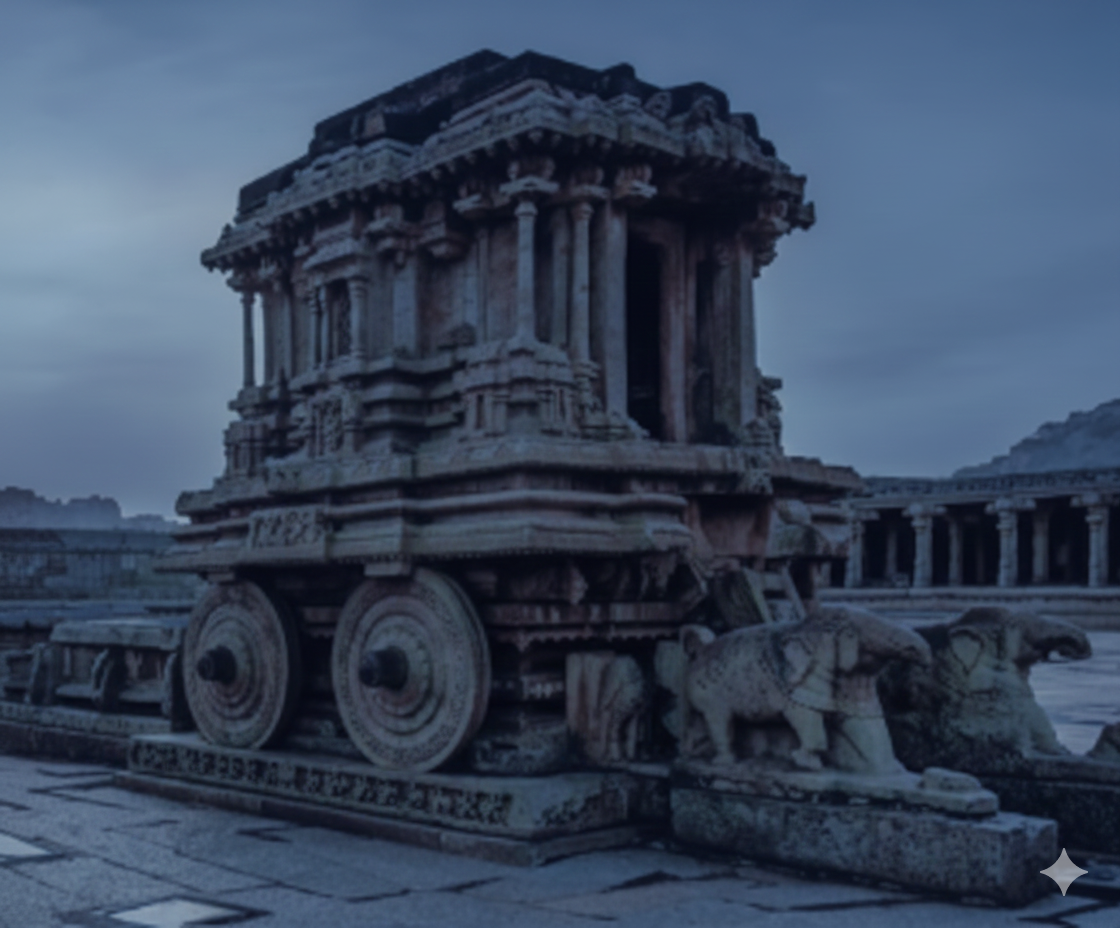
3. Hampi, a town in Karnataka, is also a UNESCO World Heritage Site. The Vittala Temple in Hampi was built in the 15th century. This temple has 56 special pillars known as the SaReGaMa pillars. When these pillars are tapped, they produce musical notes that can be heard clearly.
4. Some of the man-made wonders of modern India include the Bandra–Worli Sea Link in Mumbai; Statue of Unity in Gujarat; Bhupen Hazarika Setu (The Dhola-Sadiya Bridge) in Assam; and many more.
Answer:
Do it yourself
II. Some microplanktons in the sea are bioluminescent. Have you seen any other life form that has this quality? Identify the insect given below and find out what it is called in your language. Look out for it when you visit a field or a place with a wetland.
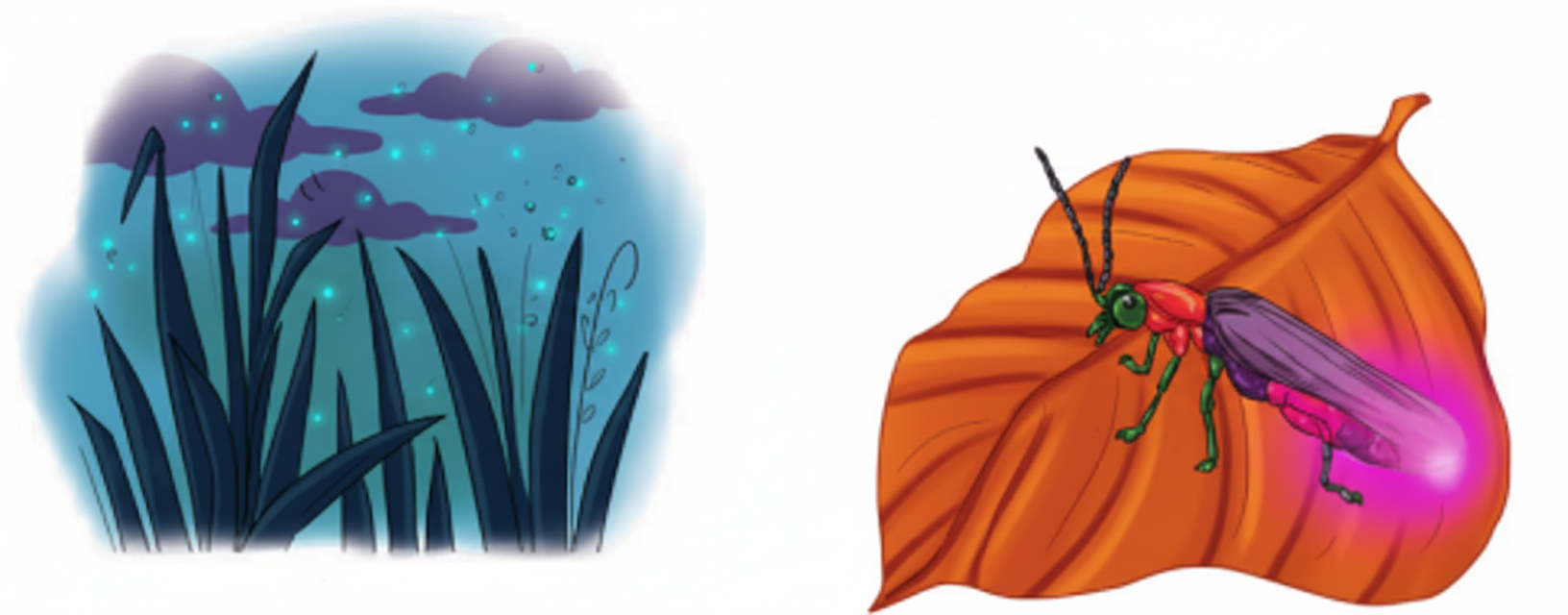
Answer:
Insect Shown: Firefly
Bioluminescence: Fireflies emit light from their abdomen through a chemical reaction, similar to the glow produced by microplanktons.
Common Names in Indian Languages:
Hindi: Jugnu
Malayalam: Minnaminungu
Tamil: Minnal Poochi
Bengali: Jonaki Poka
Telugu: Deepa Purugu
Marathi: Jugas
The Case of the Fifth Word – NCERT Solutions Class 8 English Poorvi Chapter 9 (2026-27)
Exploring The Case of the Fifth Word in Class 8 English Poorvi helps students strengthen analytical and reasoning skills. Using chapter-wise NCERT solutions makes understanding story clues and character motivations simpler, ensuring a solid grasp of the content for exams.
In the 2026-27 NCERT curriculum, mastering each story’s nuances and tackling exercises is vital. Practicing with direct answers and reviewing factual explanations helps you ace tests with confidence. Focus on understanding patterns and hidden messages in passages for better results.
Stay consistent with your practice, revisit NCERT Class 8 English Chapter 9 regularly, and pay attention to every exercise. This approach strengthens language skills and prepares you to score more in the board exam and other assessments.
FAQs on NCERT Solutions For Class 8 English Chapter 9 Spectacular Wonders - 2026-27
1. What is covered in the NCERT Solutions for Class 8 English Poorvi Chapter 9 Spectacular Wonders?
The NCERT Solutions for Class 8 English Poorvi Chapter 9 Spectacular Wonders provide comprehensive, stepwise answers to all textbook exercises for the chapter. Students will find:
- Detailed solutions for intext and back exercises
- Exam-oriented explanations and key definitions
- Essential tips for diagram and map labelling
- PDF download option for offline study
- Coverage of both short and long answer questions from the CBSE 2026–27 syllabus
2. How to write stepwise NCERT answers to score full marks in Class 8 English Poorvi Chapter 9?
To score full marks in Class 8 English Poorvi Chapter 9 Spectacular Wonders, write your NCERT answers by following these steps:
- Start with a direct answer using key words from the question
- Break complex answers into bullet points or steps
- Include definitions, examples, or diagram references where needed
- Keep your language clear and concise
- Underline key terms if permitted in exam
3. Which questions are most likely to appear from "Spectacular Wonders" in school exams?
Exam questions from Spectacular Wonders Class 8 often include:
- Short answer questions about specific wonders or features
- Definitions of key terms found in the chapter
- Long answer or descriptive questions about the significance of a particular wonder
- Questions on diagrams or map labelling related to the text
4. Are diagrams or definitions mandatory in Class 8 English Poorvi Chapter 9 answers?
Yes, including diagrams and definitions in your answers for Class 8 English Poorvi Chapter 9 can help you earn full marks:
- Definitions are vital for short and precise answers
- Neat, correctly labelled diagrams/maps are often rewarded in exams
- Check if the question specifically asks for a diagram or definition
5. How do I structure long answers for better marks in "Spectacular Wonders"?
Structure your long answers in "Spectacular Wonders" with a clear and logical flow:
- Begin with an introduction restating the question using key terms
- Develop each point in a separate paragraph or bullet
- Incorporate definitions, facts, and examples from the chapter
- Conclude with a summary statement
- Maintain neatness and proper grammar
6. Where can I download the PDF solutions for Class 8 English Poorvi Chapter 9 Spectacular Wonders?
You can download the PDF of NCERT Solutions for Class 8 English Poorvi Chapter 9 Spectacular Wonders directly from trusted educational websites. The PDF:
- Includes all stepwise answers
- Follows the latest CBSE 2026–27 syllabus
- Allows offline study and quick revision
7. What are the key definitions and concepts in Class 8 English Poorvi Chapter 9?
Important key definitions and concepts from Chapter 9 "Spectacular Wonders" include:
- Definition of 'wonder' as used in the text
- Names and unique features of different spectacular wonders
- Significance or location details of each wonder
- Related terms such as sightseeing, monuments or natural wonders
8. How do I prepare for diagram or map labelling questions in this chapter?
To prepare for diagram or map labelling questions in Spectacular Wonders:
- Practice drawing and labelling diagrams as seen in the textbook
- Use a ruler for straight lines and write labels clearly
- Review common map locations or features discussed in the chapter
- Reference CBSCE map/diagram conventions for neatness and accuracy
9. Are NCERT Solutions enough for Class 8 English exams?
NCERT Solutions for Class 8 English are sufficient for exam preparation because they:
- Follow the CBSE 2026–27 syllabus
- Offer stepwise, structured answers
- Prepare you for both short and long answer questions
- Help revise key concepts and definitions
10. What is the best way to revise "Spectacular Wonders" quickly before the exam?
The best way to revise Class 8 English Poorvi Chapter 9 (Spectacular Wonders) quickly is to:
- Read through the summary and key points
- Review all exercise and intext solutions
- Memorise important definitions
- Practice diagrams/maps and their labels
- Attempt sample questions and MCQs from the chapter
