






Class 7 Maths Chapter 11 Questions and Answers - Free PDF Download
Exercise 11.1
Refer to exercise 11.1 in the PDF
1. Find the value of:
i) \[{2^6}\]
Ans: The given expression is : \[{2^6}\]
By expanding the term \[{2^6}\] we get,
${2^6} = 2 \times 2 \times 2 \times 2 \times 2 \times 2$
By multiplying,
${2^6} = 64$
Hence, the required value of \[{2^6}\] is $64$.
ii) ${9^3}$
Ans: The given expression is : ${9^3}$
By expanding the term ${9^3}$ we get,
${9^3} = 9 \times 9 \times 9$
By multiplying,
${9^3} = 729$
Hence, the required value of ${9^3}$ is $729$.
iii) ${11^2}$
Ans: The given expression is : ${11^2}$
By expanding the term ${11^2}$ we get,
${11^2} = 11 \times 11$
By multiplying,
${11^2} = 121$
Hence, the required value of ${11^2}$ is $121$.
iv) ${5^4}$
Ans: The given expression is : ${5^4}$
By expanding the term ${5^4}$ we get,
${5^4} = 5 \times 5 \times 5 \times 5$
By multiplying,
${5^4} = 625$
Hence, the required value of ${5^4}$ is $625$.
2. Express the following in exponential form:
i) $6 \times 6 \times 6 \times 6$
Ans: The given expression is : $6 \times 6 \times 6 \times 6$
The number of $6$’s in the given expression is $4$ .
So, the exponent of $6$ is $4$.
Hence, $6 \times 6 \times 6 \times 6 = {6^4}$.
ii) $t \times t$
Ans: The given expression is : $t \times t$
The number of $t$ ’s in the given expression is $2$.
So, the exponent of $t$ is $2$.
Hence, $t \times t = {t^2}$.
iii) $b \times b \times b \times b$
Ans: The given expression is : $b \times b \times b \times b$
The number of $b$ ’s in the given expression is $4$.
So, the exponent of $t$ is $4$.
Hence, $b \times b \times b \times b = {b^4}$.
iv) $5 \times 5 \times 7 \times 7 \times 7$
Ans: The given expression is : $5 \times 5 \times 7 \times 7 \times 7$
The number of $5$ ’s in the given expression is $2$ .
The number of $7$ ’s in the given expression is $3$.
So, the exponent of $5$ is $2$ and the exponent of $7$ is $3$.
Hence, $5 \times 5 \times 7 \times 7 \times 7 = {5^2} \times {7^3}$.
v) $2 \times 2 \times a \times a$
Ans: The given expression is : $2 \times 2 \times a \times a$
The number of $2$ ’s in the given expression is $2$ .
The number of $a$ ’s in the given expression is $2$.
So, the exponent of $2$ is $2$ and the exponent of $a$ is $2$.
Hence, $2 \times 2 \times a \times a = {2^2} \times {a^2}$.
vi) $a \times a \times a \times c \times c \times c \times c \times d$
Ans: The given expression is : $a \times a \times a \times c \times c \times c \times c \times d$
The number of $a$ ’s in the given expression is $3$.
The number of $c$ ’s in the given expression is $4$.
The number of $d$ ’s in the given expression is $1$.
So, the exponent of $a$ is $3$ , the exponent of $c$ is $4$ and the exponent of $d$ is $1$ .
Hence, $a \times a \times a \times c \times c \times c \times c \times d = {a^3} \times {c^4} \times {d^1}$.
3. Express each of the following numbers using the exponential notation:
i) $512$
Ans: By factorization method, we can find,
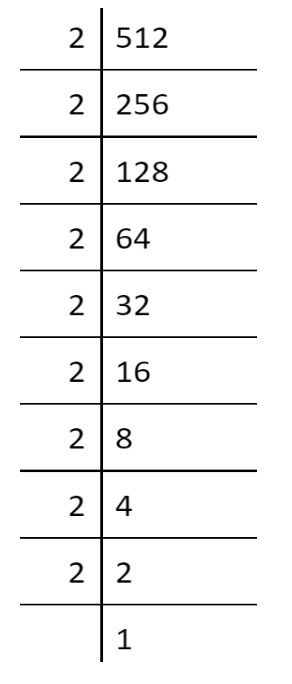
In the above expanding form of $512$, numbers of $2$’s as a factor is $9$.
So, we can express $512$ as term of $2$ .
$512 = 2 \times 2 \times 2 \times 2 \times 2 \times 2 \times 2 \times 2 \times 2$
The exponent of $2$ will be $9$ .
Hence, $512 = {2^9}$.
ii) $343$
Ans: By factorization method we can find,
In the above expanding form of $343$ , numbers of $7$’s as factor is $3$.
So, we can express $343$ as term of $7$ .
$343 = 7 \times 7 \times 7$
The exponent of $7$ will be $3$ .
Hence, $343 = {7^3}$.
iii) $729$
Ans: By factorization method we can find,
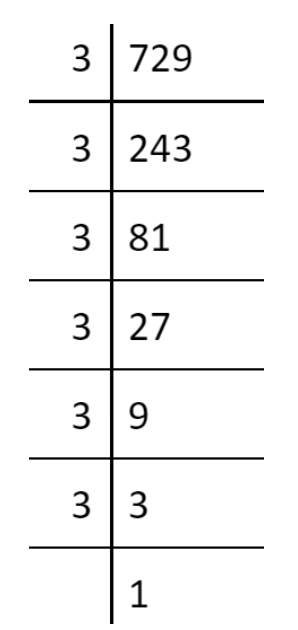
In the above expanding form of $729$, numbers of $3$’s as the factor is $6$.
So, we can express $729$ as term of $3$ .
$729 = 3 \times 3 \times 3 \times 3 \times 3 \times 3$
The exponent of $3$ will be $6$ .
Hence, $729 = {3^6}$.
iv) $3125$
Ans: By factorization method, we can find,
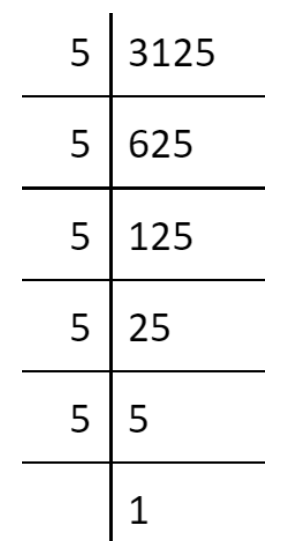
In the above expanding form of $3125$, numbers of $5$’s as a factor is $5$.
So, we can express $3125$ as term of $5$ .
$3125 = 5 \times 5 \times 5 \times 5 \times 5$
The exponent of $5$ will be $5$ .
Hence, $3125 = {5^5}$.
4. Identify the greater number, wherever possible, in each of the following:
i) ${4^3}$ and ${3^4}$
Ans: ${4^3}$ can be written as,
${4^3} = 4 \times 4 \times 4$
${4^3} = 64$
${3^4}$can be written as,
${3^4} = 3 \times 3 \times 3 \times 3$
${3^4} = 81$
Since, $81 > 64$
Thus, ${3^4} > {4^3}$.
Hence, ${3^4}$ is greater than ${4^3}$.
ii) ${5^3}$ and ${3^5}$
Ans: ${5^3}$ can be written as,
${5^3} = 5 \times 5 \times 5$
${5^3} = 125$
${3^5}$ can be written as,
${3^5} = 3 \times 3 \times 3 \times 3 \times 3$
${3^5} = 243$
Since, $243 > 125$
Thus, ${3^5} > {5^3}$.
Hence, ${3^5}$ is greater than ${5^3}$.
iii) ${2^8}$ and ${8^2}$
Ans: ${2^8}$ can be written as,
${2^8} = 2 \times 2 \times 2 \times 2 \times 2 \times 2 \times 2 \times 2$
${2^8} = 256$
${8^2}$ can be written as,
${8^2} = 8 \times 8$
${8^2} = 64$
Since, $256 > 64$
Thus, ${2^8} > {8^2}$.
Hence, ${2^8}$ is greater than ${8^2}$.
iv) ${100^2}$ and ${2^{100}}$
Ans: ${100^2}$ can be written as,
${100^2} = 100 \times 100$
${100^2} = 10000$
${2^{100}}$can be written as,
${2^{100}} = 2 \times 2 \times 2 \times 2 \times 2 \times ....14{\text{ times}} \times .... \times 2$
${2^{100}} = 16384 \times ... \times 2$
Since, $16384 \times ... \times 2 > 10000$
Thus, ${2^{100}} > {100^2}$.
Hence, ${2^{100}}$ is greater than ${100^2}$.
v) ${2^{10}}$ and ${10^2}$
Ans: ${2^{10}}$can be written as,
${2^{10}} = 2 \times 2 \times 2 \times 2 \times 2 \times 2 \times 2 \times 2 \times 2 \times 2$
${2^{10}} = 1024$
${10^2}$ can be written as,
${10^2} = 10 \times 10$
${10^2} = 100$
Since, $1024 > 100$
Thus, ${2^{10}} > {10^2}$.
Hence, ${2^{10}}$ is greater than ${10^2}$.
5. Express each of the following as product of powers of their prime factors:
i) $648$
Ans: The given expression is $648$.
By factorization method we can find the prime factors,
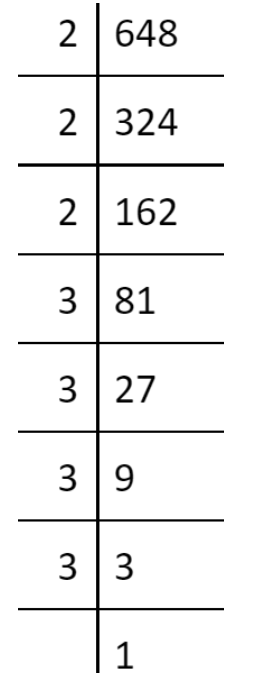
So, $648$ can be written as
$648 = 2 \times 2 \times 2 \times 3 \times 3 \times 3 \times 3$
It can be express as exponent of $2$ and $3$ .
$648 = {2^3} \times {3^4}$
Hence, the required expression is $648 = {2^3} \times {3^4}$.
ii) $405$
Ans: The given expression is $405$.
By factorization method we can find the prime factors,
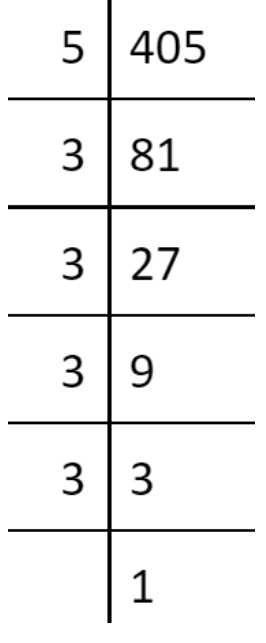
So, $405$ can be written as
$405 = 5 \times 3 \times 3 \times 3 \times 3$
Now, it can be express as
$405 = 5 \times {3^4}$
Hence, the required expression is $405 = 5 \times {3^4}$.
iii) $540$
Ans: The given expression is $540$.
By factorization method we can find the prime factors,
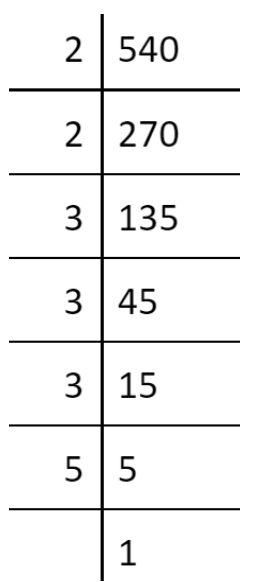
So, $540$ can be written as
$540 = 2 \times 2 \times 3 \times 3 \times 3 \times 5$
Now, it can be express as
$540 = {2^2} \times {3^3} \times 5$
Hence, the required expression is $540 = {2^2} \times {3^3} \times 5$.
iv) $3600$
Ans: The given expression is $3600$.
By factorization method we can find the prime factors,
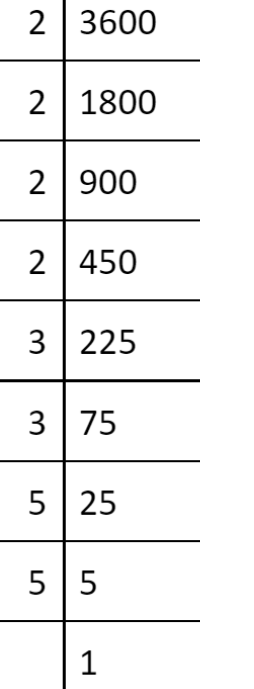
So, $3600$ can be written as
$3600 = 2 \times 2 \times 2 \times 2 \times 3 \times 3 \times 5 \times 5$
Now, it can be express as
$3600 = {2^4} \times {3^2} \times {5^2}$
Hence, the required expression is $3600 = {2^4} \times {3^2} \times {5^2}$.
6. Simplify:
i) $2 \times {10^3}$
Ans: The given expression is: $2 \times {10^3}$
By expanding the given expression,
$2 \times {10^3} = 2 \times 10 \times 10 \times 10$
$2 \times {10^3} = 2000$
Hence, the required solution is $2 \times {10^3} = 2000$.
ii) ${7^2} \times {2^2}$
Ans: The given expression is: ${7^2} \times {2^2}$
By expanding the given expression,
${7^2} \times {2^2} = 7 \times 7 \times 2 \times 2$
${7^2} \times {2^2} = 196$
Hence, the required solution is ${7^2} \times {2^2} = 196$.
iii) ${2^3} \times 5$
Ans: The given expression is: ${2^3} \times 5$
By expanding the given expression,
${2^3} \times 5 = 2 \times 2 \times 2 \times 5$
${2^3} \times 5 = 40$
Hence, the required solution is ${2^3} \times 5 = 40$.
iv) $3 \times {4^4}$
Ans: The given expression is: $3 \times {4^4}$
By expanding the given expression,
$3 \times {4^4} = 3 \times 4 \times 4 \times 4 \times 4$
$3 \times {4^4} = 768$
Hence, the required solution is $3 \times {4^4} = 768$.
v) $0 \times {10^2}$
Ans: The given expression is: $0 \times {10^2}$
By expanding the given expression,
$0 \times {10^2} = 0 \times 10 \times 10$
$0 \times {10^2} = 0$
Hence, the required solution is $0 \times {10^2} = 0$.
vi) ${5^3} \times {3^3}$
Ans: The given expression is: ${5^3} \times {3^3}$
By expanding the given expression,
${5^3} \times {3^3} = 5 \times 5 \times 5 \times 3 \times 3 \times 3$
${5^3} \times {3^3} = 675$
Hence, the required solution is ${5^3} \times {3^3} = 675$.
vii) ${2^4} \times {3^2}$
Ans: The given expression is: ${2^4} \times {3^2}$
By expanding the given expression,
${2^4} \times {3^2} = 2 \times 2 \times 2 \times 2 \times 3 \times 3$
${2^4} \times {3^2} = 144$
Hence, the required solution is ${2^4} \times {3^2} = 144$.
viii) ${3^2} \times {10^4}$
Ans: The given expression is: ${3^2} \times {10^4}$
By expanding the given expression,
${3^2} \times {10^4} = 3 \times 3 \times 10 \times 10 \times 10 \times 10$
${3^2} \times {10^4} = 90,000$
Hence, the required solution is ${3^2} \times {10^4} = 90,000$.
7. Simplify:
i) ${\left( { - 4} \right)^3}$
Ans: The given expression is: ${\left( { - 4} \right)^3}$
By expanding the given expression,
${\left( { - 4} \right)^3} = \left( { - 4} \right) \times \left( { - 4} \right) \times \left( { - 4} \right)$
${\left( { - 4} \right)^3} = - 64$
Hence, the required solution is${\left( { - 4} \right)^3} = - 64$.
ii) $\left( { - 3} \right) \times {\left( { - 2} \right)^3}$
Ans: The given expression is: $\left( { - 3} \right) \times {\left( { - 2} \right)^3}$
By expanding the given expression,
$\left( { - 3} \right) \times {\left( { - 2} \right)^3} = \left( { - 3} \right) \times \left( { - 2} \right) \times \left( { - 2} \right) \times \left( { - 2} \right)$
$\left( { - 3} \right) \times {\left( { - 2} \right)^3} = 24$
Hence, the required solution is$\left( { - 3} \right) \times {\left( { - 2} \right)^3} = 24$.
iii) ${\left( { - 3} \right)^2} \times {\left( { - 5} \right)^2}$
Ans: The given expression is: ${\left( { - 3} \right)^2} \times {\left( { - 5} \right)^2}$
By expanding the given expression,
${\left( { - 3} \right)^2} \times {\left( { - 5} \right)^2} = \left( { - 3} \right) \times \left( { - 3} \right) \times \left( { - 5} \right) \times \left( { - 5} \right)$
${\left( { - 3} \right)^2} \times {\left( { - 5} \right)^2} = 225$
Hence, the required solution is${\left( { - 3} \right)^2} \times {\left( { - 5} \right)^2} = 225$.
iv) ${\left( { - 2} \right)^3} \times {\left( { - 10} \right)^3}$
Ans: The given expression is: ${\left( { - 2} \right)^3} \times {\left( { - 10} \right)^3}$
By expanding the given expression,
${\left( { - 2} \right)^3} \times {\left( { - 10} \right)^3} = 2 \times 2 \times 2 \times 10 \times 10 \times 10$
${\left( { - 2} \right)^3} \times {\left( { - 10} \right)^3} = 8000$
Hence, the required solution is${\left( { - 2} \right)^3} \times {\left( { - 10} \right)^3} = 8000$.
8. Compare the following numbers:
i) $2.7 \times {10^{12}};1.5 \times {10^8}$
Ans: The given expressions are :$2.7 \times {10^{12}}$and $1.5 \times {10^8}$.
Since, ${10^{12}} > {10^8}$
On comparing the exponents of base 10,
$2.7 \times {10^{12}} > 1.5 \times {10^8}$
Hence, $2.7 \times {10^{12}}$ is greater than $1.5 \times {10^8}$.
ii) $4 \times {10^{14}};3 \times {10^{17}}$
Ans: The given expressions are :$4 \times {10^{14}}$and $3 \times {10^{17}}$.
Since, ${10^{17}} > {10^{14}}$
On comparing the exponents of base 10,
$3 \times {10^{17}} > 4 \times {10^{14}}$
Hence, $3 \times {10^{17}}$ is greater than $4 \times {10^{14}}$.
NCERT Solutions for Class 7 Maths Chapter 11 Exponents and Powers Exercise 11.1
Opting for the NCERT solutions for Ex 11.1 Class 7 Maths is considered as the best option for the CBSE students when it comes to exam preparation. This chapter consists of many exercises. Out of which we have provided the Exercise 11.1 Class 7 Maths NCERT solutions on this page in PDF format. You can download this solution as per your convenience or you can study it directly from our website/ app online.
Vedantu in-house subject matter experts have solved the problems/ questions from the exercise with the utmost care and by following all the guidelines by CBSE. Class 7 students who are thorough with all the concepts from the Maths textbook and quite well-versed with all the problems from the exercises given in it, then any student can easily score the highest possible marks in the final exam. With the help of this Class 7 Maths Chapter 11 Exercise 11.1 solutions, students can easily understand the pattern of questions that can be asked in the exam from this chapter and also learn the marks weightage of the chapter. So that they can prepare themselves accordingly for the final exam.
Besides these NCERT solutions for Class 7 Maths Chapter 11 Exercise 11.1, there are plenty of exercises in this chapter which contain innumerable questions as well. All these questions are solved/answered by our in-house subject experts as mentioned earlier. Hence all of these are bound to be of superior quality and anyone can refer to these during the time of exam preparation. In order to score the best possible marks in the class, it is really important to understand all the concepts of the textbooks and solve the problems from the exercises given next to it.
Do not delay any more. Download the NCERT solutions for Class 7 Maths Chapter 11 Exercise 11.1 from Vedantu website now for better exam preparation. If you have the Vedantu app in your phone, you can download the same through the app as well. The best part of these solutions is these can be accessed both online and offline as well.
Class 7 Maths Chapter 11: Exercises Breakdown
CBSE Class 7 Maths Chapter 11 Other Study Materials
Chapter-Specific NCERT Solutions for Class 7 Maths
Given below are the chapter-wise NCERT Solutions for Class 7 Maths. Go through these chapter-wise solutions to be thoroughly familiar with the concepts.
Important Related Links for NCERT Class 7 Maths
Access these essential links for NCERT Class 7 Maths, offering comprehensive solutions, study guides, and additional resources to help students master language concepts and excel in their exams.

FAQs on NCERT Solutions For Class 7 Maths Chapter 11 Exponents And Powers Exercise 11.1 - 2026-27 Free PDF Download (Login Required)
1. What key topics are covered in Vedantu’s NCERT Solutions for Class 7 Maths Chapter 11, Exponents and Powers?
Our NCERT Solutions for Class 7 Maths Chapter 11 provide detailed, step-by-step answers for all exercises based on the CBSE 2025-26 syllabus. The main topics covered include:
- Understanding bases and exponents.
- Applying the laws of exponents for multiplication and division.
- Solving problems involving the power of a power rule.
- Simplifying expressions using multiple exponential laws.
- Expressing large numbers in standard form.
2. What is the correct step-by-step method to simplify an expression like (2⁵ ÷ 2³) × 2²?
To solve such problems correctly as per the NCERT methodology, you should follow these steps:
- Step 1: Solve the expression inside the brackets first. Apply the division law of exponents (aᵐ ÷ aⁿ = aᵐ⁻ⁿ). Here, 2⁵ ÷ 2³ becomes 2⁵⁻³ = 2².
- Step 2: Now, the expression is simplified to 2² × 2².
- Step 3: Apply the multiplication law of exponents (aᵐ × aⁿ = aᵐ⁺ⁿ). So, 2² × 2² becomes 2²⁺² = 2⁴.
- Step 4: Calculate the final value, which is 2 × 2 × 2 × 2 = 16.
Following this sequence ensures accuracy and correctly applies the rules of exponents.
3. Why is it important to show each step when solving problems using laws of exponents?
Showing each step is crucial for several reasons. Firstly, it helps in systematically applying the correct law of exponents (like for multiplication, division, or power of a power) without confusion. Secondly, in exams, marks are often awarded for the correct method, not just the final answer. A step-by-step solution clearly demonstrates your understanding of concepts like identifying the base, handling negative exponents, and simplifying correctly, which minimises calculation errors and helps secure full marks.
4. What is the correct method for expressing a number as a product of powers of its prime factors in Chapter 11?
The correct method involves prime factorisation. Let's take the number 72 as an example:
- Step 1: Start by dividing the number by the smallest prime number, which is 2. 72 ÷ 2 = 36.
- Step 2: Continue dividing the result by 2 until it's no longer possible. 36 ÷ 2 = 18; 18 ÷ 2 = 9.
- Step 3: Move to the next prime number, which is 3. 9 ÷ 3 = 3.
- Step 4: The prime factors are 2, 2, 2, 3, and 3.
- Step 5: Express these factors in exponential form by counting their occurrences. Since 2 appears three times (2³) and 3 appears twice (3²), the final expression is 72 = 2³ × 3².
5. How do the NCERT Solutions help differentiate between simplifying (-3)⁴ and -3⁴?
This is a common point of confusion that the NCERT solutions clarify. In (-3)⁴, the base is -3 and the exponent is 4. The entire base is multiplied four times: (-3) × (-3) × (-3) × (-3) = 81. In -3⁴, the exponent 4 applies only to the base 3, not the negative sign. So, you first calculate 3⁴ (which is 81) and then apply the negative sign, making the answer -81. The solutions demonstrate this distinction through step-wise examples, preventing common errors.
6. What is the standard procedure for comparing large numbers in exponential form, like 4³ and 3⁴?
The most reliable method shown in the NCERT solutions for comparing such numbers is to calculate their actual values. This approach avoids confusion when bases and exponents are different.
- First, calculate the value of 4³: 4 × 4 × 4 = 64.
- Next, calculate the value of 3⁴: 3 × 3 × 3 × 3 = 81.
- Finally, compare the results. Since 81 > 64, we can conclude that 3⁴ is greater than 4³.
For very large numbers where calculation is not feasible, solutions demonstrate using laws of exponents to simplify them to a comparable form.
7. How does mastering the methods in NCERT Solutions for Chapter 11 help in higher classes?
Mastering the step-by-step methods for exponents and powers in Class 7 builds a strong foundation for advanced topics in algebra and science. Concepts like scientific notation (standard form) are essential in Physics and Chemistry for representing astronomical distances or atomic sizes. The laws of exponents are fundamental to simplifying complex algebraic expressions, polynomial operations, and solving equations in Class 8 and beyond. A solid understanding from these NCERT solutions ensures you can handle more complex calculations with speed and accuracy later on.
