






Madhu's Wish Questions and Answers - Free PDF Download
NCERT Solution for English Class 3 Chapter 9, titled "Madhu’s Wish," explores the story of a young boy named Madhu who loves food. The chapter narrates Madhu's experience of sharing his meal with an old man and the magical gift he receives in return. Vedantu provides clear explanations for each part of the story, ensuring that students can easily understand the main ideas. Class 3 English NCERT Solutions include answers to all the questions, helping students in exam preparation and improving their comprehension skills.
 Table of Content
Download the FREE PDF for Class 3 English Chapter 9 Question Answers, prepared by experts at Vedantu and aligned with the Latest CBSE Class 3 English Syllabus, to make your study sessions more productive and efficient.
Glance on Class 3 English (Santoor) Chapter 9 - Madhu’s Wish
Chapter 9, "Madhu’s Wish," in the Class 3 English (Santoor) textbook, tells the story of a boy named Madhu who loves food.
When he is given a magical opportunity to wish for anything from a magical tree, he asks for an endless variety of foods.
However, he soon realises he has overlooked the importance of water.
This chapter not only highlights the value of sharing and kindness but also teaches a valuable lesson about understanding one's needs.
The NCERT Solutions for Chapter 9 provide detailed answers and explanations to help students grasp the story’s themes and improve their comprehension skills.
Let us think
A. Answer the following.
1. What did Madhu enjoy?
Madhu enjoyed eating different kinds of food and snacks.
2. Do you think the old man had magical powers? How do you know?
Yes, the old man had magical powers because he told Madhu that anything he wished for from the tree would be granted, and it actually happened.
3. Why did the tree ask Madhu to ‘think over’ his wish?
The tree asked Madhu to ‘think over’ his wish to make sure he was certain about what he wanted and to give him a chance to consider if he might need something other than just food.
4. Name some of the things that Madhu ate.
Madhu ate laddoos, fruits like grapes, mangoes, apples, and bananas, and savoury snacks like samosas, kachori, and potato chips.
B. Think and Say.
1. Have you experienced hiccups?
Yes, I have experienced hiccups.
2. What do you do when you get hiccups?
When I get hiccups, I usually drink some water or try to hold my breath for a few seconds to stop them.
3. Do you think water is important? Why do you think so?
Yes, water is very important because it keeps us hydrated, helps in digestion, and is essential for our overall health. Without water, we cannot survive.
4. If you were in Madhu’s place, what would you wish for and why?
If I were in Madhu’s place, I would wish for good health and happiness for my family because these are the most important things in life that bring true joy and contentment.
Let us Learn
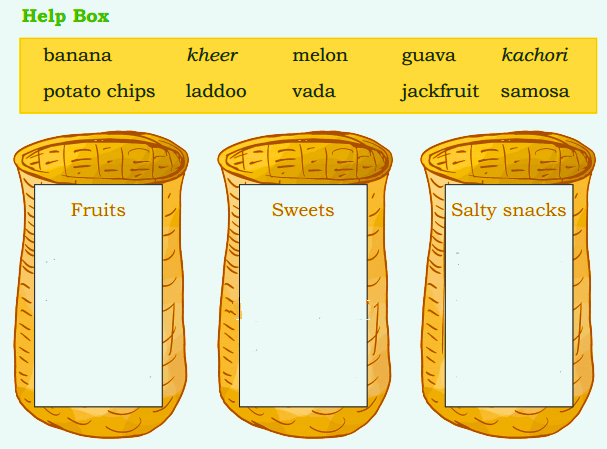
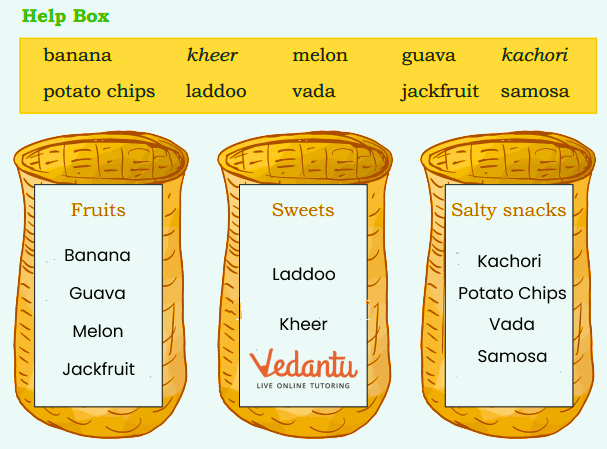
A. Madhu enjoyed the following items.
Write them in the correct basket.
Help Box
C. Choose a word from the box to describe the people below.

Ans:
1. Pramod doesn’t share his toys with anyone. He is selfish.
2. The woman saved the boy from the robber. She is brave.
3. Advait is always lying in bed and doing nothing. She is lazy.
4. Prerna always wishes everyone in the morning. She is polite.
D. Read the following sentences.
1. Sam is watching television.
2. Pratham is watching television.
Both Sam and Pratham are doing the same activity.
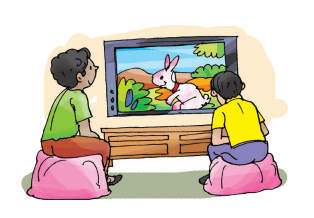
The two sentences can be combined into a single sentence:
Sam and Pratham are watching television.
Now, look at the following sentences.
1. Aman has a pen.
2. Aman has a pencil.
3. Aman has an eraser.

The three sentences talk about Aman. The three sentences can be combined as one sentence using ‘and’.
The new sentence will be:
Aman has a pen, a pencil and an eraser.
Let us take one more example:
1. Sam works in the afternoon.
2. Pratham works at night.
Both sentences talk about doing ‘work’ but by different people and at different times.
The two sentences can be combined as:
Sam works in the afternoon but Pratham works at night.
Rewrite the following sentences using ‘and’ or ‘but’.
1. I eat an apple. I eat an orange. I eat a peach. (and)
I eat an apple, an orange, and a peach.
2. I like to watch cartoons. My sister likes to watch movies. (but)
I like to watch cartoons, but my sister likes to watch movies.
3. Anita plays volleyball. Anju plays volleyball. (and)
Anita and Anju play volleyball.
4. Dolma wants a new comic book. She has spent all her pocket money on sweets. (but)
Dolma wants a new comic book, but she has spent all her pocket money on sweets.
5. Rajesh wants to go to the park. He has not finished his homework. (but)
Rajesh wants to go to the park, but he has not finished his homework.
Let us Listen
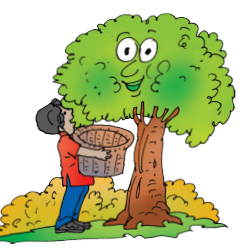
A. Your teacher will read parts of the story. Listen carefully and tell the class what happened after that.
1. Madhu said, “Oh tree, let me have different types of food. Nothing else.”
2. As he was eating, he suddenly got hiccups. He wanted water.
Let us Write
A. Complete the Following Story.

Ans: Vijaya is a young girl. She lives with her father, mother, grandmother, and grandfather in a small village. Each day, she wakes up early in the morning to help her mother with household chores. After that, she gets ready for school, where she enjoys learning new things and playing with her friends. In the evening, Vijaya helps her grandmother in the garden, where they grow vegetables and flowers. She also spends time listening to her grandfather's stories about the old days. After dinner, she finishes her homework and reads a book before going to bed. Vijaya is a kind and cheerful girl who loves her family and enjoys her simple village life.
Fun with Words
B. Notice that the first letter of each word has the same letter.

The first letter of each word is ______________________.
Ans: C
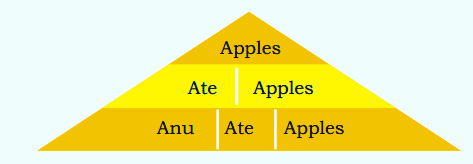
The first letter of each word is ______________________.
Ans: A
The first letter of each word is ______________________.
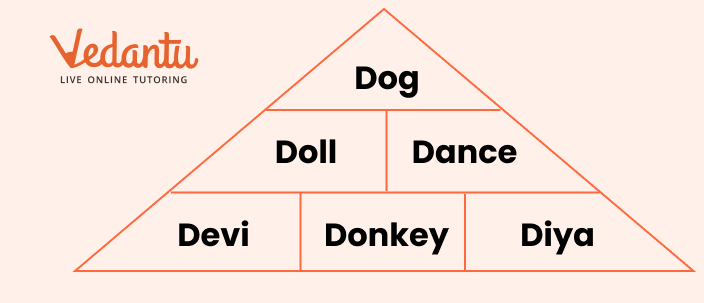
The first letter of each word is ______________________.
Ans: D
Let us Write
A. Read the incomplete sentences. Discuss with your friends and complete them.
1. Madhu shared his food with the old man because _____________ ______________________________________________________________________
2. Madhu was happy because ______________________________________ ______________________________________________________________________
3. After eating fruits, Madhu asked for savouries because ______________________________________________________________________ ______________________________________________________________________
4. Madhu asked for water because _________________________________ ______________________________________________________________________
Ans:
Madhu shared his food with the old man because he felt sorry for him and wanted to help.
Madhu was happy because the old man told him that he could wish for anything from the tree, and it would be granted.
After eating fruits, Madhu asked for savouries because he got bored of eating only fruits and wanted to try something different.
Madhu asked for water because he got hiccups after eating so much food and realised he needed water to quench his thirst.
Benefits of NCERT Solutions for Class 3 English Chapter 9 Madhu’s Wish
The NCERT Solutions for Class 3 English Chapter 9 offer easy-to-understand explanations of the story, making it simpler for young students to understand the plot and lessons.
By answering questions from Chapter 9, "Madhu’s Wish," students enhance their reading skills and ability to remember details from the story.
These answers also help students get ready for tests by showing them the kinds of questions they might face.
NCERT solutions make learning more fun and engaging, encouraging students to think about the story’s message and characters.
With these detailed answers, students can deepen their understanding of the chapter, leading to better performance in class activities and exams.
Important Study Material for English Chapter 9 Class 3 - Madhu’s Wish
Conclusion
The NCERT Solutions for Class 3 English Chapter 9, "Madhu’s Wish," provide a clear understanding of the story and its important lessons. These solutions help students improve their reading and comprehension skills while making learning enjoyable. By reviewing the answers, students can better prepare for exams and develop a deeper understanding of the story's message about understanding and valuing what is truly important in life.
Chapter-wise NCERT Solutions Class 3 English - Santoor
After familiarising yourself with the Class 3 English Chapter 9 Question Answers, you can access comprehensive NCERT Solutions from all English Class 3 Santoor textbook chapters.
Related Important Study Material Links for Class 3 English (Santoor)
You can also download additional study materials provided by Vedantu for Class 3 English.

FAQs on NCERT Solutions for Class 3 English Santoor Chapter 9 Madhu’s Wish - 2026-27 Free PDF Download (Sign-In Required)
1. What are the correct NCERT Solutions for Class 3 English Chapter 9 Madhu's Wish as per the CBSE 2026–27 syllabus?
The NCERT Solutions for Class 3 English Chapter 9 Madhu's Wish provide accurate, stepwise answers to all textbook questions, fully following the CBSE 2026–27 guidelines. Each answer is written in simple, clear language designed for Class 3 level, covering comprehension, vocabulary, and key learning outcomes of the story.
2. How does Madhu's Wish teach the importance of understanding one’s real needs?
The chapter "Madhu's Wish" emphasizes the value of essentials over desires by showing how Madhu, after wishing for many foods, realizes that water is irreplaceable. This highlights the difference between wants and genuine needs, a theme reinforced in the NCERT Solutions for Class 3 English Chapter 9.
3. What is the stepwise approach followed in the NCERT Solutions for answering comprehension questions in Chapter 9?
The stepwise approach includes:
- Reading the question carefully
- Identifying key details from the story
- Forming concise, clear answers in simple sentences
- Ensuring responses are based on the NCERT text and CBSE marking scheme
4. Can NCERT Solutions for Class 3 English Chapter 9 help boost comprehension and writing skills?
Yes, the solutions encourage students to read carefully, understand context, and answer in their own words, which strengthens both comprehension and basic writing skills essential for CBSE exams.
5. Why did the magical tree ask Madhu to ‘think over’ his wish, and how should this be reflected in answers?
The magical tree wanted Madhu to reflect on his true needs before making a wish. This teaching moment is highlighted in NCERT Solutions by guiding students to think critically and express the importance of making thoughtful decisions in life.
6. What vocabulary skills are strengthened through the exercises in Madhu's Wish NCERT Solutions?
Students learn to:
- Use adjectives correctly for describing people and actions
- Combine sentences effectively using conjunctions like ‘and’ and ‘but’
- Apply new words in relevant contexts
7. In what ways do the NCERT Solutions for Madhu's Wish encourage higher-order thinking (HOTS)?
By including what-if scenarios (e.g., ‘If you were in Madhu’s place, what would you wish for and why?’) and open-ended questions, the solutions prompt students to analyze, evaluate, and create their own reasoning—developing HOTS skills as required by CBSE.
8. How are ‘and’ and ‘but’ used in sentence combining exercises in Chapter 9 NCERT Solutions?
The solutions model how to join similar ideas with ‘and’ and contrast different ideas using ‘but’, helping students construct grammatically correct and contextually meaningful sentences as per NCERT curriculum.
9. What lesson does Madhu finally learn according to the official NCERT Solutions?
Madhu learns that basic needs, such as water, are more valuable than unlimited luxuries. This realization forms the moral core of the chapter and is emphasized clearly in all solution answers for conceptual clarity.
10. How can parents use Class 3 English Chapter 9 NCERT Solutions to support their child’s learning at home?
Parents can read through solutions with their child, discuss the reasoning behind each answer, and encourage their child to explain the chapter’s moral in their own words, thereby reinforcing understanding and exam readiness.
11. What types of questions are included in the NCERT Solutions for Class 3 English Chapter 9?
The solutions include:
- Comprehension and direct recall questions
- Vocabulary-based fill-in-the-blanks
- Grammar and sentence construction tasks
- Application and opinion-based questions (HOTS)
12. Are the NCERT Solutions for Chapter 9 Madhu's Wish suitable for homework help?
Yes, the solutions are designed to directly answer all textbook exercises and encourage independent thinking, making them an excellent resource for homework support as per the CBSE 2026–27 curriculum.
13. What critical errors should students avoid while answering NCERT textbook questions in Chapter 9?
Students should avoid:
- Copying answers without understanding
- Missing key story details
- Writing incomplete or off-topic responses
- Ignoring grammar and spelling rules taught via NCERT Solutions
14. How does the structure of NCERT Solutions help in stepwise learning for Class 3 students?
Each solution follows a clear, logical format:
- Restate the question
- Answer in one or more simple sentences
- Clarify reasoning when needed
15. What makes Vedantu’s NCERT Solutions for Class 3 English Chapter 9 reliable for CBSE exam preparation?
Vedantu’s solutions are:
- Aligned with the latest CBSE 2026–27 syllabus
- Prepared by subject-matter experts
- Written in child-friendly language
- Focused on CBSE exam patterns and answer presentation
- Regularly updated for accuracy and relevance
