






Badal And Moti Questions and Answers - Free PDF Download
NCERT Solutions for Class 3 English Chapter 2, "Badal and Moti" (Santoor), introduces children to the story in an interesting and interactive way. This chapter provides a fun approach to learning about the characters and their experiences. Our solutions include step-by-step explanations, practice exercises, and colourful pictures that help students understand the concepts easily.
 Table of Content
These explanations break down the story into simple, understandable parts, making the learning process enjoyable. With interactive activities and exercises, students will not only improve their understanding of the chapter but also develop important language skills. Explore the revised CBSE Class 3 English syllabus and begin practising Chapter 2 to make learning both effective and enjoyable.
Glance on Class 3 English (Santoor) Chapter 2 - Badal and Moti
The story in Chapter 2 "Badal and Moti" introduces young learners to different body parts such as hands, legs, eyes, ears, nose, and mouth.
It highlights the actions related to each body part, making learning interactive and fun.
The story encourages children to use their senses to explore their surroundings.
Its rhythmic language and repetition help children remember and understand the content easily.
This chapter provides a basic understanding of the human body and its functions.
The playful tone of the story keeps learning enjoyable, and colourful pictures support better understanding.
A. Answer the following.
1. What did Badal come across by the side of the road?
Ans: Badal came across a puppy shivering in the cold by the side of the road. He felt sorry for the puppy and decided to bring it home. Badal hoped his mother would let the puppy stay with them. He wanted to help the little puppy find warmth and safety.
2. What did Badal and his mother name the puppy?
Ans: Badal and his mother named the puppy Moti. They chose this name as they were fond of the puppy and wanted to give it a special name. Moti became a beloved member of their family. The name reflected their affection for the new pet.
3. What did Badal fall into?
Ans: Badal fell into a deep pit while coming home from school. He had slipped on a muddy lane and couldn't get out of the pit. This caused his mother and the neighbours to worry about him. Moti played a key role in finding Badal.
4. How did Moti find Badal?
Ans: Moti found Badal by following his scent after he went missing. Moti’s keen sense of smell led him to the pit where Badal was trapped. He started barking to alert the neighbours about Badal’s location. This helped in rescuing Badal from the pit.
5. Write ‘T’ for true and ‘F’ for false.
a) Badal lived with his grandmother. ( )
b) Moti grew up and loved Badal. ( )
c) Badal’s mother was worried when he did not come home in time. ( )
d) Moti caught Badal’s photo. ( )
e) Badal hugged his puppy Moti and thanked him. ( )
Ans: a) Badal lived with his grandmother. (F)
b) Moti grew up and loved Badal. (T)
c) Badal’s mother was worried when he did not come home in time. (T)
d) Moti caught Badal’s photo. (F)
e) Badal hugged his puppy Moti and thanked him. (T)
6. B. Think and discuss in pairs.
1. Do you remember when you fell down last time? How did you fall? Who picked you up? Share your experiences.
Ans: Yes, I remember falling down while playing in the park. I slipped on a wet spot and fell. My friend helped me get up and made sure I was okay.
2. Do you have a pet? Do you know someone who has a pet?
Ans: I don't have a pet, but I know a friend who has a cat. The cat is very playful and likes to cuddle.
3. If you were allowed to keep any animal as a pet, which animal would you choose? Why?
Ans: I would choose a dog as a pet. They are friendly, loyal, and make great companions for playing and spending time together.
7. A. Look at the following words from the lesson.
Notice that all these words end with ‘ed’. All these actions have already happened.
Add ‘ed’ and write:
walk + ed =
play + ed =
talk + ed =
ask + ed =
touch + ed =
Ans:
walk + ed = walked
play + ed = played
talk + ed = talked
ask + ed = asked
touch + ed = touched
8. B. Match the words to make pairs. Colour each pair with the same colour. Two have been done for you.
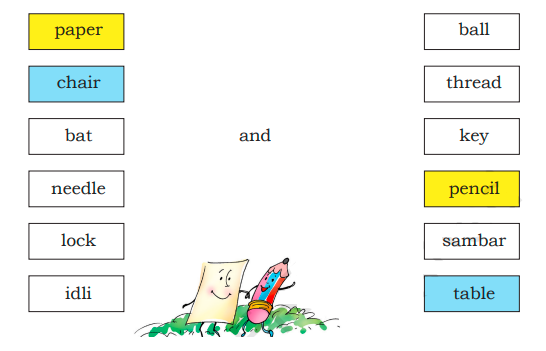
Ans:
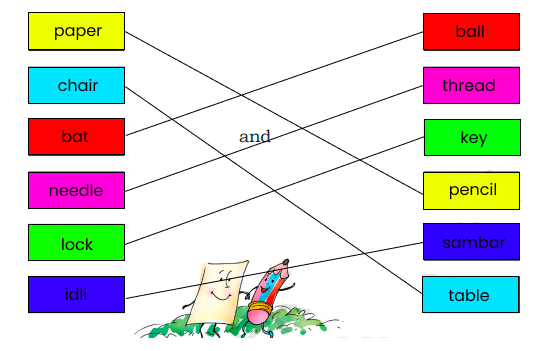
9. A. Your teacher will read out the story of Badal and Moti once again to you. Now read the following sentences and number them in the sequence of the story.
The first sentence has already been marked for you.
One rainy day, he slipped and fell into a deep pit. ( )
Badal and his mother named the puppy Moti. ( )
Badal hugged Moti. ( )
Badal came across a puppy by the side of the road. ( 1 )
Moti accompanied Badal’s mother to search for him. ( )
Moti followed Badal’s scent and went near the pit and started barking. ( )
Ans:
Badal came across a puppy by the side of the road. (1)
Badal and his mother named the puppy Moti. (2)
One rainy day, he slipped and fell into a deep pit. (3)
Moti accompanied Badal’s mother to search for him. (4)
Moti followed Badal’s scent and went near the pit and started barking. (5)
Badal hugged Moti. (6)
10. A. Talk in pairs about what you do every day:
1. before you come to the school;
2. during the school hours;
3. after going back home.
B. You may use the following clues.
1. Every day I ___ up at ___ in the morning. Then I ___ my teeth and go to the ____. After that, I take a ___ and dress up for school. I ___ breakfast and I ____ to school.
2. _______
3. _______
Ans:
1. Every day I wake up at 7:00 in the morning. Then I brush my teeth and go to the bathroom. After that, I take a shower and dress up for school. I eat breakfast and I walk to school.
2. I attend my classes and participate in various activities. I listen to my teacher and complete my assignments. During break time, I play with my friends and chat with them.
3. I return home and have lunch. I then do my homework and relax. In the evening, I may play outside or read a book, and later have dinner with my family.
11. A. Look at the pictures. They show a story of two friends: a pigeon and an ant. But the pictures are jumbled up. Number them to get the correct order to make a story.
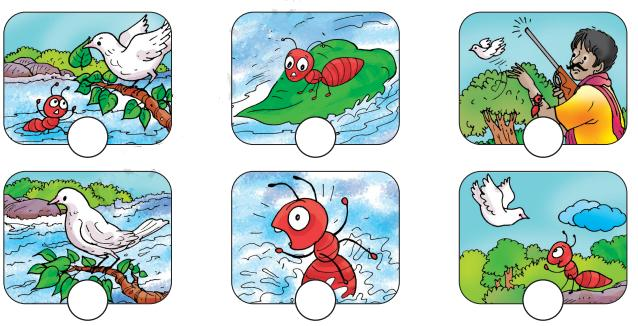
Ans:
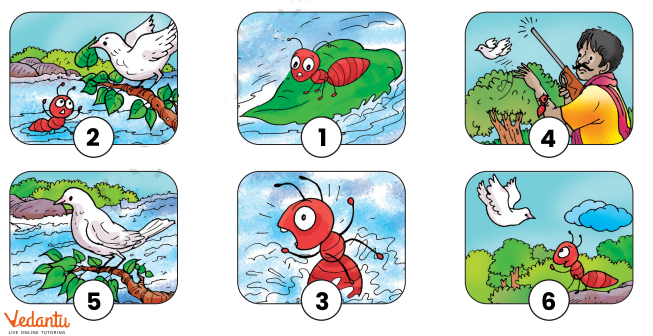
12. B. Now fill in the blanks using the words in the box to complete the story.
A dove was resting on a ___________ of a tree near a ___________. An ant ______________ into the stream and cried for help. The dove dropped a ___________ into the stream. The ant ___________ on the leaf and landed safely. Another day the ant saw a ___________ aiming at the dove. She quickly climbed up and bit the hunter’s hand. The dove ______________ away unhurt.
Ans: A dove was resting on a branch of a tree near a stream. An ant fell into the stream and cried for help. The dove dropped a ___________ into the stream. The ant climbed on the leaf and landed safely. Another day the ant saw a hunter aiming at the dove. She quickly climbed up and bit the hunter’s hand. The dove flew away unhurt.
13. C. Look at these sentences from the lesson.
“Can this puppy stay with us, Maa?”
“Yes beta, but only if you promise to take care of the puppy.”
Add a ? or a . to the following:
1. The sun rises in the east ______
2. What is your name ______
3. I like to eat mangoes ______
4. May I borrow your English textbook ______
5. Brinda and Namrata are good friends ______
6. Whose shoes are these ______
Ans: 1. The sun rises in the east.
2. What is your name?
3. I like to eat mangoes.
4. May I borrow your English textbook?
5. Brinda and Namrata are good friends.
6. Whose shoes are these?
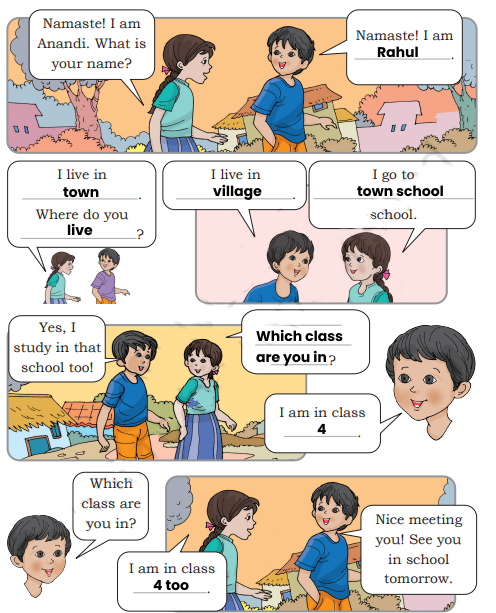
14. C. Complete the following conversation between two children.
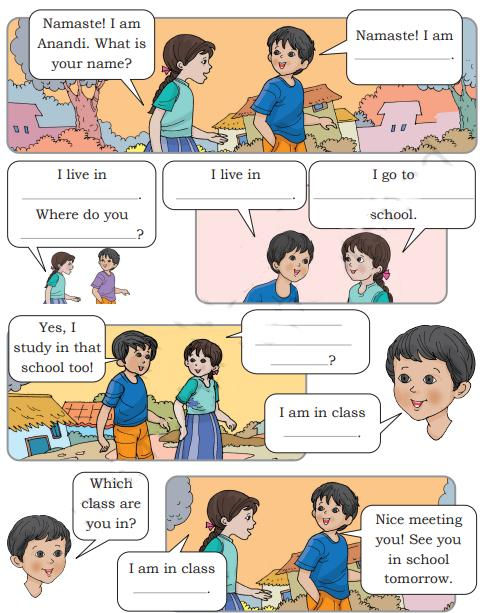
Ans:
Benefits of NCERT Solutions for Class 3 English Chapter 2 story Badal and Moti
These solutions provide clear explanations of the chapter, helping students understand the story and its lessons about sharing and cooperation.
By breaking down the text and vocabulary, the solutions make it easier for students to grasp the context and actions of the characters.
The solutions offer straightforward answers to textbook questions, aiding students in completing their assignments correctly and efficiently.
The chapter's questions promote thinking about empathy, cooperation, and problem-solving, helping students apply these concepts in real life.
The solutions include fun exercises and activities related to the story, making learning enjoyable and interactive.
With these solutions, students can better understand the chapter’s themes and feel more confident in their knowledge.
The PDF is available for FREE download, allowing students to easily access the material whenever they need it.
Important Study Material Links for English Chapter 2 Class 3 - Badal and Moti
Conclusion
NCERT Solutions for Class 3 English (Santoor) Chapter 2, "Badal and Moti," offers a thorough understanding of the story through detailed explanations and examples. These solutions break down the story’s themes and concepts into manageable steps, helping in effective learning and comprehension. They include practice exercises and questions to help students prepare for their exams.
The solutions are available in an easily accessible PDF format, allowing students to review and study the material conveniently. Updated for the 2026-27 syllabus, the FREE Class 3 English Chapter 2 PDF from Vedantu is an excellent resource for improving understanding and performance. By using these solutions, students can enhance their grasp of the story and perform better in their examinations.
Chapter-wise NCERT Solutions Class 3 English - Santoor
After familiarising yourself with the Class 3 English Chapter 2 Question Answers, you can access comprehensive NCERT Solutions from all English Class 3 Santoor textbook chapters.
Related Important Study Material Links for Class 3 English (Santoor)
You can also download additional study materials provided by Vedantu for Class 3 English.

FAQs on NCERT Solutions for Class 3 English Santoor Chapter 2 Badal and Moti - 2026-27 Free PDF Download (Sign-In Required)
1. What are the stepwise NCERT solutions for Class 3 English Chapter 2 'Badal and Moti' as per the CBSE 2026–27 official format?
The stepwise NCERT solutions for Class 3 English Chapter 2 'Badal and Moti' follow the exact question pattern in the CBSE 2026–27 textbook. Each answer explains the story sequence, includes relevant keywords from the lesson, and presents complete sentences as required in NCERT-approved answers. Students should read the chapter carefully and answer each question in their own words, as shown in the model solutions.
2. How can I download the Class 3 English Chapter 2 question answer PDF with textbook-approved solutions?
To download the Class 3 English Chapter 2 question answer PDF, students should visit trusted educational sites like Vedantu, where NCERT solutions are provided free in PDF format. These solutions follow the NCERT and CBSE 2026–27 guidelines and include stepwise answers for every question in 'Badal and Moti'.
3. Are the NCERT solutions for Class 3 English Chapter 2 available in English medium as per the latest syllabus?
Yes, the NCERT solutions for Class 3 English Chapter 2 'Badal and Moti' are provided in English medium, fully aligned with the latest CBSE 2026–27 syllabus. Each solution follows the NCERT answer format, ensuring clarity and correct grammar.
4. What is the correct answer to 'Who saved whom in the story Badal and Moti?' as per NCERT standards?
According to the CBSE prescibed NCERT solution, in the story 'Badal and Moti', Badal saved Moti from the wild animal, and later Moti saved Badal by barking loudly to alert everyone. This mutual saving is explained stepwise in the official answer format.
5. Where can I find Class 3rd English Chapter 2 'Badal and Moti' question answer in a CBSE approved stepwise format?
You can find Class 3rd English Chapter 2 'Badal and Moti' question answers in a CBSE approved stepwise format on platforms like Vedantu, where each solution follows the NCERT pattern with clear, complete sentences and covers all parts of every exercise, including intext and end questions.
6. How does the NCERT answer key for Class 3 English Chapter 2 ensure accuracy with respect to textbook answers?
The NCERT answer key for Class 3 English Chapter 2 matches the exact questions in the NCERT textbook and strictly follows CBSE's recommended answer structure. Stepwise explanations and correct grammar are maintained for each response so students can confidently use them as model answers.
7. Is there any difference between 'Class 3 English Chapter 2 PDF' and the online NCERT solution format?
The content of 'Class 3 English Chapter 2 PDF' and the online NCERT solution format is generally the same and follows the NCERT structure. The PDF offers offline access, while the online format may have interactive elements, but both provide stepwise, CBSE aligned answers.
8. Can these NCERT textbook solutions be used directly for CBSE school assignments and exams for Class 3 English Chapter 2?
Yes, these NCERT textbook solutions for Class 3 English Chapter 2 are designed for direct application in CBSE school assignments and exams. They strictly use the NCERT-approved answer style and present model answers expected by examiners as per the 2026–27 syllabus.
9. What is the best method to attempt all intext and end questions in NCERT Class 3 English Chapter 2?
The best method is to read each question carefully, recall the relevant part of the story 'Badal and Moti', and answer in short, complete sentences. Students should use the vocabulary and context from the chapter itself, following the NCERT answer format for full accuracy as demonstrated in provided solutions.
10. Which part of the NCERT solution for Class 3 English Chapter 2 helps build comprehension skills most effectively?
The parts of the NCERT solution that require students to explain events in their own words, summarize the story, and answer 'why' or 'how' questions, help build comprehension skills most effectively. These solutions use stepwise reasoning, which is emphasized in the CBSE 2026–27 format.
11. Why is it important to write in the NCERT answer format for Class 3 English Chapter 2 solutions?
Writing in the NCERT answer format ensures that responses are clear, correctly structured, and meet the expectations of CBSE examiners. This approach improves scoring and teaches students to think and express as per national academic standards.
12. If the question asks about Moti's feelings in Chapter 2, how should I frame the answer per NCERT pattern?
Per NCERT pattern, your answer should use sentences based on the text, such as: 'Moti felt scared when he saw the wild animal, but he barked bravely to save Badal.' This kind of answer demonstrates understanding and uses story context, just as the NCERT expects.
13. What should I do if my answer to an exercise is different from the NCERT solution for Class 3 English Chapter 2?
If your answer is different but it is correct and relevant to the story, it may still be accepted. However, it's best to cross-check with the NCERT solution to ensure your response matches the official answer structure and main idea intended by the CBSE guidelines.
