









How to Solve Decimal Word Problems with Formulas and Examples
Introduction
Decimals are numbers that fall between integers on a number line. In mathematics, they are just another method to express fractions. We may write more accurate values of quantifiable things such as length, weight, distance, money, and so on using decimals.
Define Decimals
Decimals is the exact value of the fraction which contains both whole numbers as well as fraction parts in them. The decimal number can be identified by the “.” Or a decimal sign in between the digits in the number. The numbers towards the left of the decimal sign are integers or whole numbers, while the numbers to the right are decimal fractions. . If we proceed directly from one place, the following place will be ( \[\frac{1}{{10}}\] ) times smaller, resulting in a ( \[\frac{1}{{10}}\] )th or tenth place value. Take a look at the decimal place value chart for the number 12.45, for example.
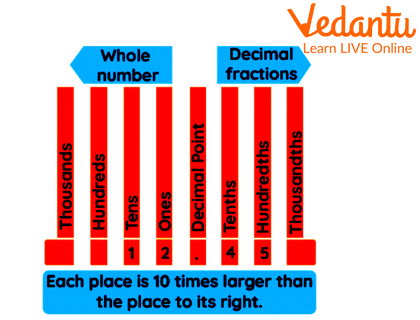
Place Value Chart Of Decimal Number
Addition And Subtraction Of Decimals
The standard addition and subtraction rules apply when adding and subtracting decimals. The only details to consider are the decimal places following the decimal point. The numbers must be put in columns based on where they fall before and after the decimal point. According to the decimal place value chart, place values before the decimal point begin with ones, tens, hundreds, and so on, but place values following the decimal point begin with tenths, followed by hundredths, and so on.
Example Of Addition Word Problems Of Decimals
Sample problem: you brought two erasers of 2.25 and 3.89 bucks each. How much money did you spend on the erasers?
Ans:
Step one: write the decimal number under their columns of their own place values.
Step two: add the digits present in the same column.
Money spent on first eraser = 2.25
Money spent on second eraser= 3.89
Total money spent on the erasers = 6.14
Example Of Subtraction Of Decimal Number
Sample problem: Ritu had 500 gm of flour with her. She used 250.78gm of flour to bake a cake. How much flour is left with her?
Ans:
Step one: write the digits in their place value columns.
Step two: Subtract the digits placed in the same column.
Total amount of flour = 500gm
Amount of flour used for baking cake = 250.78gm
Amount of flour left= 249.22gm
Conclusion
Decimals can be added, subtracted, multiplied and divided. Putting a zero after the decimal digits has no effect on the value of a decimal. For instance, 5 can be written as 5.00. Despite the fact that the time and angle measurements are in decimal format, those cannot be subtracted or added together as decimals.
Decimal Word Problems With Solutions
1. Kavita travelled 267.97km and Sheena travelled 862.73km using their own cars. Who travelled the most and by how much?
a. 590.74, Kavita
b. 594.76, Sheena
c. 549.67, Sheena
d. 509.47, Kavita
Ans: 594.76, Sheena
Explanation: the approximate distance covered by Kavita is 200km and Sheena is 800km. As the distance travelled by Sheena is the longest so we will subtract 862.73 from 267.97 which will give us the answer as 594.76.
2. Annie spent 29.89 bucks on fruits and 62.45 bucks on vegetables. How much money did she spend in total?
a. 92.34
b. 92.35
c. 93.72
d. 90.45
Ans: 92.34
Explanation: the amount of money spent on vegetables and fruits can be calculated by adding the amount spent on each item. So, the digits would be placed in their columns and would be added together to get the result.
3. The cost of mangoes is 85.345 and the cost of apples is two times that of mangoes then what is the cost of apples?
a. 170.69
b. 170.89
c. 170.79
d. 170.99
Ans: 170.69
Explanation: in this question, we need to do multiplication to find the original cost of the apples. For that, you need to multiply 85.345 by 2.
FAQs on Word Problems on Decimals Step by Step Solutions
1. What are word problems on decimals?
Word problems on decimals are mathematical problems where real-life situations require calculations using decimal numbers. These problems often involve operations such as addition, subtraction, multiplication, and division of decimals.
- They commonly relate to money, measurements, distance, weight, and time.
- Example: If a pen costs $2.75 and a notebook costs $3.40, the total cost is $6.15.
- They test both understanding of decimals and the ability to interpret real-world scenarios.
2. How do you solve word problems involving decimals?
To solve word problems involving decimals, first identify the required operation and then perform accurate decimal calculation. Follow these steps:
- Read the problem carefully and identify key numbers.
- Determine whether to add, subtract, multiply, or divide.
- Align decimal points properly before calculating.
- Write the final answer with correct units.
3. How do you add decimals in word problems?
To add decimals in word problems, line up the decimal points and add as whole numbers. Steps:
- Write numbers vertically with decimals aligned.
- Add digits from right to left.
- Place the decimal point directly below in the answer.
4. How do you subtract decimals in word problems?
To subtract decimals, align the decimal points and subtract as with whole numbers. Steps:
- Write numbers in columns.
- Add zeros if needed to equalize decimal places.
- Subtract from right to left.
5. How do you multiply decimals in word problems?
To multiply decimals, multiply as whole numbers and then place the decimal point based on total decimal places. Rule: Count total decimal places in both numbers.
- Multiply ignoring decimals.
- Count total decimal digits.
- Place decimal accordingly.
6. How do you divide decimals in word problems?
To divide decimals, make the divisor a whole number by moving the decimal point in both numbers equally. Steps:
- Shift decimal in divisor to make it whole.
- Shift decimal in dividend the same number of places.
- Divide normally.
7. What is an example of a real-life decimal word problem?
A real-life decimal word problem often involves money, measurement, or distance using decimal values. Example:
- A rope is 5.75 m long. 2.40 m is cut off.
- Remaining length = 5.75 − 2.40 = 3.35 m.
8. Why is it important to line up decimal points?
It is important to line up decimal points to ensure correct place value alignment. Decimals represent tenths, hundredths, and thousandths, so misalignment causes incorrect results.
- Example (correct): 3.45 + 1.20 = 4.65.
- Incorrect alignment can change the value entirely.
9. What are common mistakes in decimal word problems?
Common mistakes in decimal word problems include misplacing the decimal point and choosing the wrong operation. Typical errors:
- Not aligning decimals properly.
- Forgetting to count decimal places in multiplication.
- Not adjusting decimals before division.
- Ignoring units like dollars or meters.
10. How are decimal word problems used in everyday life?
Decimal word problems are used in everyday life for calculations involving money, measurements, and distances. Examples include:
- Calculating total shopping bills (e.g., $12.75 + $8.50 = $21.25).
- Measuring ingredients in cooking (2.5 kg of flour).
- Finding fuel consumption or travel distance.
