









How to Identify Which Object Is Heavier with Pictures and Practice Questions
Children, especially the ones who are studying Kindergarten, are very interested in knowing about animals, mammals, birds, reptiles, other animals, objects, things and various other categories. In addition, they are interested in comparing one with the other on various factors, including which is heavier and trying to figure out the resultant one.
For example, mammals are recognised as the hairiest, largest, and fastest land animals. Every mammal, from lightning-fast cheetahs to super-slow sloths, from large buffaloes to small shrews, has something unique about them.
Let us look at more details on the worksheet that children do perform interestingly.
Worksheet on ‘Which is Heavier’
Let us look at some of the worksheets here.
Comparing weights worksheet - 1
Two objects are compared in these measuring worksheets to find which is heavier or lighter. These worksheets explain the notion of weight and its nomenclature; in later grades, real weight measurement in units is considered.
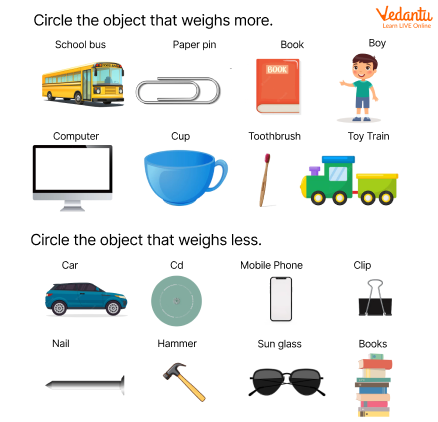
Comparing weights worksheets
Answers
School bus
Clip
Comparing weights worksheet - 2
The activities listed below are designed to help the child practise and learn the idea of weight. Which of the two items is lighter or heavier? This is a combination of activities for children aged 4 to 7. Children will have fun with it.
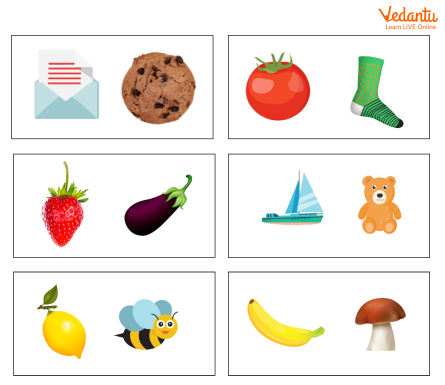
Comparing the objects worksheet
By showing the above sheet, you may ask your child to identify the heavier objects comparing between the two items in a cell.
Comparing the Objects Worksheet- Practice Yourself!
It's all about comparing the objects. Children will be given a worksheet with a few of the things and asked to complete an activity by comparing the objects and determining the resultant one. They could be in terms of foods, products, or things, among other things. When you do this activity with your kids, they will gain more information and abilities, and they will be able to work more efficiently on similar worksheets.
(Image will uploaded soon)
You may ask your child to answer by showing the above sheet by comparing between two items in the first question and by comparing with three items in the second question.
Summary
Comparing the items and figuring out the resultant one is a good activity that can be performed by the children. By making them perform this, we can teach them about the objects, animals, measurements, and more. This will not only help them to increase their thinking skills but also makes them remember about names of the objects, their spellings, usage and more.
So, why late? Start this activity with your children by preparing the worksheets on various categories.
FAQs on Which Is Heavier Worksheet for Kids to Learn Weight Comparison
1. What is a “Which Is Heavier” worksheet for kids?
A “Which Is Heavier” worksheet is a maths activity that helps children compare the weight of objects and decide which one weighs more. These worksheets usually include pictures of everyday items where students:
- Look at two or more objects
- Compare their weights
- Circle or tick the heavier object
2. How do you teach children to identify which object is heavier?
To identify which object is heavier, children must understand that the heavier object has more weight than the other. You can teach this by:
- Letting them hold two objects and feel the difference
- Using a balance scale to compare weights
- Asking questions like, “Which feels heavier?”
3. What does heavier mean in maths for kids?
In maths, heavier means having more weight than something else. When comparing two objects:
- The object with greater weight is called heavier
- The object with less weight is called lighter
4. How do you compare two objects to see which is heavier?
To compare two objects, you check which one has more weight. You can do this by:
- Holding one object in each hand and feeling the difference
- Placing both objects on a balance scale
5. What tools are used to measure which object is heavier?
The main tool used to measure which object is heavier is a balance scale or a weighing scale. Common tools include:
- Pan balance – compares two objects directly
- Digital scale – shows exact weight in grams or kilograms
6. What is the difference between heavier and lighter?
The difference is that heavier means more weight, while lighter means less weight. When comparing objects:
- If Object A weighs 5 kg and Object B weighs 2 kg, Object A is heavier
- Object B is lighter
7. Can you give an example question from a Which Is Heavier worksheet?
An example question is: “Which is heavier, a brick or a pillow?” The correct answer is the brick because it has more weight. In worksheets, students usually:
- Look at pictures of the brick and pillow
- Circle the heavier object
8. Why is learning about heavier and lighter important for kids?
Learning about heavier and lighter is important because it builds early measurement and comparison skills. It helps children:
- Understand real-life concepts of weight
- Develop observation skills
- Prepare for learning standard units like grams (g) and kilograms (kg)
9. What units are used to measure weight in heavier and lighter problems?
The standard units used to measure weight are grams (g) and kilograms (kg). In simple worksheets:
- Light objects are usually measured in grams
- Heavy objects are measured in kilograms
10. What are common mistakes kids make in Which Is Heavier worksheets?
A common mistake is confusing size with weight, thinking bigger objects are always heavier. Children may:
- Choose a larger object even if it is lighter
- Ignore the idea of actual weight comparison
