








Minus Definition Rules and Solved Examples
Learning mathematical operations and their use at an early age can help kids have a better grasp of Mathematics as they grow up. Mathematical operators are defined as mathematical symbols, which emphasise a particular function. The mathematical operators are similar to verbs in the English language. Just as verbs run and eat denote a particular action, mathematical operators such as plus (+), minus (-) denote a function.
The article focuses on providing an explanation, and the use of a mathematical operator called minus. Some solved examples are also provided in the article that can help in better understanding of what is minus for kids.
What is Minus?
Minus is a mathematical operator. In simpler terms, minus can be defined as a sign that is used to represent various things. The minus sign is denoted by (-). One of the most common things for which the sign is used is the representation of subtraction operations in maths. This is explained in detail in the below article.
Image mentioning minus sign and its mathematical operation
What is Subtraction?
Subtraction is a mathematical operation that is used to define a condition when we need to calculate the remaining numbers if certain numbers are taken away. Minus is the sign that is used to represent this mathematical operation. It can be better understood by the following example.
Example:
Shreya has 8 candies, Rashmi takes 2 candies from her. How many candies are left with Shreya?
Ans.
Total number of candies shreya has = 8
Candies taken by Rashmi = 2
The number of candies left with shreya can be calculated as:
8-2= 6
6 candies are left with Shreya.
The (-) sign represents the operation of subtraction.

Image illustrating the minus sign
What Does Minus Represent?
As we have seen the minus sign is used to represent subtraction, but apart from it, the minus sign is also used to represent the following actions:
Minus Is Used to Represent Negative Numbers
The minus sign (-) represents the negative integers. Integers are defined as a group consisting of whole numbers and negative numbers. Integers can be written without the fractional part. The minus sign helps in defining the negative numbers. It can be better understood by the exemplary diagram mentioned below.
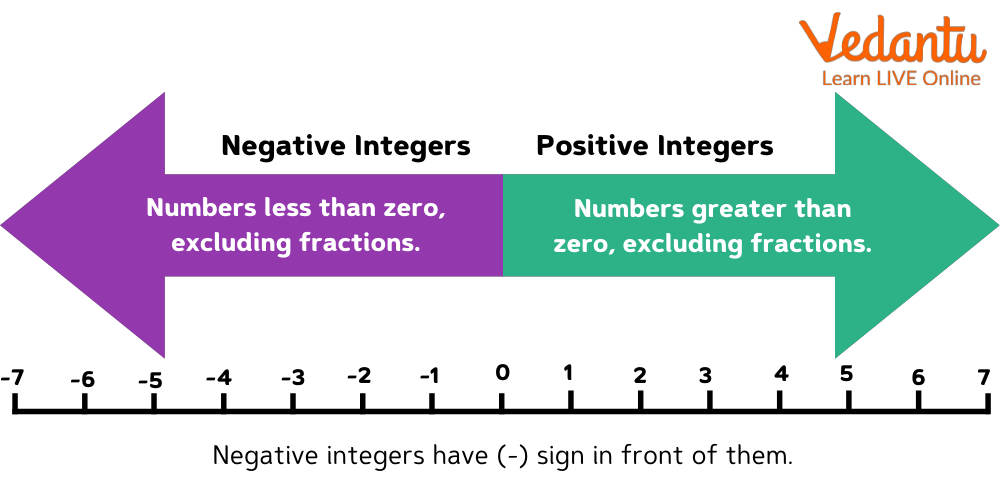
The image illustrates the minus representation of negative numbers
Minus is Used in the Representation of Temperature
The minus sign is used to represent the temperature that is below 0 degrees. For example, a temperature of -5 degrees Celsius is defined as the temperature being 5 degrees below zero. If the temperature further drops by 2 degrees Celsius, it is said that the temperature is -7 degrees Celsius.
Minus is Used to Represent the Direction
In a graph, the negative direction is represented by the minus sign. This can be better understood by the graph mentioned below.
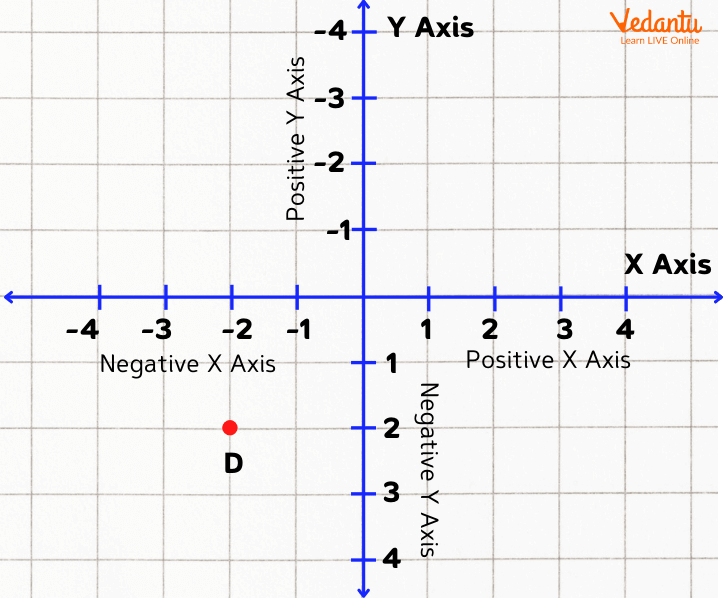
Image illustrating the negative direction in graph
Thus, we can conclude that the minus sign is a mathematical operator that is used to represent subtraction operations. Apart from it, minus is also used to represent negative integers, direction and temperatures. Hopefully we have provided a precise discussion that can help kids to understand what is minus.
FAQs on What Is Minus in Mathematics
1. What is minus in Maths?
Minus in Maths means subtraction, which is the process of taking one number away from another. It is represented by the symbol −.
- Example: 7 − 3 = 4
- Here, 7 is the minuend, 3 is the subtrahend, and 4 is the difference.
2. What does the minus sign (−) mean?
The minus sign (−) indicates subtraction or a negative value. It can show:
- Subtraction: 9 − 5 = 4
- Negative number: −6 means 6 below zero
3. How do you subtract numbers using minus?
To subtract using minus, you take the smaller number away from the larger number step by step. Follow these steps:
- Write numbers in correct place value order.
- Subtract digits from right to left.
- Borrow if the top digit is smaller than the bottom digit.
4. What is the difference in subtraction?
The difference is the final answer obtained after subtracting one number from another. In subtraction:
- Minuend − Subtrahend = Difference
- Example: 10 − 4 = 6
5. What is the formula for subtraction?
The basic subtraction formula is a − b = c, where a is the minuend, b is the subtrahend, and c is the difference. Example:
- 15 − 8 = 7
6. What happens when you subtract a larger number from a smaller number?
When you subtract a larger number from a smaller number, the result is a negative number. Example:
- 5 − 9 = −4
7. What is the difference between minus and negative?
Minus refers to the operation of subtraction, while negative describes a number less than zero. For example:
- 8 − 3 (minus shows subtraction)
- −3 (negative three is a value below zero)
8. How do you subtract negative numbers?
Subtracting a negative number is the same as adding its positive value. The rule is: a − (−b) = a + b.
- Example: 6 − (−2) = 6 + 2 = 8
9. Can you give a real-life example of minus?
Minus is used in real life to calculate how much is left after something is taken away. Example:
- If you have $20 and spend $7, then 20 − 7 = 13
10. What are common mistakes when using minus?
Common mistakes in subtraction include errors with borrowing and sign confusion. Watch out for:
- Forgetting to borrow in column subtraction
- Mixing up minus and negative signs
- Incorrectly subtracting negative numbers
