








2D and 3D Shapes for Year 5 with Properties and Examples
Kids are introduced to shapes and figures at an early age. Kids starting in Year 5 are introduced to the basic shapes and geometry. By Year 5, kids are familiarised with concepts like different shapes that they encounter every day. For example, we all have looked at and played with a ball, but have you wondered how we define its shape? The shape of a ball is a circle, similarly, a box is of a square shape. To learn more about shapes and how one can teach about shapes to Year 5 kids let us read the tips and tricks provided below.
We hope it would help you in teaching shapes to Year 5 kids, let us first discuss the concepts that can be taught to kids.
What Are the Topics Covered in Shapes in Year 5?
Before discussing the teaching methods used to teach shapes in a fun way, let us look into the topics that are covered in the introduction of shape and geometry.
The kids are taught to identify different shapes such as squares, rectangles and triangles based on their appearance.
Kids are taught about the different types of angles. Examples of angles that are introduced include acute, obtuse, right and straight angles.
Kids are also introduced to the use of protractors to measure the given angles.
The properties of individual shapes are taught to kids in Year 5. This can include the properties of a rectangle. Rectangle characteristics will be familiar to the child. For example, kids will understand that all rectangles have two sets of parellel lines, four corners, and four right angles and that the angles in all rectangles total up to 360 degrees.
How Can Parents Teach Kids Shapes in Year 5?
As we have discussed The topics that are taught under shapes in Year 5, let us now look into some of the fun cavities and methods that can help both parents and teachers in teaching shapes to kids in Year 5.
Using Mathematical Terms While Practising
One may help children learn by assisting them in describing shapes using features such as:
the total number of sides and edges
the number of vertices/corners the number of faces
lines of symmetry types of angles inside shapes.
Encourage children to use terms like diagonal, vertical, horizontal, parallel, acute, obtuse, and right angle in their Maths. The use of terms can help kids to better understand the meaning of the phrases.
Use Protractor Mat with Kids
One of the most effective ways of teaching kids shapes in Year 5 is the use of protractors. As the instrument is used to measure the angles this activity can be both fun and beneficial. Make a 'protractor mat' for your children to practise using a protractor accurately. Create a 90-degree mat in the pattern of a quarter circle using the corner of a sheet of paper. For each 10°, draw a line. Alternatively, make a half-circle mat with an angle of 180 degrees. For each 10°, draw a line. This will assist them to become accustomed to the appearance of various degrees of increments.
Playing Games That Require the Use of Coordinates
One of the games that require the use of coordinates is the game named battleships. Coordinates are integers that show where a point on a map, grid, or graph is located. Brackets are used to record coordinates, with the two numbers separated by a comma, as in: (1, 2). The first integer in a coordinate indicates the location of the point on the x-axis also called the horizontal axis) The second number indicates the location of the point on the vertical axis, often known as the y-axis.
Reading and plotting coordinates can help your youngster learn. The coordinates for the plotted point in the example below are (5, 6), where 5 is the x-axis value and 6 is the y-axis value:
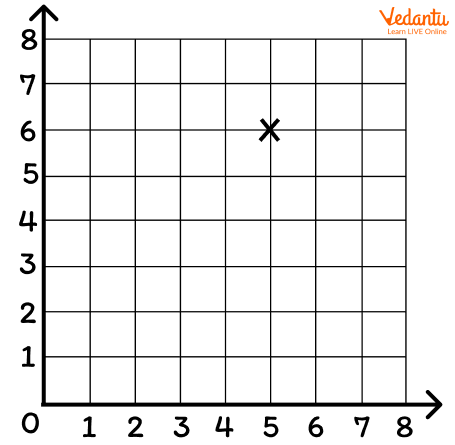
Graph representing the coordinates
In conclusion of the article, we have learnt about the topics that are usually taught in the introduction to shapes in Year 5. We have also learnt about some of the methods and activities that can be used in teaching shapes in Year 5.
FAQs on Shapes for Year 5 Students
1. What are shapes in Year 5 Maths?
In Year 5 Maths, shapes are 2D and 3D figures that are studied for their properties like sides, angles, edges, faces, and vertices. Students learn to identify, compare, and describe shapes such as:
- 2D shapes: squares, rectangles, triangles, pentagons, hexagons
- 3D shapes: cubes, cuboids, pyramids, prisms, spheres
2. What is the difference between 2D and 3D shapes?
The main difference is that 2D shapes are flat while 3D shapes have depth and volume.
- 2D shapes have length and width only (e.g., triangle, circle).
- 3D shapes have length, width, and height (e.g., cube, sphere).
- 2D shapes have sides and corners, while 3D shapes have faces, edges, and vertices.
3. What are the properties of a rectangle?
A rectangle is a 2D shape with four sides and four right angles. Its key properties are:
- It has 4 sides.
- All angles are 90°.
- Opposite sides are equal and parallel.
- It has 2 lines of symmetry.
4. How do you find the area of a rectangle?
The area of a rectangle is found using the formula Area = length × width.
- Measure the length.
- Measure the width.
- Multiply the two numbers.
5. How do you calculate the perimeter of a shape?
The perimeter is the total distance around a shape. To calculate it:
- Add all the side lengths together.
- Perimeter = 6 + 4 + 6 + 4 = 20 cm
6. What is a regular polygon?
A regular polygon is a 2D shape where all sides and all angles are equal. Examples include:
- Equilateral triangle
- Square
- Regular pentagon
7. What are vertices, edges, and faces in 3D shapes?
In 3D shapes, faces are flat surfaces, edges are where two faces meet, and vertices are corners. For example, a cube has:
- 6 faces
- 12 edges
- 8 vertices
8. What is symmetry in shapes?
A shape has symmetry if it can be divided into two identical halves.
- A line of symmetry splits a shape into mirror images.
- A square has 4 lines of symmetry.
- A rectangle has 2 lines of symmetry.
9. How do you classify triangles?
Triangles are classified by their sides or angles.
- By sides:
- Equilateral: 3 equal sides
- Isosceles: 2 equal sides
- Scalene: no equal sides
- By angles:
- Acute: all angles less than 90°
- Right-angled: one angle is 90°
- Obtuse: one angle greater than 90°
10. What is the difference between a prism and a pyramid?
The difference is that a prism has two identical parallel faces, while a pyramid has one base and triangular faces meeting at a point.
- A prism has a constant cross-section (e.g., triangular prism).
- A pyramid has one base and a single vertex (apex) at the top.
