









How to Learn Multiplication Tables Easily With Tricks and Practice Questions
In mathematics, multiplication is the repeated addition of a number. Before going into depth about the topic, Do you know what a multiplication table is? Why are they important? Let’s find out!
A multiplication table is a table which shows the product of two numbers(either two single-digit numbers or 1 single-digit number and one 2-digit number or two 2-digit numbers). It ranges from 1 1 = 1 up to 10 10 = 100 or even more because there is no limit to multiplication tables. In this article, we will learn 1 to 100 tables chart.
Multiplication Tables for Kids
A multiplication table is a table which is used to define a multiplication operation for numbers which might be a 1-digit number, 2-digit number or even more. It is a list of products of a number.
One can obtain the multiplication table by multiplying a set of numbers with the other set of numbers.
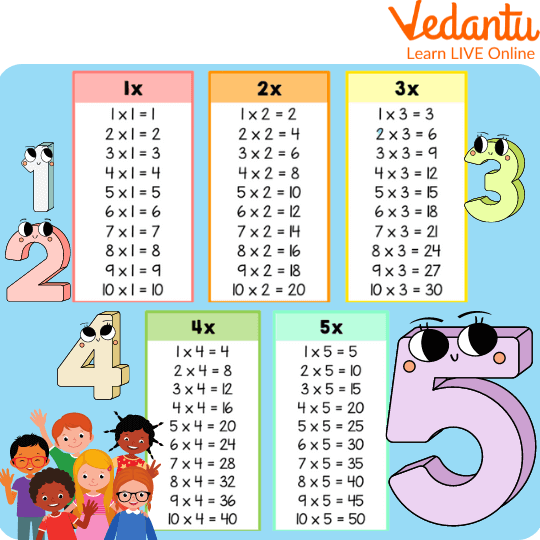
Multiplication Table
Significance Of Multiplication Tables
Have you ever thought, What is so special about multiplication tables? Well, It is very time-consuming to add numbers over and over again. So, if we already know how many times 2 numbers can be multiplied together, we can easily find the product of those numbers! Isn’t it?
It will also help to do math faster and more accurately. Multiplication tables are like all math tables, which are drawn up using multiplication formulas. One of the most common formulas for multiplication is the equation “x” times “y”. Multiplication is also important in many everyday situations.
For kids, It could be helpful in calculations like dividing chocolates among siblings. In our daily life, there are many situations, such as cooking, gardening and collecting data about the number of people, that can be helpful from having a multiplication table. It can also help people calculate percentages and currency values.
Multiplication Table
The multiplication tables of 1, 2, 5, and 10 are easier to remember as they follow a pattern.
Any number multiplied by 1 will be equal to the number itself.
If any number is multiplied by 2, it will be equal to double the number.
The ones digits in the multiplication table of 5 alternate between 0 and 5.
The table of 10 can be easily remembered because the digit at the one's place is always zero.
1 to 100 Tables Chart
With the help of a 1 to 100 tables chart, kids can easily understand multiplication tables.
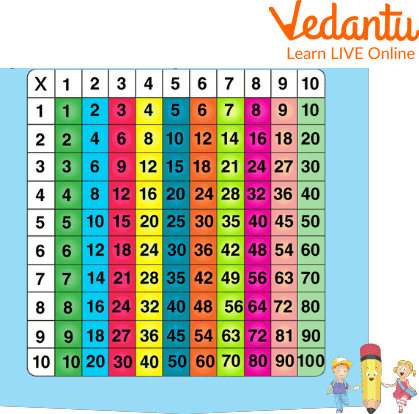
1 to 100 Tables Chart
Classroom Activities
Learning multiplication tables becomes easier for children when they learn them in a fun way or the form of activities. Few classroom activities are there which can be performed in the classroom and will help kids to learn multiplication tables more easily.
Back to Back: This Game requires some extra brain power, as it requires finding a multiplier of the number instead of a product.
Materials Required: Blackboard or Whiteboard (with chalk or markers).
Steps
Ask two students to stand in front of the board facing away from each other.
At your “start “ signal, each student will write a number between 1-10 (you can increase the range) on the board.
Ask another student to come in front of the board, assume a number in mind, and announce the product of two numbers (make sure that the answer is correct).
If the first player can guess the other student’s assumed number, he wins the round.
The student who “won” the round will stay on the board, and the person who “loses” the round will be replaced with another student.
The student who won the most rounds in a row is the winner.
Solved Examples
Find the product of the given numbers:
(a) $7 \times 7$
Ans. On multiplying 7 by 7,
It gives 49
Therefore, the answer is 49.
(b) $12 \times 12$
Ans. On multiplying 12 by 12,
It gives 144
Therefore, the required answer is 144.
(c) $10 \times 11$
Ans. On multiplying 10 by 11,
It gives 110
Therefore, the required answer is 110.
Practice Questions
Q 1. Find the product of the numbers given below:
(a) $10 \times 2$
(b) $12 \times 6$
(c) $15 \times 8$
Ans:
(a) 20
(b) 72
(c) 120
Q 2. Find the product of the numbers given below:
(a) $17 \times 9$
(b) $14 \times 6$
(c) $18 \times 8$
Ans:
(a) 153
(b) 84
(c) 144
Q 3. Find the product of the numbers given below:
(a) $20 \times 8$
(b) $44 \times 7$
(c) $98 \times 9$
Ans:
(a) 160
(b) 308
(c) 882
Summary
In this article, we have learned about multiplication tables, their definition, and their significance. We also learned that it is much easier to learn tables 1,2,5, and 10 because any number multiplied by 1 gives the number itself as an answer. We also learned about the importance of multiplication tables; what is the impact of multiplications in our lives? We also learnt some classroom activities which will help to learn multiplication tables very easily. With the help of 1 to 100 table charts, we learned multiplication. We have also done some questions to understand the concept very well and practised some questions, which will help us grasp the concept more easily.
FAQs on Multiplication Tables For Kids From 1 to 20
1. What are multiplication tables for kids?
Multiplication tables for kids are charts or lists that show the results of multiplying numbers in a fixed sequence, usually from 1 to 10 or 1 to 12. They help children quickly learn and remember multiplication facts.
- Example: In the 2 times table, 2 × 1 = 2, 2 × 2 = 4, 2 × 3 = 6.
- They are also called times tables.
- Learning them improves speed in basic arithmetic and mental maths.
2. Why are multiplication tables important for kids?
Multiplication tables are important because they build a strong foundation for division, fractions, algebra, and problem-solving. When kids memorize times tables, they can solve maths questions faster.
- They improve mental calculation skills.
- They reduce mistakes in long multiplication and division.
- They make higher-level maths easier to understand.
3. How do you teach multiplication tables to kids easily?
The easiest way to teach multiplication tables is by using repetition, patterns, and simple tricks. Start with smaller tables like 2, 5, and 10 before moving to harder ones.
- Step 1: Teach skip counting (e.g., 2, 4, 6, 8...).
- Step 2: Use charts and visual aids.
- Step 3: Practice daily with short quizzes.
- Step 4: Use songs or rhymes to improve memory.
4. What is the multiplication table from 1 to 10?
The multiplication table from 1 to 10 lists the products of numbers when multiplied by numbers from 1 through 10. For example:
- 1 × 5 = 5
- 2 × 5 = 10
- 5 × 5 = 25
- 10 × 5 = 50
5. How can I memorize multiplication tables fast?
You can memorize multiplication tables fast by practicing daily and understanding number patterns instead of just rote learning. Focus on repeated addition and patterns in numbers.
- Notice that the 5 times table always ends in 0 or 5.
- The 10 times table ends in 0.
- Practice 10–15 minutes daily using flashcards.
6. What are some easy tricks to learn multiplication tables?
Some easy tricks to learn multiplication tables include using patterns and finger methods. These tricks make learning times tables fun and simple.
- For the 9 times table, the digits of the product add up to 9 (e.g., 9 × 3 = 27, and 2 + 7 = 9).
- For the 11 times table (up to 9), repeat the digit: 11 × 4 = 44.
- Use arrays or grouping objects to visualize multiplication.
7. What is the difference between addition and multiplication?
The main difference is that addition combines numbers once, while multiplication is repeated addition of the same number. Multiplication is a faster way to add equal groups.
- Addition example: 3 + 3 + 3 = 9
- Multiplication form: 3 × 3 = 9
- Multiplication uses the symbols × or ×.
8. How do you solve multiplication step by step?
To solve a basic multiplication problem, multiply one number by the other using known multiplication facts. For small numbers, use times tables.
- Example: Solve 4 × 6.
- Step 1: Look at the 4 times table.
- Step 2: Find the 6th multiple of 4.
- Step 3: 4 × 6 = 24.
9. What are the properties of multiplication kids should know?
The main properties of multiplication are the commutative, associative, and identity properties. These rules make multiplication easier to understand.
- Commutative property: 3 × 5 = 5 × 3
- Associative property: (2 × 3) × 4 = 2 × (3 × 4)
- Identity property: Any number × 1 = that number
10. At what age should kids learn multiplication tables?
Most kids start learning multiplication tables between the ages of 7 and 9 years, usually in Grade 2 or 3. At this stage, they understand repeated addition and basic number patterns.
- They first learn tables of 2, 5, and 10.
- Then they gradually move to tables up to 12.
- Regular practice helps improve speed and accuracy.
