









What Are Like and Unlike Decimals with Definitions Examples and How to Convert
Have you ever thought about what a decimal number is? The term decimal number denotes the numerical quantity present in fractions and not as a whole. The representation of the decimal number is such that the whole part is separated from the fractional part by a decimal point or a dot. For example, 2.35, 1.2, 5.67, and 7.08 represent decimal numbers, which lie between two whole numbers or integers. In the given article, children would gain insight into the like and unlike decimals and how to convert, unlike decimals into like decimals. This is the most common topic used in mathematical calculation. Let us understand more about it.
What are Like and Unlike Decimals?
Like decimal numbers are those decimal numbers that have the same number of digits after the decimal point. For example, 2.46, 6.09, and 3.87 are called decimal numbers.
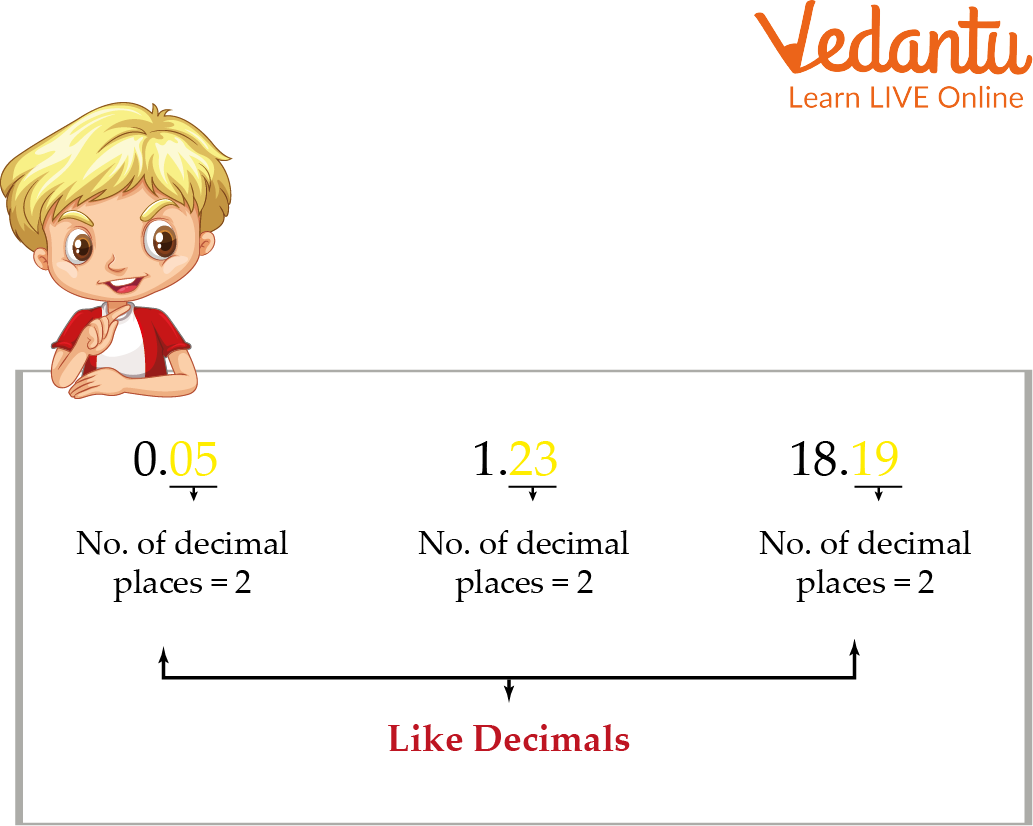
Showing like decimals
Further, unlike decimal numbers, those decimal numbers have a different number of digits after the decimal point. For example, 2.657, 3.04, and 1.871 are called, unlike decimals.
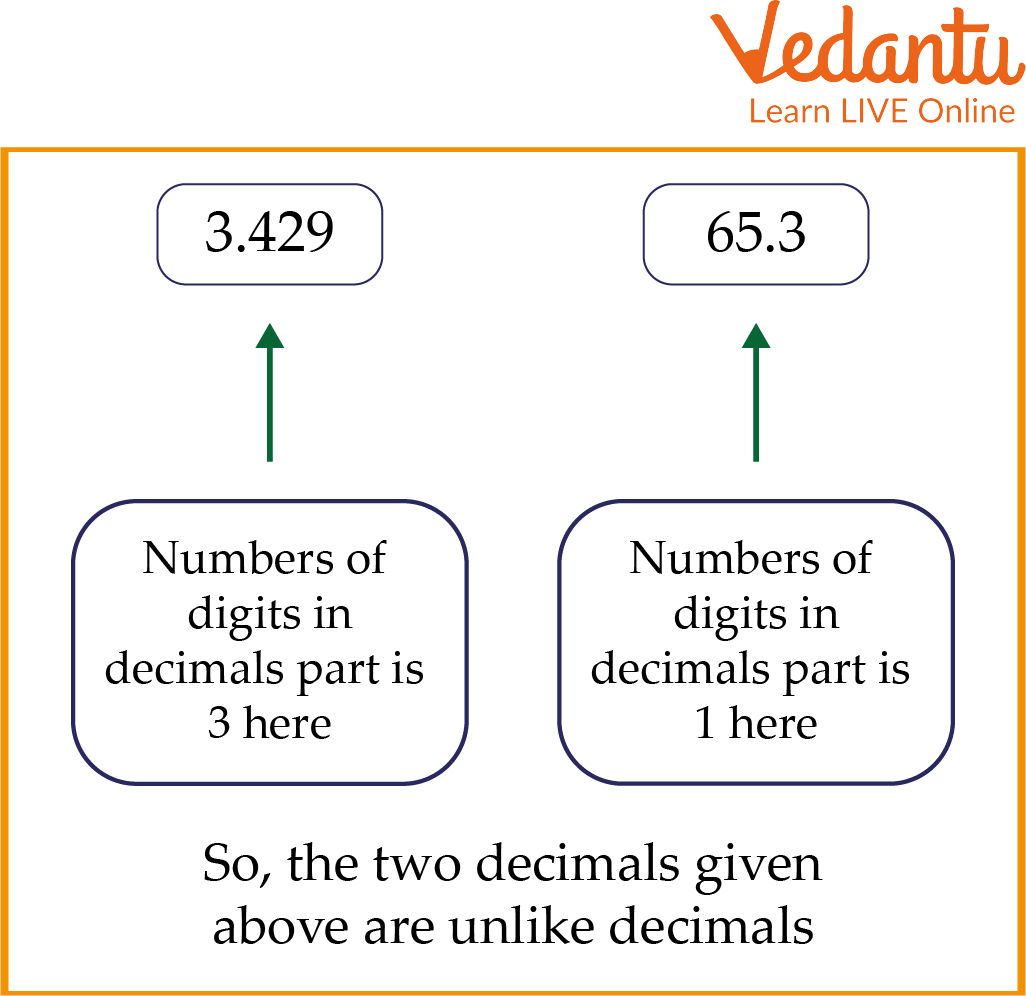
Showing unlike decimals
Convert Unlike Decimals into Like Decimals
The best and most feasible way to convert unlike decimals into like decimals is by adding zeros to the right of the decimal place, which does not lead to a change in the actual value. Steps to be followed when changing unlike decimals into like decimals are given underneath:
Write the given expression
Write the like and unlike decimal numbers from the given expression separately by enclosing them within brackets
Then, convert unlike decimals into like decimals by putting 0s to the right of the decimal point
Thus, the expression gets converted to decimal numbers.
Like and Unlike Decimals Solved Examples
Q 1. Convert the following decimals to like decimals: 1.7, 2.35, 6.135.
Ans: Follow the below-given steps to convert the unlike decimals into the like decimals, i.e.
Write the given decimals
1.7, 2.35, 6.135
Separate the like and unlike decimals. If there is no separation, then right as it is, i.e. 1.7, 2.35, 6.135
Further, we need to convert each of the decimal numbers to the like decimal number, which has an equal number of digits after the decimal point
1.700, 2.350, 6.135
Thus, the decimal expression is converted to like decimals with the utmost digits at the right of the decimal point.

Showing conversion of unlike decimals into like decimals
Q 2. Which of the given decimals is greater, 78.40 or 78.210?
Ans: To compare two decimals, one needs to follow some steps:
Write the given decimal expression
78.40 or 78.210
Now, convert the unlike decimals into like by putting zeros
78.400 or 78.210
As the left side of the decimal point is the same for both the decimal numbers; thus comparison will be based on the right side of the decimal point i.e.
400 is greater than 210
Finally, deciding which decimal is greater than the other
Hence, 78.400 is greater than 78.210.
Practice Problems
Q 1. Convert the decimal points to like decimal points: 11.4, 1.56, 1.8, 1.983.
Ans: 11.400, 1.560, 1.800, 1.983
Q 2. Compare the decimal points:
1.763 or 1.61
Ans: 1.763
Q 3. Transform the following, unlike decimals into like decimals: 1.72, 26.361, 3.35 and 0.9.
Ans: 1.7200, 26.3610, 3.3500 and 0.9000.
Q 4. Separate the following like and unlike decimals.
9.5, 18.235, 4.51, 7.06 and 20.024.
Ans: Like Decimals:
With two digits after the decimal point are 4.51 and 7.06
With three-digit after the decimal point are 18.235 and 20.024
Unlike Decimals are:
9.5, 4.31 and 18.235
9.5, 7.06 and 20.024
9.5, 7.06 and 18.235
9.5, 4.31 and 20.024
Summary
Synopsizing here with the concept of like and unlike decimals and the method of converting unlike decimals to like decimals. This article covers every topic by deeply surfing the internet to provide the students with the best experience. Images are also used to make the learning lenient and interesting. Some solved examples, along with the practice problems, are given for the conceptual clarification of the students. Hoping you enjoyed learning the topic. Feel unrestricted to ask your doubts in the comments.
FAQs on Understanding Like and Unlike Decimals in Maths
1. What are like and unlike decimals?
Like decimals are decimals that have the same number of decimal places, while unlike decimals have different numbers of decimal places.
- Example of like decimals: 3.45 and 7.89 (both have two decimal places).
- Example of unlike decimals: 4.5 and 6.789 (one has one decimal place, the other has three).
- Like and unlike decimals are commonly used when learning decimal addition and subtraction.
2. What is the difference between like decimals and unlike decimals?
The main difference is that like decimals have equal decimal places, whereas unlike decimals have unequal decimal places.
- Like decimals: 5.20 and 3.45 (both have two decimal places).
- Unlike decimals: 2.3 and 4.567 (one has one decimal place, the other has three).
- Unlike decimals can be converted into like decimals by adding zeros to the right.
3. How do you convert unlike decimals into like decimals?
You convert unlike decimals into like decimals by adding zeros to the right side of the decimal number without changing its value.
- Step 1: Identify the number with the greatest decimal places.
- Step 2: Add zeros to other numbers until all have equal decimal places.
- Example: Convert 4.5 and 3.78 → 4.50 and 3.78.
- Now they are like decimals.
4. Why is it important to make decimals like before adding or subtracting?
It is important because decimals must be aligned by place value to perform correct addition or subtraction.
- Align decimal points vertically.
- Make the numbers like decimals if needed.
- Example: 2.4 + 3.56 → 2.40 + 3.56 = 5.96.
- This prevents place value errors.
5. Can you give an example of like decimals?
An example of like decimals is 6.25 and 9.40 because both have two decimal places.
- Both numbers are written up to the hundredths place.
- They can be directly added: 6.25 + 9.40 = 15.65.
- No extra zeros are needed.
6. Can you give an example of unlike decimals?
An example of unlike decimals is 3.7 and 8.456 because they have different decimal places.
- 3.7 has one decimal place.
- 8.456 has three decimal places.
- Convert 3.7 to 3.700 to make them like decimals.
7. Do trailing zeros change the value of a decimal?
No, adding trailing zeros to the right of a decimal does not change its value.
- Example: 5.2 = 5.20 = 5.200.
- Trailing zeros help convert unlike decimals into like decimals.
- This rule is important in decimal arithmetic.
8. How do you add like and unlike decimals step by step?
To add like and unlike decimals, first make them like decimals, then align decimal points and add normally.
- Step 1: Equalize decimal places (if needed).
- Step 2: Write numbers vertically with decimal points aligned.
- Step 3: Add from right to left.
- Example: 4.6 + 2.35 → 4.60 + 2.35 = 6.95.
9. How do you subtract unlike decimals?
To subtract unlike decimals, convert them into like decimals and subtract by aligning decimal points.
- Example: 7.5 − 2.345.
- Convert 7.5 to 7.500.
- Subtract: 7.500 − 2.345 = 5.155.
- Always subtract place by place.
10. What are common mistakes when working with like and unlike decimals?
A common mistake is not aligning the decimal points correctly before performing operations.
- Adding numbers without equal decimal places.
- Ignoring place value positions.
- Forgetting to add trailing zeros when needed.
- Misplacing the decimal point in the final answer.
