









How to Find LCM by Long Division Method with Formula and Solved Examples
How Do We Find Out the LCM of a Number?
LCM by division is the process of finding the least common multiple of a given group of integers by dividing them by a common prime number. For this, we need to completely understand the prime factors of the given numbers. Prime factorization and listing the multiples are two additional techniques for calculating LCM.
LCM by Division Method
The LCM by division technique finds the LCM (Least Common Multiple) of integers by reducing them by shared prime numbers. This technique of determining the LCM of numbers is one of the standards and provides a rapid result. We must understand the common multiplication tables and the prime numbers that can totally divide the provided values.
LCM by Common Division Method
To obtain the LCM using the common division method, we must first determine the prime factors of the provided integers.
Step 1: Take the provided numbers and divide them by the least prime integer.
Step 2: In the second row, write the quotient and the number that is not divisible by the previous prime number.
Step 3: Divide the integers by the next lowest prime number.
Step 4: Keep dividing until the remaining is a prime number or one.
Step 5: To find the LCM, multiply all the divisors and the remaining prime number (if any).
Finding LCM by Long Division Method
To find an LCM by long division method let us take an example and understand this concept in a better way.
Find the LCM of 12 and 18 by the long division method.
Step one: The least prime number of the numbers 12 and 18 is 2. So we will divide both the numbers by 2.
Step two: Write the quotient below the number. The quotients further can be divided by 2.
Step three: The new quotient obtained is written below the previous one. As 9 wasn't divisible by 2 so it is written as it is in the next line.
Step four: Now we can divide 3 and 9 by 3, as it is the least prime number that can divide both 3 and 9.
Step five: We will repeat the step till 1 is obtained. Multiply all the divisors. The result would be LCM of 12 and 18.
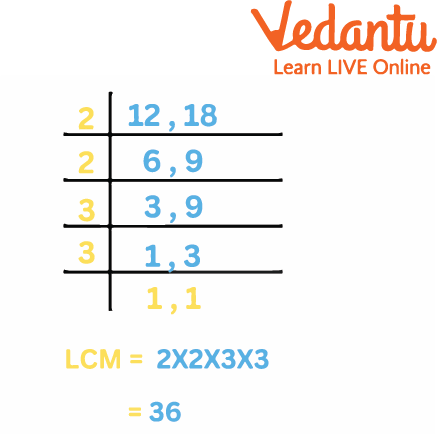
LCM of 12 and 18 by Long Division Method
Sample Questions
1. Find the LCM of 62 and 108.
a. 3348
b. 3267
c. 4577
d. 3356
Ans: 3348
Explanation: To find the LCM using the long division method, divide 62 and 108 by the prime number and obtain a quotient that can be further divided by the prime number. Repeat the steps till you get 1 as the quotient. Multiply all the divisors to obtain LCM of 62 and 108.
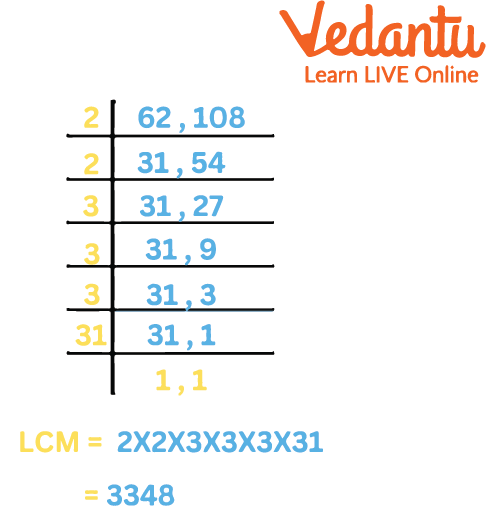
Example Of LCM
2. LCM of any prime number is
a. The number is less than it.
b. The number itself
c. 1
d. None of the above
Ans: The number itself.
Explanation: The LCM of the prime number would be the number itself as the prime numbers are not divisible by any other number than by themselves. For example, 2, 3, and 5 are not divisible by any other number than themselves.
3. We get the remainder by using the division method for finding LCM.
a. True
b. False
Ans: False
Explanation: We only get the divisor and the quotients while doing the division method for finding the LCM.
Conclusion
LCM is the least common multiple and can be calculated using the division method. In this, the divisor is the prime number that would be divisible by the set of numbers given as the dividend. We need to divide till we obtain a prime number or 1. Then we can multiply all the divisors and find the value of LCM.
FAQs on LCM by Long Division Method Explained with Steps
1. What is LCM by long division method?
The LCM by long division method is a technique to find the least common multiple of two or more numbers by dividing them simultaneously by prime numbers. In this method:
- Write the given numbers in a row.
- Divide them by the smallest possible prime number.
- Continue dividing until all numbers become 1.
- Multiply all the divisors to get the LCM.
2. How do you find LCM using the long division method?
To find the LCM using the long division method, divide the numbers step by step by prime factors and multiply the divisors. Follow these steps:
- Step 1: Write the numbers side by side.
- Step 2: Divide by the smallest prime number that divides at least one number.
- Step 3: Write the quotients and repeat the process.
- Step 4: Continue until all quotients become 1.
- Step 5: Multiply all the prime divisors to get the LCM.
3. What is the formula for LCM in the long division method?
The formula used in the long division method is LCM = Product of all prime divisors used in division. When dividing numbers simultaneously:
- Keep dividing by prime numbers.
- Include each divisor in multiplication.
4. Can you give an example of LCM by long division method?
Yes, the LCM of 12 and 18 using the long division method is 36. Steps:
- Divide 12 and 18 by 2 → 6, 9
- Divide by 2 → 3, 9
- Divide by 3 → 1, 3
- Divide by 3 → 1, 1
5. Why do we use prime numbers in the LCM long division method?
We use prime numbers in the LCM long division method because prime factors break numbers into their simplest building blocks. Dividing by primes ensures:
- Complete factorization of each number.
- No common factor is missed.
- Accurate calculation of the least common multiple.
6. What is the difference between LCM by long division and prime factorization method?
The main difference is that the long division method divides numbers simultaneously, while the prime factorization method factors each number separately. In detail:
- Long division: Divide all numbers together step by step.
- Prime factorization: Find prime factors of each number individually, then multiply highest powers.
7. How do you find the LCM of three numbers by long division method?
To find the LCM of three numbers by long division, divide all three numbers together by prime numbers until they become 1. Steps:
- Write the three numbers in a row.
- Divide by the smallest prime number possible.
- Repeat division for remaining quotients.
- Multiply all divisors to get the LCM.
8. What are common mistakes in LCM by long division method?
Common mistakes in the LCM long division method include skipping prime factors and stopping division too early. Students often:
- Forget to divide all possible numbers by a prime.
- Stop before all numbers become 1.
- Miss multiplying one of the divisors.
9. Can LCM by long division method be used for large numbers?
Yes, the long division method can be used for large numbers, but it may become lengthy. For bigger numbers:
- Start with small prime divisors like 2, 3, and 5.
- Proceed systematically.
- Consider using prime factorization if numbers are very large.
10. How is LCM by long division method useful in real life?
The LCM by long division method is useful for solving problems involving repeating events and common intervals. It helps in:
- Finding when events will occur together.
- Solving fraction addition and subtraction.
- Scheduling and time-related problems.
