









What Is the Hypotenuse Leg Theorem Formula Proof and Solved Examples
The longest side of a right-angled triangle, known as the hypotenuse, is always opposite to the right angle. According to the hypotenuse leg theorem, two right triangles are congruent if the hypotenuse and one leg of one right triangle coincide with the hypotenuse and leg side of the second right triangle. We employ the HL (Hypotenuse Leg) Theorem or the RHS (Right angle-Hypotenuse-Side) congruence rule to demonstrate the congruence of any two right triangles. In this article, we'll study more about the hypotenuse leg theorem.
Table of Contents
Introduction to Hypotenuse Leg Theorem
What is the Hypotenuse Leg Theorem?
Hypotenuse Leg Theorem Proof
Hypotenuse Leg Theorem Formula
Hypotenuse Leg Theorem Examples
What is the Hypotenuse Leg Theorem?
The hypotenuse leg theorem states that if one right triangle's hypotenuse and one of its legs are congruent with the other right triangle's hypotenuse and one of its legs, the two triangles are congruent. In other words, a collection of right triangles is said to be congruent if the hypotenuse and one leg of each triangle have the same length.
Hypotenuse Leg Theorem Formula
Consider following two right-angled triangles,
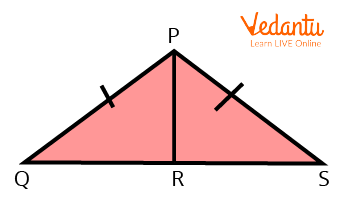
Right-Angled Triangles
By Hypotenuse Leg theorem,
If, \[\;PQ\; = \;PS\] (Hypotenuse)
\[PR\; = \;PR\] (Common side)
Therefore,
$\triangle PQR \cong \triangle PSR$
Hypotenuse Leg Theorem Proof
The hypotenuse leg theorem's proof demonstrates how a set of right triangles are congruent if the lengths of one of their associated hypotenuses and legs are the same. Look at the isosceles triangle ABC below, where the side \[AB\; = \; AC\] and AD is perpendicular to BC.
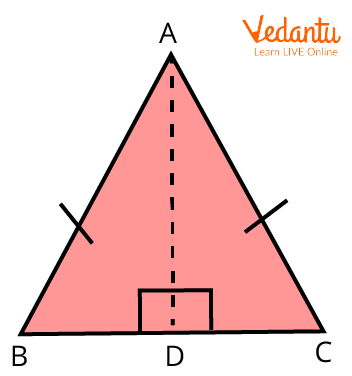
Hypotenuse Leg Theorem Proof
As an altitude, AD is perpendicular to BC and creates the right-angled triangles ADB and ADC. These triangles' respective hypotenuses, AB and AC, are equal.
Therefore, \[AB\; = \;AC\]
Due to their shared presence in both triangles, \[AD\; = \; AD\]
AD is common in both triangles.
Therefore, a hypotenuse and a pair of legs in two right triangles satisfy the hypotenuse leg theorem's definition.
Angles B and C are equal, as we know (Isosceles Triangle Property).
We are also aware of the equality of BAD and CAD angles. (BC is divided in half by AD, making BD equal to CD.)
Consequently,
Therefore, $\triangle ADB \cong \triangle ADC$.
Hence proved.
Applications of Hypotenuse Leg Theorem
The Hypotenuse leg theorem is a theorem that can be applied to demonstrate how two right triangles can be congruent.
The theorem can also be applied to prove the equality of any two right triangles' two sides.
Hypotenuse Leg Theorem Examples
1. Prove that $\triangle ABD \cong \triangle DBC.$ If $\angle A = \angle C = 90^{\circ},$ and \[AD\; = \;BC\].
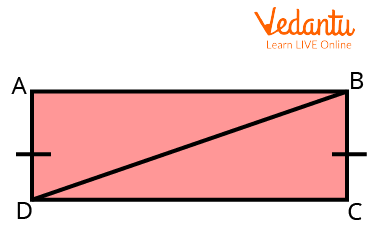
A Rectangle
Ans. We have,
\[AD\; = \;BC\] (equal leg)
\[\angle A = \angle C\] (right angle)
\[BD\; = \;DB\] (common side, hypotenuse)
By the Hypotenuse-Leg theorem,
$\triangle ABD\cong \triangle DBC$
Hence proved.
2. Let's assume that \[\angle W\; = \;\angle Z\; = \;90\;^\circ \], and M is the intersection of WZ and XY. Demonstrate the congruence of the two triangles, WMX and YMZ.
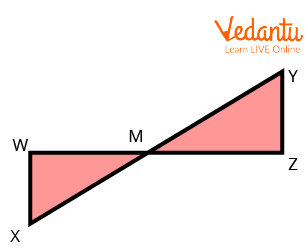
Combination of Triangles
Ans. Given that both $\triangle WMX$ and $\triangle YMZ$ have an angle of \[90^\circ \], they are right triangles (right angles)
\[WM\; = \;MZ\] (leg)
\[XM\; = \;MY\;\](Hypotenuse)
Consequently, according to the Hypotenuse-Leg theorem, $\triangle WMX$ and $\triangle YMZ$ are congruent.
3. Find the value of \[x\] and \[y\] for the given triangles, assuming that $\triangle ABC$ and $\triangle PQR$ are congruent to each other?
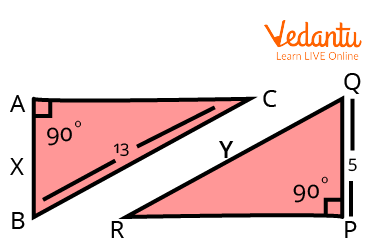
Two Triangles
Ans. By the Hypotenuse-Leg theorem,
In $\triangle ABC$ and $\triangle PQR$,
\[BC\; = \;QR\] (congruent hypotenuse)
Consequently, \[y\; = \;13\;,\;AB\; = \;PQ\] (congruent legs)
Thus, \[x\; = \;5\].
Thus, \[x\; = \;5\] and \[y\; = \;13\].
Conclusion
This article covered the Hypotenuse-Leg theorem and its proof in considerable detail. As a result of the discussion above regarding the Hypotenuse-Leg theorem, it is clear that if the sides and hypotenuse of any two triangles are equal, then the triangles must be congruent. The congruence of triangles and missing sides can be determined using this theorem.
The hypotenuse and one leg are the components that are used to test the congruence of triangles following the Hypotenuse-Leg Congruence rule.
The SAS (Side-Angle-Side) postulate and the Hypotenuse-Leg Congruence rule are related. The main distinction is that the Hypotenuse-Leg theorem uses the right angle, which is not the included angle between the hypotenuse and the leg, as the known angle. In contrast, SAS needs two sides and an added angle.
Related Links:
FAQs on Hypotenuse Leg Theorem in Right Triangle Congruence
1. What is the Hypotenuse Leg Theorem?
The Hypotenuse Leg (HL) Theorem states that two right triangles are congruent if their hypotenuse and one corresponding leg are equal in length. This theorem applies only to right triangles because:
- Each triangle must contain a 90° angle.
- The hypotenuse is the side opposite the right angle.
- If the hypotenuse and one leg match in both triangles, the triangles are congruent.
2. When can you use the Hypotenuse Leg Theorem?
You can use the Hypotenuse Leg Theorem only when comparing two right triangles with equal hypotenuse and one equal leg. To apply it:
- Both triangles must have a right angle (90°).
- Their hypotenuses must be equal.
- One pair of corresponding legs must be equal.
3. Why does the Hypotenuse Leg Theorem only work for right triangles?
The Hypotenuse Leg Theorem works only for right triangles because the presence of a right angle fixes the triangle’s shape uniquely. In a right triangle:
- The hypotenuse is always opposite the 90° angle.
- Knowing the hypotenuse and one leg determines the third side using the Pythagorean Theorem.
4. What is the difference between HL and SAS congruence?
The main difference is that HL applies only to right triangles, while SAS (Side-Angle-Side) works for any triangle.
- HL: Hypotenuse + one leg in right triangles.
- SAS: Two sides and the included angle in any triangle.
5. How do you prove triangles are congruent using the Hypotenuse Leg Theorem?
To prove triangles congruent using HL, show they are right triangles with equal hypotenuse and one equal leg. Follow these steps:
- Step 1: Prove both triangles have a 90° angle.
- Step 2: Show the hypotenuses are congruent.
- Step 3: Show one pair of corresponding legs are congruent.
6. Can you give an example of the Hypotenuse Leg Theorem?
Yes, if two right triangles each have a hypotenuse of 10 cm and one leg of 6 cm, they are congruent by HL. Example:
- Triangle A: hypotenuse = 10 cm, leg = 6 cm
- Triangle B: hypotenuse = 10 cm, leg = 6 cm
7. Is the Hypotenuse Leg Theorem the same as the Pythagorean Theorem?
No, the Hypotenuse Leg Theorem is a congruence rule, while the Pythagorean Theorem is a formula for side lengths.
- HL: Proves two right triangles are congruent.
- Pythagorean Theorem: Uses the formula a² + b² = c² to find a missing side.
8. What is the hypotenuse in a right triangle?
The hypotenuse is the longest side of a right triangle and is opposite the 90° angle. Key properties include:
- It is always the longest side.
- It is labeled c in the formula a² + b² = c².
- It is required when applying the Hypotenuse Leg Theorem.
9. What are common mistakes when using the Hypotenuse Leg Theorem?
A common mistake is applying the HL Theorem to triangles that are not right triangles. Avoid these errors:
- Forgetting to verify the right angle.
- Confusing a leg with the hypotenuse.
- Using two legs instead of one leg and the hypotenuse.
10. How is the Hypotenuse Leg Theorem used in geometry proofs?
The Hypotenuse Leg Theorem is used in geometry proofs to establish triangle congruence in right triangle configurations. It helps to:
- Prove segments are equal.
- Show angles are congruent.
- Justify steps in coordinate geometry or construction problems.
