




What is the hypotenuse – leg theorem?
Answer
 Verified
603k+ views
Hint: First of all we will understand the hypotenuse – leg theorem and what it is used for. Now, we will take examples of two right angle triangles with some of the given assumptions and we will try to prove them congruent using the hypotenuse – leg theorem. Also we will see its relation with R.H.S congruence criteria.
Complete answer:
Here we are asked to describe the hypotenuse – leg theorem. So, we need to understand the statement of the theorem and then we need to see its use.
Now, the hypotenuse – leg theorem is used to prove if two given right angle triangles are congruent or not. The theorem states that ‘if the hypotenuse and one side of a right angle triangle is equal to the hypotenuse and one side of the other triangle then the two right angle triangles are congruent to each other’.
Let us consider an example: - here we are assuming an isosceles triangle ABC with sides AB = AC, we draw a perpendicular AD from the vertex A to the side BC. We need to prove that the right triangles ABD and ACD are congruent.
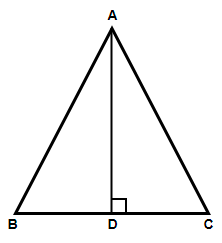
Now, in right triangles ABD with ACD we have,
AB = AC (triangle ABC is isosceles)
AD =AD (common side)
Clearly we can see that AB is the hypotenuse of triangle ABD and similarly AC is the hypotenuse of the triangle ACD while AD is the side common in them. So we can say that the hypotenuse and one side of triangle ABD is equal to the hypotenuse and the other side of the triangle ACD. Therefore, the two right triangles are congruent by the hypotenuse – leg theorem.
Note: Note that the hypotenuse – leg theorem is also called the R.H.S congruence criteria. R.H.S is a congruence criteria in which R, H and S stands for right angle, hypotenuse and side respectively. It is used to prove two triangles congruent when they have a right angle, their hypotenuses are of equal length and one of the remaining two sides are also equal.
Complete answer:
Here we are asked to describe the hypotenuse – leg theorem. So, we need to understand the statement of the theorem and then we need to see its use.
Now, the hypotenuse – leg theorem is used to prove if two given right angle triangles are congruent or not. The theorem states that ‘if the hypotenuse and one side of a right angle triangle is equal to the hypotenuse and one side of the other triangle then the two right angle triangles are congruent to each other’.
Let us consider an example: - here we are assuming an isosceles triangle ABC with sides AB = AC, we draw a perpendicular AD from the vertex A to the side BC. We need to prove that the right triangles ABD and ACD are congruent.
Now, in right triangles ABD with ACD we have,
AB = AC (triangle ABC is isosceles)
AD =AD (common side)
Clearly we can see that AB is the hypotenuse of triangle ABD and similarly AC is the hypotenuse of the triangle ACD while AD is the side common in them. So we can say that the hypotenuse and one side of triangle ABD is equal to the hypotenuse and the other side of the triangle ACD. Therefore, the two right triangles are congruent by the hypotenuse – leg theorem.
Note: Note that the hypotenuse – leg theorem is also called the R.H.S congruence criteria. R.H.S is a congruence criteria in which R, H and S stands for right angle, hypotenuse and side respectively. It is used to prove two triangles congruent when they have a right angle, their hypotenuses are of equal length and one of the remaining two sides are also equal.
Recently Updated Pages
Master Class 10 Computer Science: Engaging Questions & Answers for Success

Differentiate between voluntary action and reflex class 10 biology CBSE
The uses of bleaching powder are A It is used bleaching class 10 chemistry CBSE
Fill in the blanks with abstract nouns of the words class 10 english CBSE
How many threedigit numbers are there class 10 maths CBSE
What is a reflex arc class 10 biology CBSE
Trending doubts
Explain the Treaty of Vienna of 1815 class 10 social science CBSE
10 examples of evaporation in daily life with explanations
GST is a direct or indirect tax?
The sum of all even numbers between 21 and 51 is a class 10 maths CBSE
What would happen if platelets were absent in the blood class 10 biology CBSE
Compare the advantages and disadvantages of multipurpose class 10 social science CBSE