









How to Calculate the HCF of 8 and 12 Step by Step
The Highest Common Factor (HCF) of two numbers is the highest possible number that divides both numbers completely. The Highest Common Factor (HCF) is also called the Greatest Common Divisor (GCD). The HCF of two numbers can be determined by a variety of methods. Using the prime factorisation method is one of the easiest ways to get the HCF of two or more numbers. In this article, we will learn about HCF and how to find it. Also, we will see the HCF chart.
Factors
A number completely divides the given number without leaving any remainder is said to be the factor of that number. A number can have either positive or negative factors. For example, let's find the factors of 8. Since the number 8 is completely divisible by 1, 2, 4, and 8, we can list these as the positive factors of 8. The product of two negative numbers is a positive number, hence (-1) (-8) = 8 and (-2) (-4) = 8. In addition, the number 8 has negative factors, which can be written as -1, -2, -4, and -8.
Common Factors
When two or more numbers are exactly divided by the same number(s), those common divisors are known as common factors of the given numbers. Or we can say a common factor is a number that divides a pair of two or more numbers exactly without leaving any remainder. For example, the factors of 18 are 1, 2, 3, 6, 9, and 18.
Let's find out the common factors of the given numbers: 8, 12, 15, and 18.
Step 1: First of all we will find out the factors of the given numbers.
Factors of 8 = 1, 2, 4, and 8.
Factors of 12 = 1, 2, 3, 4, 6, and 12.
Factors of 15 = 1, 3, 5, and 15.
Factors of 18 = 1, 2, 3, 6, 9, and 18.
Step 2: Now, we will check the common factors (8, 12, 15, 18) = 1
So, 1 is the common factor of 8,12,15, and 18.
What is HCF?
The HCF (Highest Common Factor) of two or more numbers is the highest number among all the common factors of the given numbers. In simple words, the HCF (Highest Common Factor) of two natural numbers x and y is the largest possible number that divides both x and y.
Using the above definition, the HCF of a few sets of numbers can be listed as follows:
HCF of 60 and 40 is 20, i.e., HCF (60, 40) = 20
HCF of 100 and 150 is 50, i.e., HCF (150, 50) = 50
HCF of 144 and 24 is 24, i.e., HCF (144, 24) = 24
HCF of 17 and 89 is 1, i.e., HCF (17, 89) = 1
Steps to Find HCF
Let us understand the steps to find the HCF using two numbers by using the prime factorisation method:
What is the HCF of 8 and 12?
Step 1: First of all, find factors of 8 and 12 separately.
Factors of 8 = 1, 2, 4, and 8.
Factors of 12 = 1, 2, 3, 4, 6, and 12
Step 2: Now, find the common factors of 8 and 12.
The common factors of 8 and 12 are 1, 2, and 4.
Step 3: Now check the highest number among the common factors.
Among these numbers, 4 is the highest (largest) number.
So, the HCF of 8 and 12 is 4.
This is written as HCF (8, 12) = 4.
Observe the following HCF chart to understand this concept.
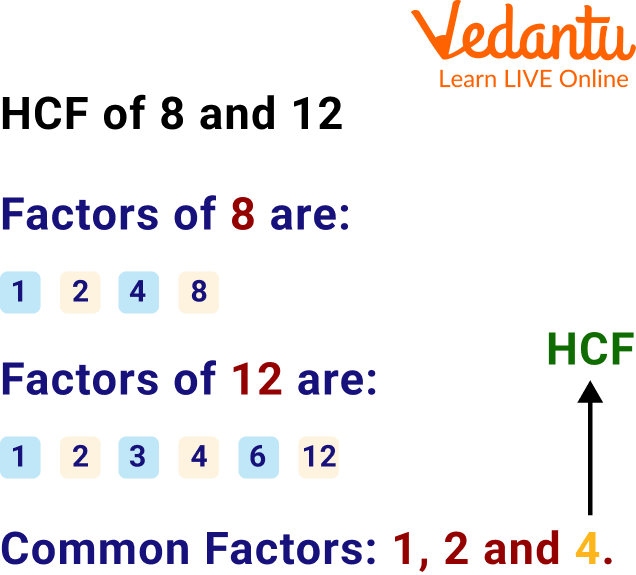
HCF of 8 and 12
Solved Example
Q1. Find the HCF of 24 and 32 by prime factorisation.
Ans: Prime factorisation of 24 and 32 is $(2 \times 2 \times 2 \times 3)$ and $(2 \times 2 \times 2 \times 2 \times 2)$ respectively.
As visible, 24 and 32 have common prime factors.
Hence, the HCF of 24 and 32 is $2 \times 2 \times 2=8$.
Q2. What is the HCF of 20 and 30?
Ans: Factors of 20: 1, 2, 4, 5, 10, 20
Factors of $30: 1,2,3,5,6,10,15,30$
There are 4 common factors of 20 and 30, which are $1,2,10$, and 5.
Therefore, the highest common factor of 20 and 30 is 10.
Practice Problem
Q1. What is HCF of 135 and 225?
Ans: 45
Q2. What is HCF of 65 and 117?
Ans: 13
Conclusion
From the HCF of two numbers examples, we have learned to find the factors and then take the common factors. Then after that multiplication of the common factors will give us the HCF. We can use the division method to find the HCF. Hence, after going through this article we have made our concepts of HCF very clear in both methods and now we know how to find the HCF of two numbers. With the examples and practice problems, we will get more clarity on the topic. So after reading the article, go through the practice problem to have a better understanding.
FAQs on Finding the HCF of 8 and 12
1. What is the HCF of 8 and 12?
The HCF of 8 and 12 is 4. HCF (Highest Common Factor), also called GCD (Greatest Common Divisor), is the largest number that divides both numbers exactly.
- Factors of 8: 1, 2, 4, 8
- Factors of 12: 1, 2, 3, 4, 6, 12
- Common factors: 1, 2, 4
- Highest common factor = 4
2. How do you find the HCF of 8 and 12?
You can find the HCF of 8 and 12 using the factor method, prime factorization, or division method.
- Step 1: Prime factorize both numbers.
- 8 = 2 × 2 × 2 = 2³
- 12 = 2 × 2 × 3 = 2² × 3
- Step 2: Take common prime factors with the smallest powers.
- Common prime factor = 2²
- HCF = 2² = 4
3. What are the common factors of 8 and 12?
The common factors of 8 and 12 are 1, 2, and 4. These are the numbers that divide both 8 and 12 exactly without leaving a remainder.
- Factors of 8: 1, 2, 4, 8
- Factors of 12: 1, 2, 3, 4, 6, 12
- Common factors: 1, 2, 4
4. What is the HCF of 8 and 12 by prime factorization?
The HCF of 8 and 12 by prime factorization is 4. Prime factorization expresses numbers as products of prime numbers.
- 8 = 2 × 2 × 2 = 2³
- 12 = 2 × 2 × 3 = 2² × 3
- Common prime factor with smallest power = 2²
- HCF = 2² = 4
5. What is the HCF of 8 and 12 by the division method?
The HCF of 8 and 12 using the division method is 4. This method is also called the Euclidean algorithm.
- Step 1: Divide 12 by 8 → Remainder = 4
- Step 2: Divide 8 by 4 → Remainder = 0
- When the remainder becomes 0, the divisor is the HCF.
- HCF = 4
6. What is the greatest common divisor (GCD) of 8 and 12?
The greatest common divisor (GCD) of 8 and 12 is 4. GCD and HCF mean the same thing in mathematics.
- Both terms refer to the largest number that divides two or more numbers exactly.
- For 8 and 12, the greatest number dividing both is 4.
7. What is the LCM of 8 and 12, and how is it related to the HCF?
The LCM of 8 and 12 is 24, and it is related to HCF by the formula LCM × HCF = Product of the numbers.
- HCF of 8 and 12 = 4
- Product = 8 × 12 = 96
- LCM = 96 ÷ 4 = 24
8. Why is 4 the HCF of 8 and 12?
The number 4 is the HCF of 8 and 12 because it is the largest number that divides both exactly.
- 8 ÷ 4 = 2 (no remainder)
- 12 ÷ 4 = 3 (no remainder)
- No number greater than 4 divides both 8 and 12.
9. Can you give a real-life example of the HCF of 8 and 12?
A real-life example of the HCF of 8 and 12 is dividing items into equal groups of maximum size.
- Suppose you have 8 apples and 12 oranges.
- You want to divide them into equal groups without leftovers.
- The largest possible equal group size is 4.
10. What is the difference between HCF and LCM of 8 and 12?
The HCF of 8 and 12 is 4, while the LCM of 8 and 12 is 24. HCF and LCM represent different concepts.
- HCF (Highest Common Factor): Largest number that divides both numbers exactly.
- LCM (Least Common Multiple): Smallest number that is a multiple of both numbers.
- For 8 and 12: HCF = 4, LCM = 24
