









What Is the HCF of 30 Using Prime Factorization and Division Method
What if you need to find the maximum common dimension for any two clothes having different sizes?. Here we use HCF as the most common and most efficient way.
The HCF of two numbers is the biggest number that can divide both evenly.
HCF can be evaluated for two or more numbers.
The greatest common factor of any two numbers will divide it completely or equally the given numbers.
For example – the HCF of 9 and 15 is 3. Because 3 is the largest number it can divide 9 and 15 exactly.
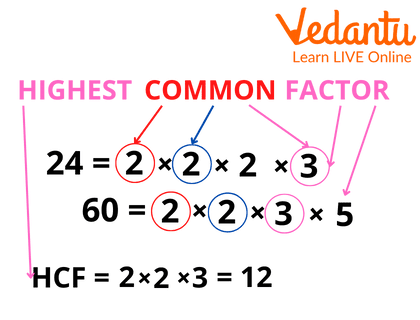
HCF
Methods To HCF
There are two methods of finding HCF.
Division method
Prime Factorization Method
Prime factorization is the simple process of finding the prime numbers when multiplied together to get the original number.
To understand it better let’s solve one example , Are you Ready!
Let’s start
Find the common factors of 30 and 45.
Find HCF of 30 and 45,
First, we will get each number as a product of prime factors.
So, for 30 = 2 x 3 x 5
And for 45 = 3 x 3 x 5
The product of all common prime factors is the HCF
2 x 3 x 5
3 x 3 x 5
The blue colour is common in both.
So the HCF = 5 X 3 = 15.
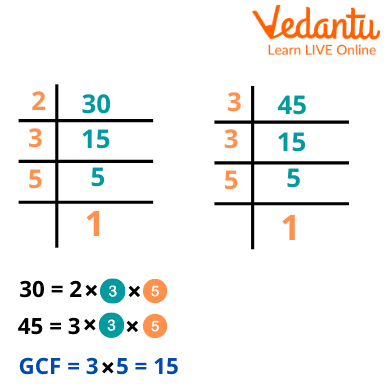
HCF of 30 and 45
Division Method
In the division method, we will divide the largest number by the smallest number until we get the remainder as 0.
To understand it better, let's solve an example.
We will use same question, we have used for prime factorization method
Let’s Start
Find HCF of 30 and 45,
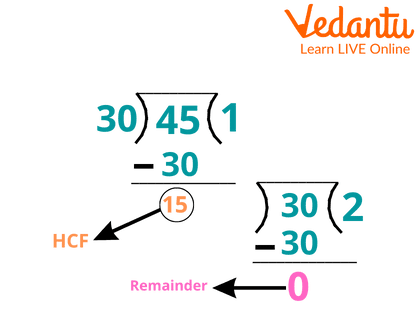
HCF of 30 and 45
As we can see in the image, the greatest number 45 is divided by the smallest number 30. After diving, we get a remainder of 15. Now we have 15 and 30, we will repeat the method. We will divide the largest number by the smallest here. The largest number is 30 and the smallest number is 15. We will divide 30 by 15 and we get the remainder as 0. Hence, the HCF of 30 and 45 is 15.
HCF Solved Examples
Question 1: find HCF of 30 and 50
Solution: 30 = 2 x 3 x 5
50= 2 x 5 x 5
HCF = 2 x 5 =10.
Question 2: Find the HCF of 30 and 60 by both methods.
Solution:
HCF of 30 and 60 by factorization method
30 = 2 x 3 x 5
60 = 2 x 2 x 3 x 5
So here 2,3 and 5 are the common factors in it.
HCF = 2 x 3 x 5 = 30
HCF = 30
HCF of 30 and 60 by division method
Ans:
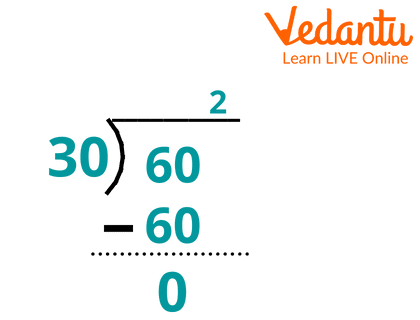
HCF of 30 and 60
As after dividing the largest number by smallest we are getting 0 as remainder.
So the HCF will be 30
HCF = 30.
HCF Properties
Let’s see some interesting properties of HCF –
The HCF of two numbers cannot be greater than any of them.
If one number is the factor of another number, the smaller number will be the HCF in this case.
Eg:- HCF of 10 and 5 will be 5 only.
The HCF of two numbers is the product of common prime factors.
The HCF of co-prime numbers will always be equal to 1. (same goes for prime numbers also.
HCF Math Question
Question 1: What is the greatest number which can divide 44, 70, and 82?
Solution: By prime factorization method;
44 = 2 x 2 x 11
70 = 2 x 5 x 7
82 = 2 x 41
So here 2 is the only common factor for 44, 70 and 82
HCF = 2.
Question 2: Find the HCF of 20 , 50
Solution: In the fraction, we have to do the HCF of all the numerators and LCM of all the denominators.
So we have to find HCF of 20,50
And LCM of 20 , 50
Let’s find HCF first,
20= 2 x 2 x 5
50 = 2 x 5 x 5
2 and 5 the only common factor here,
So HCF = 2 x 5 = 10
Summary
In this article, we got to know about HCF. It can be found for 2 or more numbers. We also learnt that there are 2 methods to find HCF. We can find HCF either by prime factorization or by division method. We got to know about its properties and real-life use of it. And now we can use this knowledge to solve various types of HCF-related problems.
FAQs on HCF of 30 Explained with Factors and Methods
1. What is the HCF of 30?
The HCF of 30 depends on the other number, but the HCF of 30 with itself is 30. The Highest Common Factor (HCF) is the greatest number that divides two or more numbers exactly. For example:
- HCF of 30 and 15 = 15
- HCF of 30 and 45 = 15
- HCF of 30 and 18 = 6
2. What are the factors of 30?
The factors of 30 are 1, 2, 3, 5, 6, 10, 15, 30. A factor is a number that divides 30 exactly without leaving a remainder.
- 30 ÷ 1 = 30
- 30 ÷ 2 = 15
- 30 ÷ 3 = 10
- 30 ÷ 5 = 6
3. How do you find the HCF of 30 using prime factorization?
The prime factorization of 30 is 2 × 3 × 5. To find the HCF using this method:
- Step 1: Write prime factors of each number.
- Step 2: Identify common prime factors.
- Step 3: Multiply the common primes.
- 30 = 2 × 3 × 5
- 45 = 3 × 3 × 5
- Common primes = 3 and 5
- HCF = 3 × 5 = 15
4. What is the HCF of 30 and 45?
The HCF of 30 and 45 is 15. Using prime factorization:
- 30 = 2 × 3 × 5
- 45 = 3 × 3 × 5
- Common factors = 3 and 5
- HCF = 3 × 5 = 15
5. What is the HCF of 30 and 18?
The HCF of 30 and 18 is 6. Using prime factorization:
- 30 = 2 × 3 × 5
- 18 = 2 × 3 × 3
- Common prime factors = 2 and 3
- HCF = 2 × 3 = 6
6. What is the HCF of 30 and 60?
The HCF of 30 and 60 is 30. Since 60 is a multiple of 30, 30 divides both numbers exactly.
- 30 = 2 × 3 × 5
- 60 = 2 × 2 × 3 × 5
- Common prime factors = 2, 3, 5
- HCF = 30
7. What is the formula for finding HCF?
The relationship between HCF and LCM is given by the formula HCF × LCM = Product of the two numbers. This formula is mainly used for two numbers.
- Example: For 30 and 45
- HCF = 15
- LCM = 90
- 15 × 90 = 1350
- 30 × 45 = 1350
8. Is 30 a prime or composite number?
The number 30 is a composite number because it has more than two factors. Its factors are 1, 2, 3, 5, 6, 10, 15, and 30. A prime number has only two factors (1 and itself), but 30 has multiple divisors. Therefore, 30 is not prime.
9. What is the greatest common factor of 30 and 75?
The HCF of 30 and 75 is 15. Using prime factorization:
- 30 = 2 × 3 × 5
- 75 = 3 × 5 × 5
- Common prime factors = 3 and 5
- HCF = 3 × 5 = 15
10. Why is HCF of 30 important in Maths?
The HCF of 30 is important because it helps in simplifying fractions, solving word problems, and dividing quantities into equal groups. For example:
- Simplifying 30/45 → divide by HCF 15 → 2/3
- Dividing 30 objects into equal groups
